The Arab American National Museum in Dearborn, Michigan, will kick off the Arab Film Festival on Friday.
Home to one of the largest Arab-American communities in the country, some consider Dearborn to be the “Arab capital” of the US and the museum has been devoted to documenting, preserving and presenting the history, culture and contributions of the community since 2005.
The annual festival will run from August 12 to 21, with a line-up featuring everything from live-action comedy shorts to full-length features, animation and even documentaries tackling America's Israel bias.

“As a young Arab American myself, I never really saw my story, my family story reflected in the music I listened to or the films that I watched or the textbooks in my classroom,” said Dave Serio, curator of education at the museum.
“So our goal really is to kind of inspire Arab Americans to see their stories, their perspective, people that look like them, names that they might have, on the big screen.”
Beginning in 2005, it is one of the museum's longest-running programmes and offers a range of windows into Arab cinematic creativity and storytelling.
-

Director and writer Alessandra El Chanti shoots for When Beirut Was Beirut. All photos: Alessandra El Chanti -
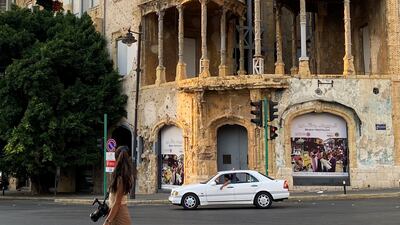
Lebanon's Beit Beirut is among the buildings given a voice in the short film. -
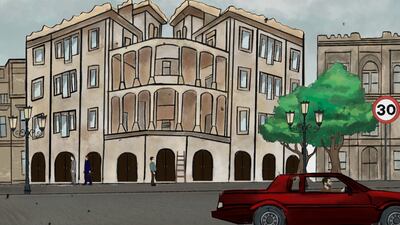
Lebanon's Beit Beirut as imagined in the animated film When Beirut Was Beirut. -

Beirut's famous Egg as imagined in the short film. -

Ms El Chanti explores what Lebanon's inanimate objects might have to say in her short film.


One of the films in this year's set is When Beirut Was Beirut from writer-director Alessandra El Chanti. The short is a “poetic hybrid documentary” that focuses on an imagined conversation between three famous buildings in the Lebanese capital and what they witnessed during the country's civil war.
“I wonder what inanimate objects could say, because they also have stories, too,” Ms El Chanti, a Lebanese citizen who now lives in Doha, Qatar, told The National.
“I feel like we always go to Lebanon and we're just passers-by — we recognise that there are war-torn buildings, you can see the bullet holes.
“But there's so much character in them like that … if you see buildings, you really feel like, you know, they want to say something.”
The film, which began production in 2020, was produced entirely over Zoom by an all-Lebanese team of six artists.
Many of the films at this year's festival will be making their US or Michigan state debut, Mr Serio said.
Ms El Chanti hopes members of the Lebanese diaspora watching her film at the festival walk away feeling “there's a lot that you should learn about your country that you don't know about — it literally could be from the perspective of anything and everything”.
Yasmina Tawil, the director of film programming at the Arab Film and Media Institute — one of the festival's sponsors — told The National that while Arab film festivals such as this are considered “niche” in the entertainment industry, they can build towards more inclusion in the mainstream.
“[Arab film festivals] are not the taste makers of the industry … yet,” said Ms Tawil.
“We're not a Sundance, we're not a Cannes.
“But when a distributor goes to pick up a film, [the festivals] will add to the credence and the hype of the film. And I would at least hope that distributors would look at that as a sign of one of their big audiences … already knows about and really likes the film enough to programme it in their festival.”
Accessibility to the mainstream American market is one of the most difficult hurdles Arab films have faced, Ms Tawil said.
“They'll get picked up for distribution in the Middle East, in Europe and then maybe not make it over here [to the US]. Or if a torrented copy does, it might not have English subtitles and things like that.”
She added that her institute's mission is, in part, to serve as a “caretaker” for Arab films in America.

“Even if they're not in theatres, just somewhere where people can go and can license a copy and show it at their school or show it in their festival, or show it in their theatre, or rent it to watch at home. That's so big.”
The museum has offered both virtual and in-person attendance options, opening its mission to viewers across state and national borders.
“The Arab-American community is ridiculously talented,” said Mr Serio. “And our film festival is just honoured to be able to showcase a fraction of the amazing work that the Arab-American community is working on.”