A senior US State Department official on Friday cited “modest progress” as the seventh round of talks to revive the Iran nuclear deal concluded in Vienna with myriad outstanding issues to address.
“It was better than it might have been; it was worse than it should have been,” the US official told reporters on a press call.
“It was better than it might have been because there was some modest progress.”
However, the US and Iran remain at the same impasse that has held up an agreement since before Iran's President Ebrahim Raisi — a nuclear deal sceptic — took office in August.
The seventh round of indirect talks — which constitute the first negotiations with the Raisi administration — lasted for weeks and only ended on an agreement regarding what will be on the agenda for future discussions.
The US official credited the EU for that progress, which revolved around reaching a “common understanding of what the text will be able to serve as the basis for negotiations on the nuclear issues".
The official said Iranian negotiators cut off the talks on Friday to return to Tehran after agreeing to a future agenda. Nonetheless, US negotiators were prepared to stay and continue the talks into next week.
-
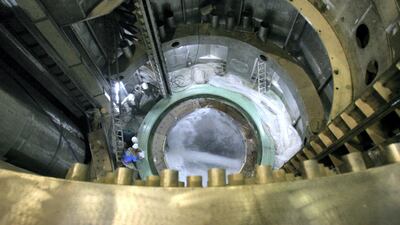
Russian contractors work at the Bushehr nuclear reactor site in 2007. The plant opened four years later. Bloomberg -
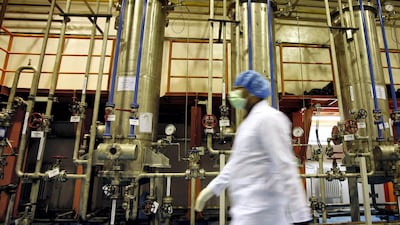
An Iranian technician at the International Atomic Energy Agency inspects the country's Isfahan plant in 2007. Tehran is no longer co-operating with the agency at nuclear sites across the country. EPA -

Workers wait to begin constructing a second reactor at the Bushehr nuclear power plant in 2019. AFP -
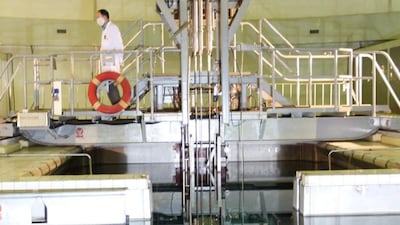
A metal-encased rod with 20 per cent enriched nuclear fuel is inserted into a reactor in Tehran in 2012. AFP -
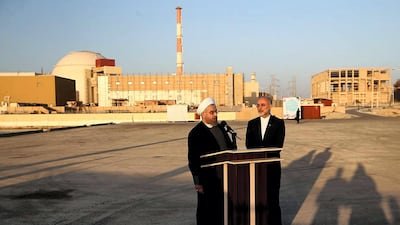
Fomer Iranian President Hassan Rouhani and the country's Atomic Energy Organisation chief Ali Akbar Salehi speak at the Bushehr nuclear site in 2015. AFP -
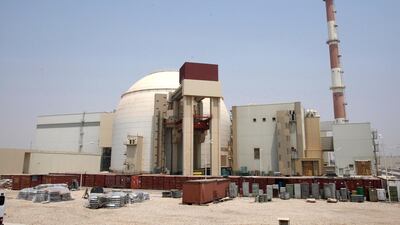
Iran's Bushehr nuclear plant has been restarted. EPA -
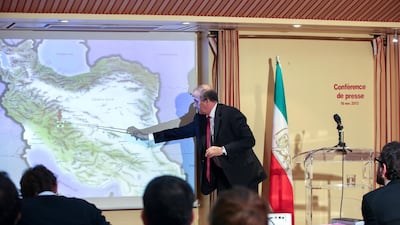
Mehdi Abrichamtchi, chairman of the Peace and Security Committee at the National Council of Resistance of Iran, shows journalists the location of a secret nuclear site in Iran in 2013. AFP -
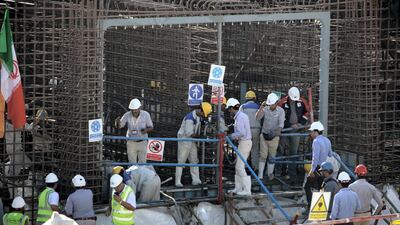
Workers prepare to begin the construction of a second reactor at the Bushehr site. AFP


In addition, the official credited Russia and International Atomic Energy Agency (IAEA) Director Rafael Grossi for brokering a deal that would allow the global nuclear watchdog to replace broken cameras at Iran’s Karaj centrifuge site.
The cameras were destroyed in a sabotage attack on the site in June, which Iran has attributed to Israel.
The senior State Department official said the US had “come close” to calling an extraordinary meeting of the IAEA’s board of governors until Iran agreed to replace the broken cameras.
“If Iran fails to follow up this time … I think it will be inevitable that this issue comes before the board of governors,” the State Department official said.
The official also said that the pace of the talks will have to accelerate as Iran’s advancements in its nuclear programme threaten to render the 2015 nuclear deal obsolete.
“If it takes this much time to agree on a common agenda, imagine how much time it will take to resolve the issues on the agenda,” the US official said. “So, it’s going to have to be a very significant acceleration.”
Since the Hassan Rouhani administration, the US and Iran have remained at an impasse over disagreements regarding what sanctions Washington must lift and what nuclear activities Tehran must scale back for both sides to come back into compliance with the agreement.
Iran began steadily ratcheting up its breaches of the 2015 accord following former president Donald Trump’s withdrawal from the agreement in 2018, which came with the reinstatement of US sectoral sanctions on the Iranian economy.
Since then, the breakout time Iran needs to produce a nuclear weapon has decreased from a year to a few months, a senior US official has said.