A renowned Moroccan-born immunologist has been put at the helm of ‘Operation Warp Speed’, the challenge launched by US President Donald Trump this week to develop a Covid-19 vaccine by the end of the year.
Moncef Slaoui, the former head of pharmaceuticals giant GlaxoSmithKline, will serve as the chief scientist on the effort, which was named after a concept from science fiction books and films such as Star Trek.
As the pandemic continues to claim thousands of lives around the world, Mr Trump compared the urgent drive to the one in the 1940s to produce an atomic bomb, saying it was a “massive scientific, industrial and logistical endeavour unlike anything our country has seen since the Manhattan Project”.
Dr Slaoui, who is Belgian-American, has already helped to create more than a dozen new vaccines, including one for cervical cancer as well as pneumococcal infections.
In a world first, he won European approval for a malaria vaccine in 2015, and has published more than 100 scientific papers on immunology. He will be supported by a team of scientists and logistics specialists, including the US Army General Gus Perna, who was appointed chief operations officer.

The president has called Dr Slaoui “one of the most respected men in the world” in the field of vaccine development. It is an intensely personal specialisation for Mr Slaoui, who lost his sister to whooping cough – a highly contagious bacterial disease for which the pertussis vaccine became available in the 1940s – while growing up in Morocco.
Leaving the country of his birth at the age of 17, Dr Slaoui headed to France to study medicine but missed out on his first choice of university. He then went to Belgium, where he lived for 27 years, before completing his studies at Harvard in the United States.
As a young researcher in 1984, he joined a group of scientists working on vaccines against malaria at a vaccine company in Belgium called SmithKline-Rit, which would go on to become GSK.
-
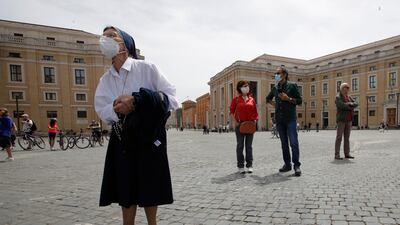
A nun wearing a face mask looks up at the window of Pope Francis' studio overlooking St Peter's square as he appears to give his blessing after the Angelus prayer, at the Vatican. AP Photo -
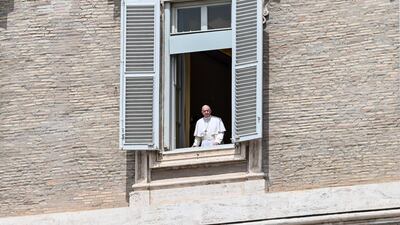
Pope Francis looks from the window of the Apostolic palace overlooking St Peter's Square before his blessing to faithful. AFP -
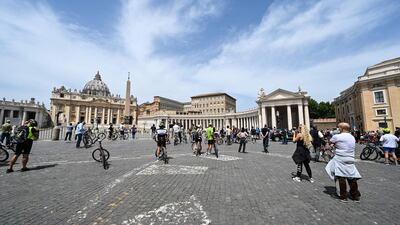
People wait for Pope Francis to give his blessing from the window of the Apostolic palace overlooking St Peter's Square. AFP -
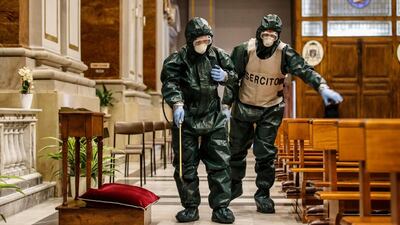
Soldiers of the Italian 7th CBRN defence regiment 'Cremona' are deployed to sanitise the San Francesco D'Assisi Cathedral, in Civitavecchia, near Rome, Italy. EPA -
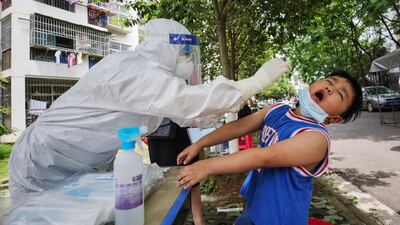
A medical worker taking a swab sample from a child to be tested for Covid-19, in a street in Wuhan, in China's central Hubei province. AFP -
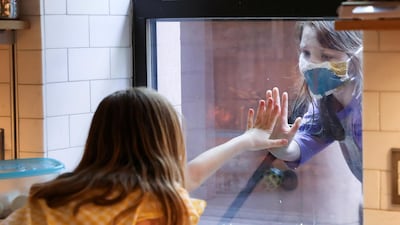
Lydia Hassebroek says hello to her friend Rose through her kitchen window in Brooklyn, New York, US. Reuters -

People sit on the grass in Central Park in New York City, amid the coronavirus pandemic. AFP -
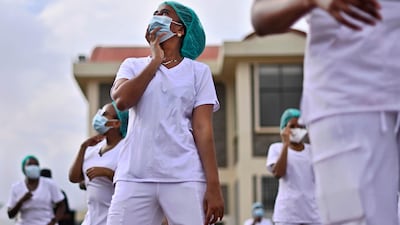
Nurses assigned to the Infectious Diseases Unit at the Kenyatta University Hospital dance during a Zumba class held at the hospital compound in Nairobi. AFP -

Buses are seen parked before reopening to the public after the government eased a nationwide lockdown in Lahore, Pakistan. AFP -
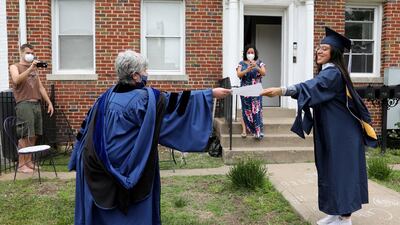
George Washington University graduate Catalina Perez, right, receives a copy of her diploma from neighbour Paula Lytle as they keep a social distance at a surprise graduation party for Perez, who completed her undergraduate studies in International Affairs across the span of 10 years only to miss her commencement due to coronavirus, in Washington, US. Reuters -

Faith healers wear face masks as they perform a healing ritual on worshippers in the town of Mbare in Harare, Zimbabwe. EPA


Over the course of a career with the company spanning 32 years, including stints heading up research and development, Dr Slaoui radically altered working practices and reorganised the vaccines department.
His involvement led to the development of dozens of new treatments, and in 2016 Fortune magazine listed him among the world's 50 greatest leaders.
After leaving GSK in 2017, he took up a position on the board of US pharmaceuticals giant Moderna, which is among the front runners in the race for a Covid-19 vaccine.
His ties to – and investment in – Moderna have been criticised by some in the US as a potential conflict of interest. On Monday, the senator and former presidential candidate Elizabeth Warren called on him to “divest immediately” from the company.
As his appointment was announced, Dr Slaoui said he was optimistic that progress would be made before the end of the year.
“I have very recently seen early data from a clinical trial with a coronavirus vaccine,” he said. “And these data made me feel even more confident that we will be able to deliver a few hundred million doses of vaccine by the end of 2020.”
Unveiling Operation Warp Speed in the White House rose garden, Mr Trump said the government would invest in all the top coronavirus vaccine candidates. A list had been compiled of the 14 most promising, with a plan to narrow that further.
The US has been hit harder than any other country by the pandemic. Almost 90,000 people have died and nearly 1.5 million people have been infected across America.
As well as its grim death toll, record numbers of Americans have lost their jobs as a result of the outbreak, with unemployment reaching an all-time high of 14.7 per cent in April.
Many experts have issued warnings that it would probably take 12 to 18 months or more to produce a viable Covid-19 vaccine ready for the public. The US president is seeking to condense that time frame but has also played down the need for a vaccine as he encourages US states to rehabilitate their economies by lifting restrictions.
Mr Trump said the federal government would invest in the manufacturing of top vaccine candidates before they were approved. He said the effort would also include moves to increase production of supplies needed for the eventual distribution of a vaccine.
“When a vaccine is ready,” he said, “the US government will deploy every plane, truck, and soldier required to help distribute it to the American people as quickly as possible.”