US President Donald Trump on Monday made the surprise announcement that he is taking hydroxychloroquine, an anti-malaria drug that his own government experts say is not suitable for fighting the novel coronavirus.
Mr Trump, noting that he has tested negative for the virus and shows no symptoms, said he'd been taking the drug as a preventative measure for about a week and a half.
"I take a pill every day," he said, adding that he combines this with zinc.
Asked why, he said: "Because I think it's good. I've heard a lot of good stories."
Mr Trump has been promoting the use of hydroxychloroquine for a number of weeks, but US government regulators warn it has "not been shown to be safe."
US Senate Minority Leader Chuck Schumer called Trump's decision to take the drug "reckless."
"It gives people false hope, has people avoid real medical attention, and can actually cause them trouble. It is just dangerous what he did," Mr Schumer said on MSNBC.
Trump's latest remarks came as US deaths from Covid-19 passed 90,000 people - almost a third of the total world toll.
"You'd be surprised at how many people are taking it, especially the front-line workers, before you catch it. The front-line workers -- many, many are taking it. I happen to be taking it," he let slip to reporters attending a White House meeting devoted to the struggling restaurant industry.
"I'm taking it, hydroxychloroquine, right now, yeah. A couple of weeks ago, I started taking it," he said.
Trump has often played down the dangers of coronavirus, including last week when he said it threatened only a small number of people. He has refused to wear a mask, despite federal recommendations to do so and the fact that most of his staff have taken to covering their faces in public.
A personal valet to Trump has tested positive for the coronavirus, as has Katie Miller, Vice President Mike Pence's press secretary.
Mr Trump said his use of the medicine was approved by the White House physician, Sean Conley. However, Mr Trump insisted that he, not the doctor, took the first step.
"I asked him, 'what do you think?' He said, 'if you'd like it.' I said 'yeah, I'd like it.'"
Dr Conley later issued a statement saying that he had agreed to Trump using the anti-viral drug "after numerous discussions" between them about the pros and cons.
"We concluded the potential benefit from treatment outweighed the relative risk," Dr Conley said.
Mr Trump said he has received many "positive calls" from people, whom he did not identify, telling him about the malaria drug. He mentioned a letter he'd received from a New York doctor, also unidentified, who reported giving the medicine to hundreds of patients and "I haven't lost one."
By contrast, the government's Food and Drug Administration warns against giving hydroxychloroquine for either prevention or treatment of the coronavirus, noting reported side effects including "serious heart rhythm problems in patients with Covid-19." Only emergency use is authorised under temporary rules.
Earlier this month, a medical paper out of New York suggested that combining hydroxychloroquine with the dietary supplement zinc sulfate, which has antiviral properties, could create a more effective treatment against coronavirus.
But Matthew Heinz, an Arizona doctor who served under Barack Obama's government, said medicines like hydroxychloroquine are not "benign" and open for unregulated use.
"I cannot stress enough how reckless it is to encourage anybody to take hydroxychloroquine or any other unproven remedy," he said in a statement.
-
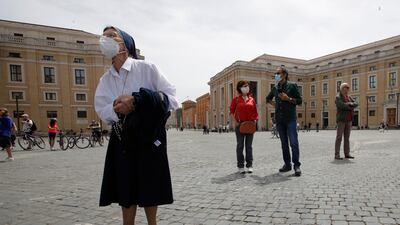
A nun wearing a face mask looks up at the window of Pope Francis' studio overlooking St Peter's square as he appears to give his blessing after the Angelus prayer, at the Vatican. AP Photo -
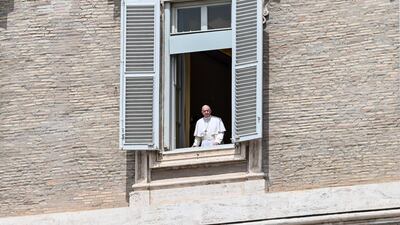
Pope Francis looks from the window of the Apostolic palace overlooking St Peter's Square before his blessing to faithful. AFP -
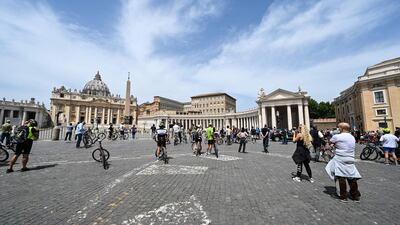
People wait for Pope Francis to give his blessing from the window of the Apostolic palace overlooking St Peter's Square. AFP -
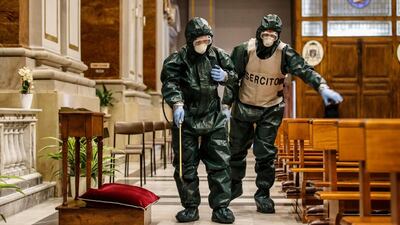
Soldiers of the Italian 7th CBRN defence regiment 'Cremona' are deployed to sanitise the San Francesco D'Assisi Cathedral, in Civitavecchia, near Rome, Italy. EPA -
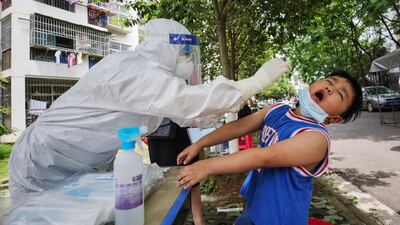
A medical worker taking a swab sample from a child to be tested for Covid-19, in a street in Wuhan, in China's central Hubei province. AFP -
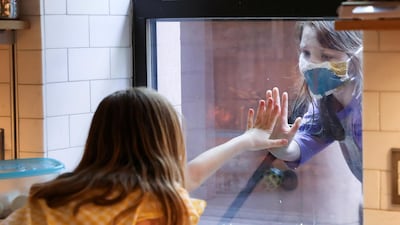
Lydia Hassebroek says hello to her friend Rose through her kitchen window in Brooklyn, New York, US. Reuters -

People sit on the grass in Central Park in New York City, amid the coronavirus pandemic. AFP -
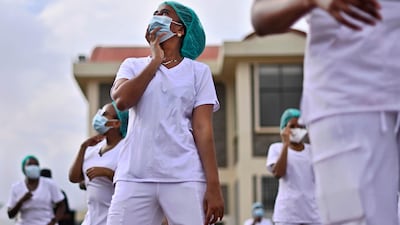
Nurses assigned to the Infectious Diseases Unit at the Kenyatta University Hospital dance during a Zumba class held at the hospital compound in Nairobi. AFP -

Buses are seen parked before reopening to the public after the government eased a nationwide lockdown in Lahore, Pakistan. AFP -
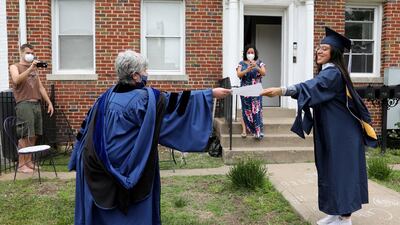
George Washington University graduate Catalina Perez, right, receives a copy of her diploma from neighbour Paula Lytle as they keep a social distance at a surprise graduation party for Perez, who completed her undergraduate studies in International Affairs across the span of 10 years only to miss her commencement due to coronavirus, in Washington, US. Reuters -

Faith healers wear face masks as they perform a healing ritual on worshippers in the town of Mbare in Harare, Zimbabwe. EPA


Trump signalled, as he has throughout the crisis, that there was nothing to lose by trying possible treatments.
"It seems to have an impact, and maybe it does, maybe it doesn't but if it doesn't, you're not going to get sick or die," Mr Trump said. "I take a pill every day. At some point I'll stop."
The president said again on Monday that he showed "zero symptoms."
"Every couple days they want to test me, you know, for obvious reasons. I mean I am the president, so they want to test me. I don't want to be tested but they want to test me," he said. "I've shown always negative."