Daily air strikes prompted Syrian father Abdullah Mohammed to come up with a new way to help his daughter Salwa adapt to the sounds of war.
He encourages the three-year-old to simply laugh whenever she hears the sound of bombs or missiles.
In video footage obtained by Reuters, Mr Mohammed is seen laughing with his daughter as the sound of an apparent explosion is heard in the distance.
-
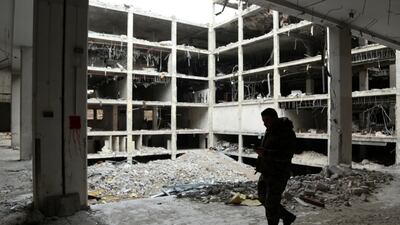
A view of damages to the Al-Shahba Mall building on the Aleppo Gaziantep highway in the northern countryside of Aleppo, Syria. EPA -
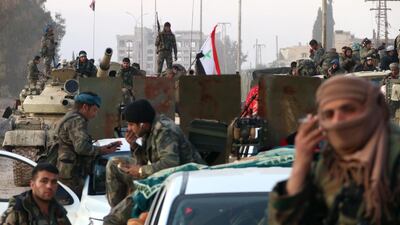
Syrian army soldiers advance on a road in the northern Aleppo countryside. AFP -
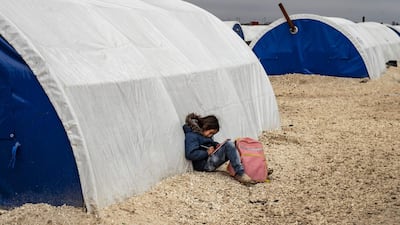
Displaced Syrians are pictured in the Washukanni Camp for the internally displaced people near the predominantly Kurdish city of Hasakeh in northeastern Syria. AFP -
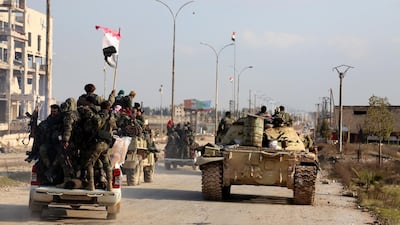
Syrian army units advance to the Aleppo Ghazi Aintab International Highway and the northern countryside of Aleppo, Syria. EPA -
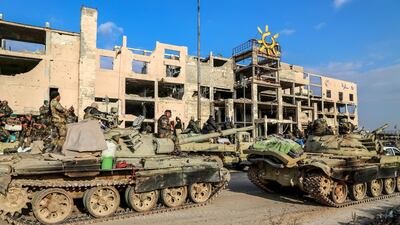
Syrian army units advance to the Aleppo Ghazi Aintab International Highway and the northern countryside of Aleppo, Syria. EPA -
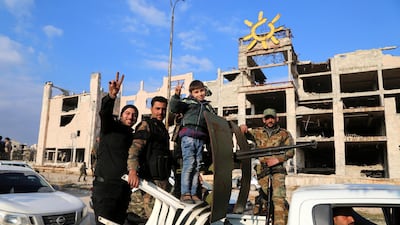
Syrian army units advance to the Aleppo Ghazi Aintab International Highway and the northern countryside of Aleppo, Syria. EPA -
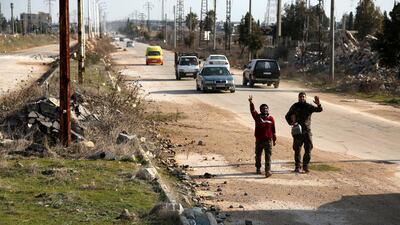
People walk as Syrian army units advance to the Aleppo Ghazi Aintab International Highway and the northern countryside of Aleppo, Syria. EPA -
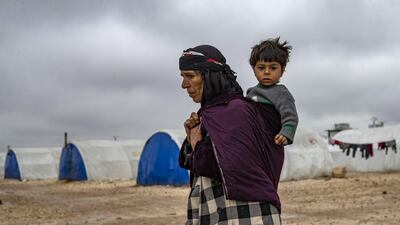
An elderly displaced Syrian woman carries a child in the Washukanni Camp for the internally displaced people near the predominantly Kurdish city of Hasakeh in northeastern Syria. AFP -
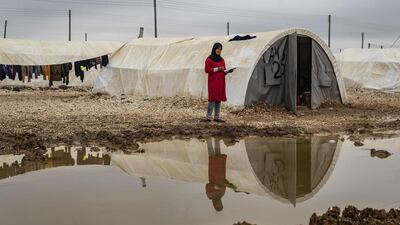
A displaced Syrian woman is pictured in the Washukanni Camp for the internally displaced people near the predominantly Kurdish city of Hasakeh in northeastern Syria. AFP -
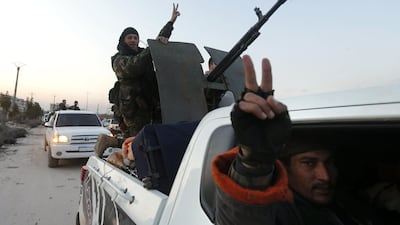
A picture taken during a guided tour organised by the Syrian army shows regime forces in the area of al-Lirmoun, north of Aleppo. AFP -
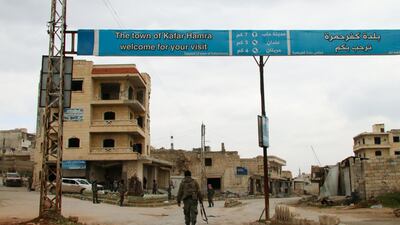
Syrian army soldiers walk in the town of Kafr Hamra in the northern Aleppo countryside. AFP -
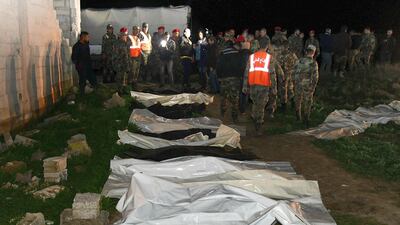
A handout picture released by the official Syrian Arab News Agency (SANA) shows Syrian government forces uncovering a mass grave containing bodies of people reportedly believed to have died between 2012 and 2014, in al-Ubb in the eastern Ghouta region about 20 kilometres east of the capital Damascus, which was formerly held by rebel forces until early 2018. The Syrian army has discovered a mass grave containing around 70 bodies in a former rebel bastion near Damascus, the state news agency reported on February 17. SANA said the victims found in the Eastern Ghouta region were "civilians and security personnel who were executed by terrorist groups". The densely-populated semi-urban area just east of Damascus was controled by rebel and jihadist factions for around six years until government forces retook it in 2018, following a long and bloody siege. The area of the mass grave, near Eastern Ghouta's main town of Douma, was controlled by rebel group Jaish al-Islam. AFP


The father noted that many children suffer psychological hardships and stress due to the daily air raids.
He said that he managed to convince his daughter that these noises are similar to sounds of fireworks and that they are nothing to be scared of.
Air strikes drove his family far from his hometown of Saraqib in north-west Syria, forcing him to live at his friend's house with his wife and daughter in Sarmada.
The 32-year-old said he hoped for a restored sense of normalcy, and a proper education for his daughter, in the near future.