


Civilians in Idlib are enduring “unfathomable suffering” as Syrian regime forces and their allies bombard the last remaining areas under rebel control, a UN report has found.
Hundreds of Syrian men, women and children have been killed in ground and air attacks by the regime and its Russian allies.
These have obliterated towns, villages and civilian infrastructure from November last year until this June.
A report from the UN Syria Commission of Inquiry provided detailed accounts of 52 attacks amid the carnage in the last province outside the regime's control.
Hospitals, schools, markets and homes have been destroyed with ground assaults from the Syrian army and its allies often using cluster bombs.
Regime attacks on Maarat Al Numan and Ariha in Idlib, and Atarib and Darat Azza in western Aleppo at the end of 2019 and early this year led to mass displacement with civilians forced to flee “and may amount to the crimes against humanity of forcible transfer, murder and other inhumane acts”.
“We document two incidents in the report where we think it was Russian airplanes that conducted those attacks,” said panel member Hanny Megally.
The report said Russian warplanes were solely implicated in a deadly March 5 strike on a poultry farm near Marat Misrin that sheltered displaced people, and in three strikes that damaged a hospital in the rebel-held town of Ariha on Jan. 29.
Russia denies involvement in the second attack, it said.
The report said civilians faced a vast array of threats, including from rebel groups such as Hayat Tahrir Al Sham, the dominant umbrella group of opposition militants in Syria.
Other threats include indiscriminate aerial bombardments, arrest, torture, pillaging and dire conditions at the border with Turkey.
"What is clear from the military campaign is that pro-government forces and UN-designated terrorists flagrantly violated the laws of war and the rights of Syrian civilians," said Paulo Pinheiro, chairman of the commission.
“It is completely abhorrent that, after more than nine years, civilians continue to be indiscriminately attacked, or even targeted, while going about their daily lives.
“Children were shelled at school, parents were shelled at the market, patients were shelled at the hospital and entire families were bombarded even while fleeing."
Hayat Tahrir, a former Al Qaeda affiliate, was accused of pillaging homes when civilians fled.
The group was also found to have tortured and executed dissenting civilians including journalists, and to have shelled heavily populated areas in government-held territory.
-
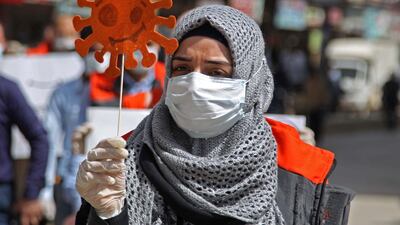
A mask-clad civil society volunteer marches with an effigy depicting the SARS-CoV-2 virion, the agent responsible for the COVID-19 coronavirus disease, during an awareness campaign about the novel coronavirus pandemic, urging people to remain at home, in Syria's northwestern city of Idlib in Idlib province on March 24, 2020. (Photo by Abdulaziz KETAZ / AFP) -
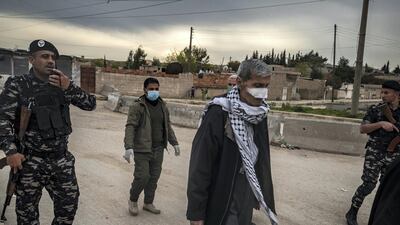
Syrian Kurdish passengers who were stranded in Damascus arrive in Qamishli in Syria's northeastern Hasakeh province on April 5, 2020, after being stranded in Damascus for the past weeks. (Photo by DELIL SOULEIMAN / AFP) -
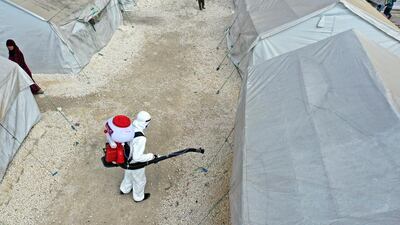
A drone image taken on April 9, 2020, shows a sanitation worker disinfecting a camp for displaced Syrians next to the Idlib municipal stadium in the northwestern Syrian city, during a campaign to limit the spread of the coronavirus (COVID-19) pandemic. (Photo by OMAR HAJ KADOUR / AFP) -
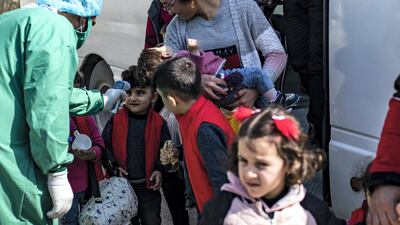
A medic checks the body temperature of young passengers, as a preventive measure against the coronavirus, upon their arrival by bus in Syria's Kurdish area from Iraqi Kurdistan via the Semalka border crossing in northeastern Syria on February 26, 2020. (Photo by Delil SOULEIMAN / AFP) -
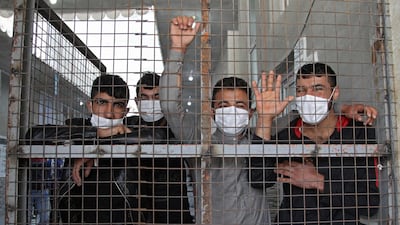
A picture taken on April 27, 2020 shows Syrians who returned from Turkey standing at a quarantine facility in the countryside of the town of Jisr al-Shughur, west of the mostly rebel-held Syrian province of Idlib, on April 27, 2020 during the coronavirus COVID-19 pandemic. / AFP / Abdulaziz KETAZ -
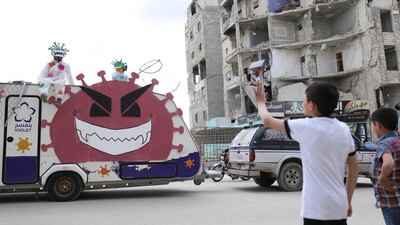
epa08392436 A truck for prevention against the COVID-19 coronavirus disease, operated by local NGO 'Violet Organization', drives through the streets of Idlib, Syria, 29 April 2020. EPA/YAHYA NEMAH -
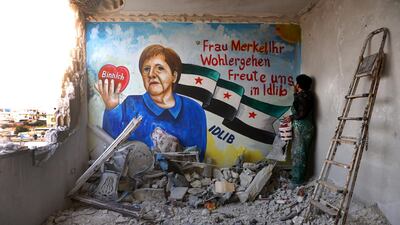
Artist Aziz al-Asmar paints a mural wishing for the well-being of German Chancellor Angela Merkel, who is in quarantine after being treated by a doctor who tested positive for coronavirus (COVID-19), inside a damaged building in the town of Binnish in Syria's northwestern Idlib province on March 24, 2020. (Photo by Muhammad HAJ KADOUR / AFP) -
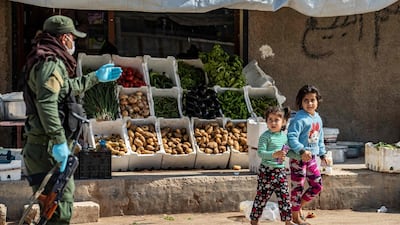
A member of the Kurdish Internal Security Forces of Asayesh urges children to return home, in Syria's northeastern city of Hasakeh on April 30, 2020, following measures taken by the Kurdish-led local authorities there, to limit the spread of the novel coronavirus. / AFP / DELIL SOULEIMAN -
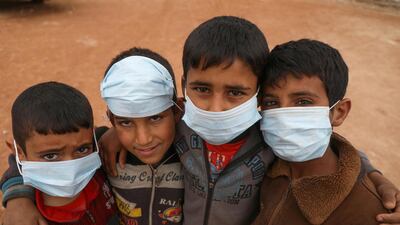
Syrian boys pose for a picture during an awareness workshop on Coronavirus (COVID-19) held by Doctor Ali Ghazal at a camp for displaced people in Atme town in Syria's northwestern Idlib province, near the border with Turkey, on March 14, 2020. (Photo by AAREF WATAD / AFP) -
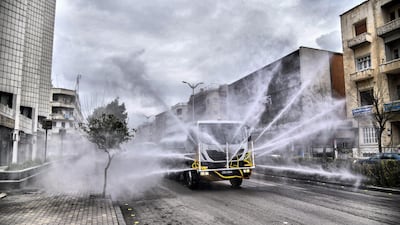
A handout picture released by the official Syrian Arab News Agency (SANA) on March 20, 2020 shows Syrian Red Crescent vehicles spraying disinfectant along a street in the capital Damascus, as part of measures against the spread of COVID-19 coronavirus disease. (Photo by - / SANA / AFP) / == RESTRICTED TO EDITORIAL USE - MANDATORY CREDIT "AFP PHOTO / HO / SANA" - NO MARKETING NO ADVERTISING CAMPAIGNS - DISTRIBUTED AS A SERVICE TO CLIENTS == -
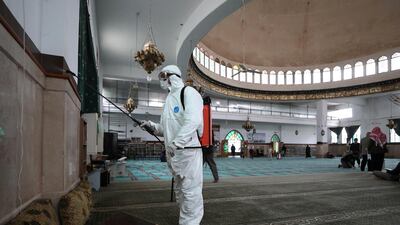
A volunteer from the Violet organisation disinfects a mosque in Syria's northwestern city of Idlib on April 25, 2020, from coronavirus (COVID-19) during the Muslim holy fasting month of Ramadan. (Photo by OMAR HAJ KADOUR / AFP) -
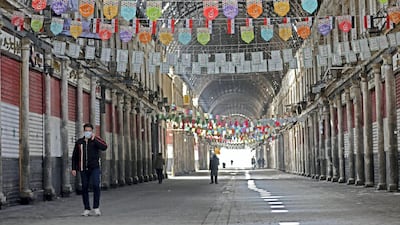
Only a few people walk in the century-old covered bazaar of Hamidiya in Syria's capital Damascus on March 24, 2020, after measures were taken by the authorities to fight the novel coronavirus pandemic. - Across much of the Syrian capital, with squares and markets once thronging with people even during the war, are now almost entirely empty. Five cases of COVID-19 have been reported in the country since Sunday, and the authorities have ordered all non-essential businesses closed. (Photo by LOUAI BESHARA / AFP) -
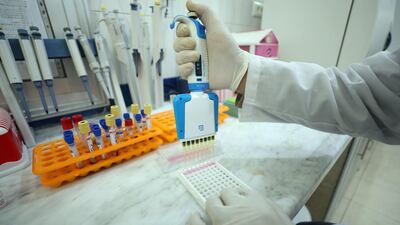
Researchers are examining the possibility of using inhalers to introduce stem cells into a patients lungs. AFP -
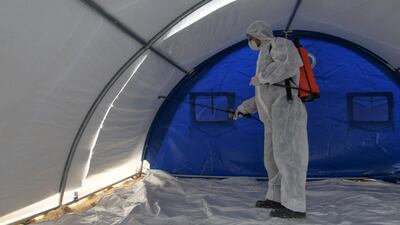
A member of the Syrian Violet NGO disinfects a triage tent erected for suspected coronavirus patients outside the Ibn Sina Hospital in Syria's northwestern Idlib city on March 19, 2020. - Syrian authorities on March 13 announced measures aimed at preventing coronavirus from reaching the war-torn country, including school closures and a ban on smoking shisha in cafes, state media reported. (Photo by Abdulaziz KETAZ / AFP) -
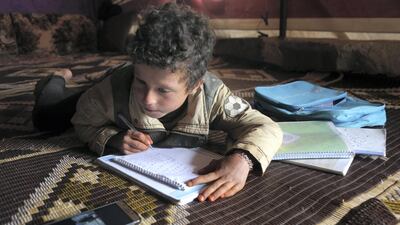
A young pupil follows a lesson on a mobile telephone inside a tent, in a camp for displaced Syrians in the village of Kafr Yahmoul in the northwestern Idlib province, amid the coronavirus pandemic on April 3, 2020. - Like in much of the world, educators in Syria are taking classes online after the country's various regions sent pupils home hoping to stem the COVID-19 pandemic. But distance learning is no small feat in a country battered by nine years of war, where fighting has displaced millions and the electricity supply is sporadic at best. (Photo by Aref TAMMAWI / AFP)


“Women, men and children that we interviewed faced the ghastly choice of being bombarded or fleeing deeper into HTS-controlled areas where there are rampant abuses of human rights and extremely limited humanitarian assistance,” said Karen Koning AbuZayd, a member of the inquiry. “The acts by HTS members amount to war crimes.”
Hanny Megally, another member of the inquiry, said that the Covid-19 pandemic was making the situation even worse in Idlib and western Aleppo. As many as a million people are believed to be displaced in Idlib alone.
“Now more than ever, civilians need sustained and unfettered access to humanitarian assistance, which must neither be politicised by member states nor instrumentalised by parties to the conflict,” he said. “Pandemics know no borders; neither should life-saving aid.”
The report said that “a perfect storm” is in the making as Syria faces the coronavirus outbreak.

