

A dozen Lebanese protesters bound their hands with rope at Beirut’s Justice Palace on Wednesday morning to protest against a crackdown on criticism of the president on social media.
"We heard that President Michel Aoun asked the general prosecutor to indict anyone who slanders him," protester Nawal Meouchi told The National.
"As we've all done it, we came here directly to say, 'Here you are, we are yours'."
The protesters carried banners demanding freedom of speech.
“Instead of going after the people who are corrupt in our country, they decided to go after us,” said Rita, another demonstrator. “They can’t take our freedom of speech away from us.”
Others carried banners that read, “You can imprison a revolutionary but you cannot imprison the revolution", and “Freedom remains our priority".
State prosecutor Ghassan Oueidat assigned the Internal Security Forces’ criminal investigations bureau identify people who published posts and pictures insulting the president, the state-run National News Agency reported on Monday.
Mr Oueidat said that those who were identified were to be prosecuted for slander and defamation.
Lebanese protesters return to the streets
-
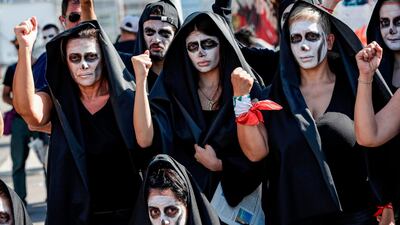
Lebanese anti-government protesters take part in a symbolic funeral for the country in the capital Beirut on June 13, 2020, the third consecutive day of demonstrations over a deepening economic crisis. AFP -
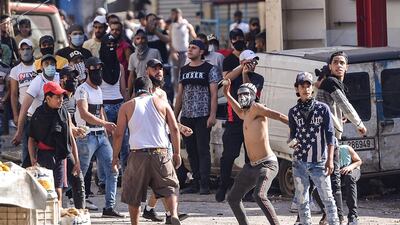
Lebanese anti-government protesters throw rocks at soldiers amid clashes in the Bab al-Tabbaneh neighbourhood in the northern port city of Tripoli on the third consecutive day of demonstrations against deepening economic crisis. AFP -
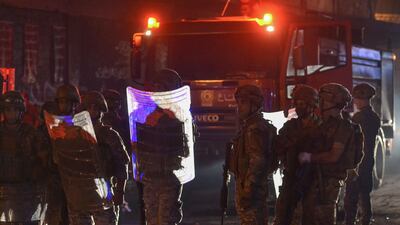
Lebanese soldiers deploy by a civil defence firefighting truck during clashes with anti-government protesters in the northern port city of Tripoli amid fresh demonstrations over a spiralling economic crisis. AFP -
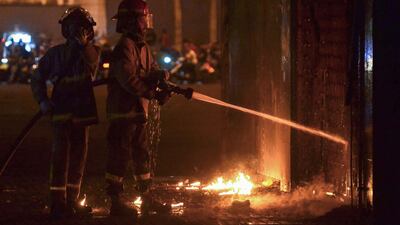
Lebanese civil defence firefighters extinguish flames in a shop as anti-government protesters and security forces clash in the northern port city of Tripoli amid fresh demonstrations over a spiralling economic crisis. AFP -
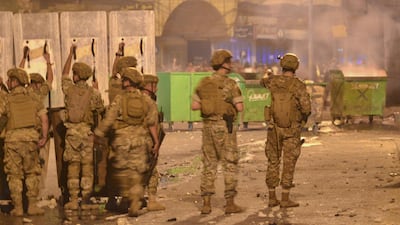
Lebanese soldiers with riot gear react during clashes with anti-government protesters in the northern port city of Tripoli amid fresh demonstrations over a spiralling economic crisis. AFP -
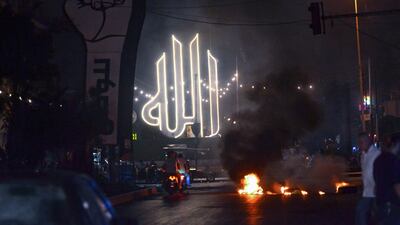
Lebanese anti-government protesters block a road with burning tyres in the northern port city of Tripoli amid fresh protests over a spiralling economic crisis. AFP -
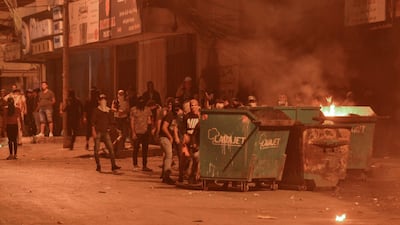
Lebanese anti-government protesters clash with security forces in the northern port city of Tripoli amid fresh protests over a spiralling economic crisis. AFP -
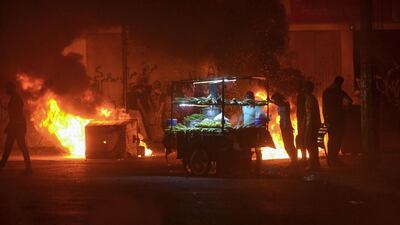
Lebanese anti-government protesters buy corn from a street vendor next to burning garbage bins during clashes with security forces in the northern port city of Tripoli amid fresh protests over a spiralling economic crisis. AFP -
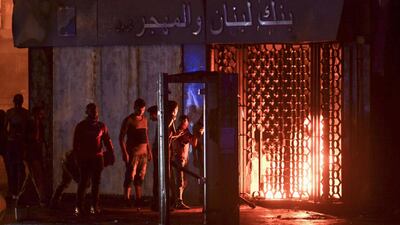
Lebanese anti-government protesters take shelter behind a public phone booth as a local bank's branch burns during clashes with security forces in the northern port city of Tripoli amid fresh protests over a spiralling economic crisis. AFP -
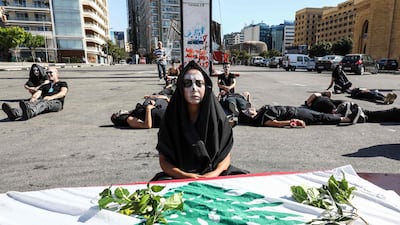
Lebanese anti-government protesters take part in a symbolic funeral for the country in the central area of the capital Beirut on the third consecutive day of demonstrations over a deepening economic crisis. AFP -
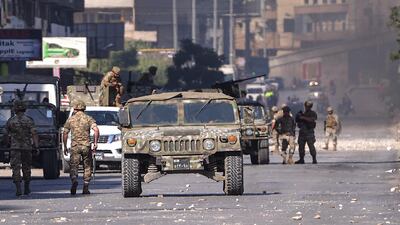
Lebanese soldiers deploy during an anti-government protest in the Bab al-Tabbaneh neighbourhood in the northern port city of Tripoli on the third day of demonstrations across the country over deepening economic crisis. AFP -
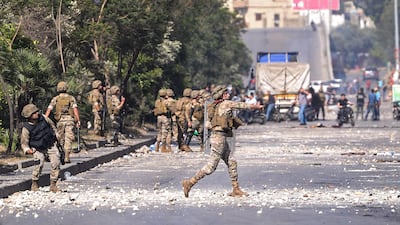
Lebanese soldiers clash with anti-government protesters in the Bab al-Tabbaneh neighbourhood in the northern port city of Tripoli on the third day of demonstrations across the country against deepening economic crisis. AFP


Lebanon’s worst economic crisis boiled over in late 2019, pushing hundreds of thousands to the streets in what they call the “October revolution”.
Protesters hurled insults at Lebanon’s political leaders, including the president, who they accuse of corruption and mismanagement.
The chant, "All of them means all of them", was common at many protests where they called for an end to the country's elite.
Numbers dwindled at rallies after the new government was formed in January amid political pressure, including from Mr Aoun’s Free Patriotic Movement.
The coronavirus pandemic reduced their numbers further.
But demonstrations picked up against last week as the local currency, which has lost about 70 per cent of its value at exchange shops, continued to tumble.
Officially pegged to the US dollar at 1,507 pounds, on Wednesday local media reported exchange shops selling for them 3,910 pounds.
Paula Yacoubian, the only Lebanese MP not representing a traditional party, voiced her anger at the judiciary’s decision to pursue insults against Mr Aoun.
“A state incapable of stopping pain has decided to ban screaming," Ms Yacoubian tweeted on Wednesday.
"Lebanon will not become a police state."
Lebanese law punishes insults against the president with up to two years in prison, but for years it has only been occasionally used.
But under Mr Aoun, the authorities have been increasingly resorting to such laws to stifle dissent, said Aya Majzoub, Lebanon and Bahrain researcher at Human Rights Watch.
Ms Majzoub said figures from the Internal Security Forces' cyber-crime bureau showed the use of such laws jumped by 325 per cent between 2015 and 2018.
Mr Aoun became president in 2016.
Ms Majzoub said such practices were incompatible with international treaties signed by Lebanon, including the International Covenant on Civil and Political Rights.
“What’s more worrying is that the public prosecutor said he would investigate anyone insulting the president, which is slightly different from the president saying that he can personally file a lawsuit against someone,” she said.
“This decision, in the wake of recent prosecutions targeting activists and journalists peacefully expressing their opinions, has shattered any remaining pretence that Lebanese authorities care about or respect the right to free speech."

