The UK should use a “window of opportunity” to stop runaway infections or the country will within weeks be back to the levels of cases suffered at the peak of the pandemic, a top scientist said.
Professor Stephen Reicher, from the University of St Andrews, on Wednesday said tougher rules have to be brought in now to break the spiral.
The UK reported 14,542 new infections on Tuesday – with cases doubling over the past 11 days.
The surge in numbers comes as UK health secretary Matt Hancock is expected to announce a “traffic light” system of measures based on the level of infections.
Prof Reicher told BBC's Radio 4 Today programme: "If you look at the figures at the moment, the level of infections is about 10% of what it was at the peak in March, but at the rate of doubling, it would be at the same as March by the end of October.
“We have a window of opportunity to do something. If we squander that opportunity then we really are in trouble and we would be talking about going back to full lockdown.”
Prof Reicher said a “circuit-breaker” suite of measures “might buy us time” but cautioned there was “no point” if nothing changed by the end of it.
Professor Calum Semple, a member of the Government’s scientific advisory panel who specialises in disease outbreaks, agreed that short and sharp restrictions might need to be applied nationally.
He told the BBC: “It’s always easier to reduce an outbreak at the earlier stage than to let it run and then try to reduce it at a later stage.
“So, yes, circuit breakers are certainly something we should be thinking about on a national basis.”
Pubs with no beer in Scotland
The warning comes as Scottish First Minister Nicola Sturgeon announced all pubs and restaurants in the central belt - which includes Glasgow and Edinburgh - would close for two weeks.
In other areas, they will be able to open until 6pm - but only to serve food and non-alcoholic drinks. They will still be allowed to serve alcohol in beer gardens until 10pm.
The new rules, affecting 3.4 million people, come into force at 6pm on Friday.
Ms Sturgeon insisted the new rules were not a second lockdown but admitted they felt like a "backward step" in combating the disease.
Meanwhile, mayors from the UK’s major Covid-hit cities - Manchester, Liverpool, Leeds and Newcastle - told the government tougher restrictions affecting millions were not working.
Scientists from the world’s top universities have also penned an open letter calling for the UK to lift lockdown measures and build herd immunity among young people.
-
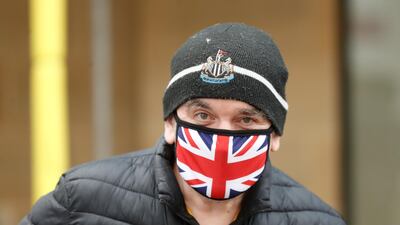
A man wears a protective face mask in Newcastle upon Tyne. Reuters -
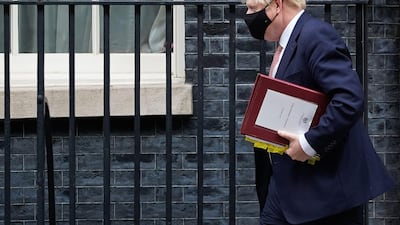
Prime Minister Boris Johnson leaves 10 Downing Street in central London. AFP -
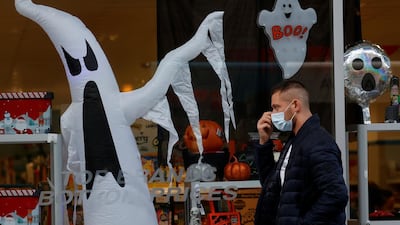
A man wears a face mask as he walks past a Halloween display in Liverpool. Reuters -
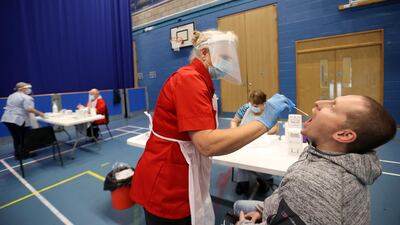
A health worker takes a swab for Covid-19 test at a Stoke-on-Trent City Council facility. Reuters -
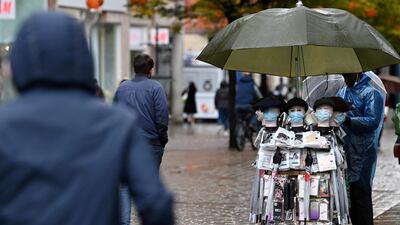
A street seller stands with his stall selling protective face masks in Manchester. AFP -

Musicians perform near the houses of Parliament in London during a protest highlighting their inability to perform live or work during the pandemic. Reuters -

Kate Middleton, Duchess of Cambridge, chats with students during her visit to the University of Derby. She met students to hear how the pandemic has impacted university life. AFP -

People wearing face masks walk across Westminster Bridge in London. AP Photo -
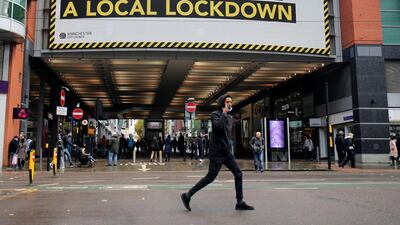
A sign in Manchester appeals to the public to adhere to the Covid-19 restrictions. Reuters -
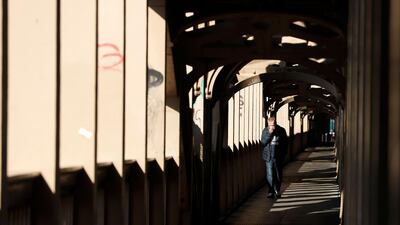
A man walks across the High Level bridge in Newcastle upon Tyne. Reuters


The petition, signed by about 2,500 scientists, warned tough lockdown rules were having “damaging physical and mental health” effects.
They argued that older people should be shielded while the young should move freely throughout society.
During Prime Minister's Questions, Labour leader Keir Starmer urged Boris Johnson to explain why tighter lockdown restrictions were not having an effect.
“It’s obvious that something has gone wrong here,” he said.
An analysis, released by Labour as Mr Johnson faced questions, showed the town of Bolton, in north-west England, saw its infection rate rise from 22 cases per 100,000 people to 255 per 100,000 since it was placed under increased restrictions on July 30.
The infection rate in Burnley, another north-west town, increased more than 20 times to 434 cases per 100,000 from 21, the study found.
Mr Johnson declined to comment on the reasons behind these surges, but agreed infections were rising across the country.
He said: “I wish I could pretend that everything was going to be rosy in the Midlands or, indeed, in London where, alas, we are also seeing infections rise.
“That is why we need a concerted national effort, we need to follow the guidance.”
Mr Johnson admitted on Tuesday that the country had "had more than enough of this disease" and promised a return to normal life by this time next year.
He said he was “working night and day to repel this virus, and we will succeed, just as this country has seen off every alien invader for the last thousand years”.