
For generations a patchwork of Christian faiths in southern Turkey’s Hatay province, one of the religion’s earliest centres, have marked Easter with colourful processions and incense-heavy church services.
This year, the marking of Jesus’s resurrection has been hard-hit by a curfew imposed to halt the spread of coronavirus, forcing the faithful to remain behind closed doors during their most important festival.
“All the churches will be closed for the weekend and nobody can go out,” said Joseph Nasuh, 66, a lay leader among the Orthodox community in Antakya. “Not being able to celebrate Easter is hurting people a lot.”
This weekend would usually see the followers of Eastern Orthodoxy, who observe the Gregorian calendar, mark Easter with feasting and visits to neighbours and relatives.
Last weekend, it was Catholic and Protestant churches that shuttered their doors as the government imposed a complete 48-hour lockdown in 31 provinces, a safeguard that will be repeated this weekend.
Hatay’s capital Antakya is the site of ancient Antioch, where, according to the New Testament, the term Christian was first applied to the followers of Jesus.
The city, founded around 300 BCE by one of Alexander the Great’s generals, saw both Paul and Peter preach the gospels in the 1st century and is the site of one of Christianity’s earliest churches.
Since this era, generations of Christians have worshipped mostly uninterrupted as the city changed hands under emperors, kings and sultans, becoming part of Turkey in 1939.
"The last time we did not celebrate Easter in the usual way was after an earthquake in 1872 that caused a lot of fires and damaged many of the city's churches," Mr Nasuh told The National.
This year, Christians will mark the festival at home, lighting candles and conducting prayers and rituals as best they can.
“I have prepared the cross in my home, put out flowers on the table and will do the ceremony with my family. All the food is already prepared,” Mr Nasuh, a retired architect, said.
Domenico Bertoli, an Italian priest at the Antakya Catholic Church, said last weekend’s festivities for the followers of western Christianity proved to be a challenging time.

“The state ordered the shutdown and we closed our doors. What else could we do?” he said.
Father Bertoli, 83, said the church provided support over social media and by phone to worshippers.
“No-one has ever experienced anything like it,” he added. “We did our ceremonies at home. Some we carried out online and through Facebook. We told people ‘Now your houses are small churches’. Wherever a Christian lives, in that home there is small church.”
Mr Nasruh said some of the congregation wanted to attend church to pray for an end to the outbreak, which has so far taken more than 1,500 lives in Turkey among nearly 70,000 confirmed cases.
“Some people who believe the virus is sent by God as a test, like the flood, say we should continue to go to church to pray for forgiveness so it ends,” he said.
Another centre for Turkey’s Christians, whose numbers plummeted from a fifth of the population before the First World War to less than one in 200 today, is Istanbul.
Turkey’s largest city has been the seat of the Ecumenical Patriarchate of Constantinople since the 4th century and is considered “first among equals” in Orthodox Christianity.
On the nearby island of Buyukada, home for Orthodox monks since the days of the Byzantine Empire, Christian families are also preparing for an Easter without the usual celebrations.
“The first Easter I remember was 40 years ago,” said restauranteur Angela Gunberk. “The churches were packed, I will never forget it.
“Easter is a holiday that makes me feel and enjoy my religion. The family comes together, cakes are baked and different foods are prepared.
“My son in law is Armenian and last week was the Armenian and Catholic Easter. This week is Orthodox Easter and for the first time in our lives we face a situation where we can’t carry out our traditions.”
Like many families on the island, Mrs Gunberk will follow services on Greek television. “I’m happy, because my children are with me but, of course, there are many people who are away from their grandchildren, away from their children.”
Aret Bozkurt, an Armenian Apostolic Christian, is another islander adjusting to Easter under coronavirus restrictions.
“Normally Easter lasts all week and we do something every day but this year it was very different,” said the musician, 46, whose church follows the Julian calendar. “We prayed at home and followed the services on an Armenian TV station or online.”
Despite the challenging circumstances, Mr Nasuh said this year would see the community adapt to maintain its religious customs.
“Even if all the churches in Antakya were destroyed, we will just light a candle in our houses and all the city will become a church,” he said.
-
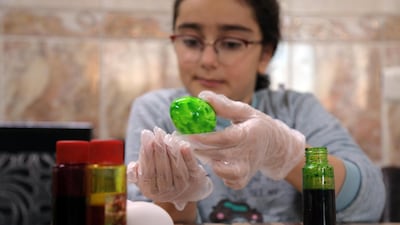
A girl decorates eggs on Holy Saturday, as Christians worldwide following the Western Gregorian calendar mark the Easter holiday weekend, in Arbil, the capital of the autonomous Kurdish region of northern Iraq. AFP -
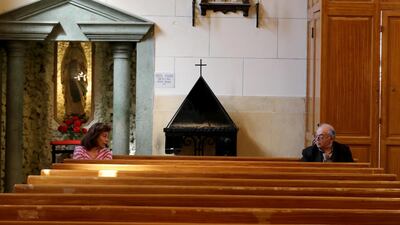
People pray during an Easter mass led by Bishop Krikor Kousa at the Armenian Catholic Church as Egypt ramps up efforts to slow the spread of the coronavirus disease (COVID-19), in Cairo, Egypt. REUTERS -
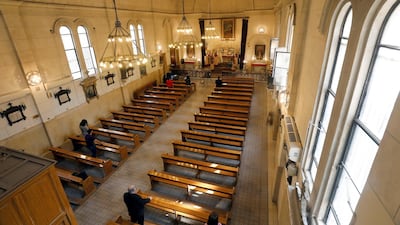
Easter mass at the Armenian Catholic Church as Egypt ramps up efforts to slow the spread of the coronavirus disease (COVID-19), in Cairo, Egypt. REUTERS -

A Christian worshipper prays in front of the closed door of the Church of the Holy Sepulchre before the start of the Easter Sunday service amid the coronavirus disease (COVID-19) outbreak, in Jerusalem's Old City. All cultural sites in the Holy Land are shuttered, regardless of their religious affiliation, as authorities seek to forestall the spread of the deadly respiratory disease. Christians will be prevented from congregating for the Easter service, whether this coming Sunday -- as in the case of Bitar and fellow Catholics -- or a week later on April 19 in the case of the Orthodox. AFP -
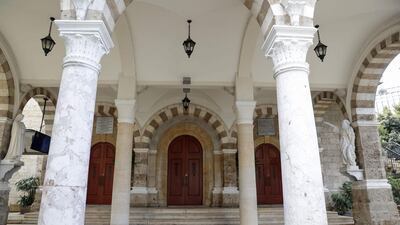
The Saint Maron Church doors remain closed amid the COVID-19 pandemic lockdown, as Easter Sunday Mass is held indoors without worshippers and broadcast live, in the Gemmayze district of the Lebanese capital Beirut. AFP -
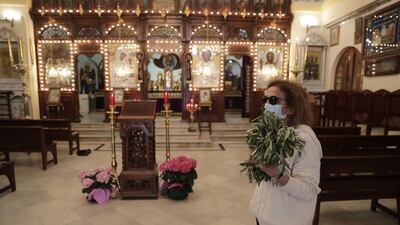
A Lebanese woman wearing a protective mask amid the COVID-19 pandemic takes part in Palm Sunday celebrations for Orthodox Christians at a church in the Ashrafiyeh district of the capital Beirut. AFP -
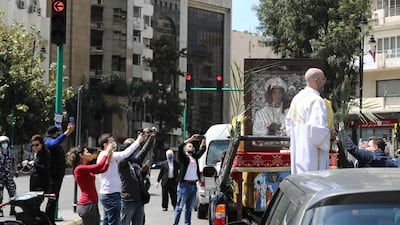
Lebanese people, some wearing protective masks amid the COVID-10 pandemic, take pictures of a car procession celebrating Palm sunday for Orthodox Christians, in the Ashrafiyeh negihborhood of the capital Beirut. AFP -
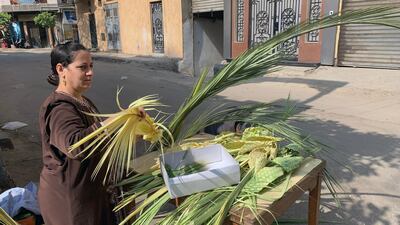
A woman prepares palm leave products as Egyptian Coptic Christians celebrate Palm Sunday, at Ghamra district in Cairo, Egypt. EPA -
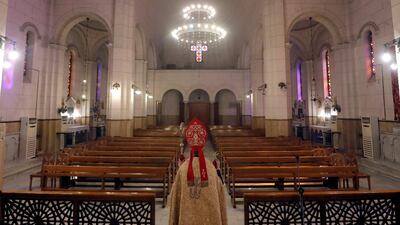
Bishop Krikor Kousa leads the Easter Sunday Mass behind closed doors as Egypt ramps up efforts to slow the spread of the coronavirus disease (COVID-19), at the Armenian Catholic Patriarchate and the Church of the Assumption in Cairo, Egypt. REUTERS



