As coronavirus restrictions are lifted in the UK, authorities are concerned that children could be further exploited by modern slavery after the number of referrals made to England's local councils soared over the past five years.
Referrals of suspected child victims of slavery in England have increased by 1,400 per cent in five years, putting children's services under growing and significant pressure, the Local Government Association (LGA) has warned.
England's national membership body for local councils has simultaneously raised concerns that the lifting of Covid-19 restrictions could lead to more exploitation as businesses reopen.
Many businesses emerging from lockdown may lack money to pay staff and could take advantage of people who have been made more vulnerable by the pandemic.
The closing of certain high-risk businesses such as nail bars has left trafficking victims further removed from the public eye and harder to identify and rescue, the LGA said.
-
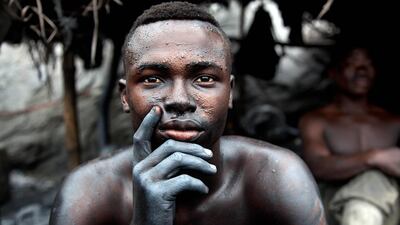
This photograph titled 'Blue Hand' shows a man enslaved in illegal gold mining in Ghana. "They are forced to spend 48 to 72 hours deep in the mines shafts," says Lisa Kristine, an American photographer who spent years documenting modern day slavery around the world. Photos: Lisa Kristine. -
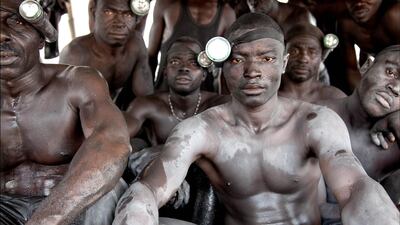
'Price by Gold'. Kristine says: "Most of these boys and men come from northern Ghana hoping to strike it rich working at legal mines. When they can’t get a job, they borrow money at usurious interest rates or join teams of slaves known as gangs. The gangs work in areas abandoned by big companies. They can only sell their gold to the moneylender at a price he sets. They are trapped by illegal, fictitious debt, and are often hunted by local police and private security guards for trespassing. Many of them talk about wanting to escape. Some of them believe they will become rich if they work just a little longer and harder." -

'Stacking'. In the brick kilns of India and Nepal, men, women and children are all involved in the process of making bricks. "They suck dust into their lungs all day, every day," says Kristine. -
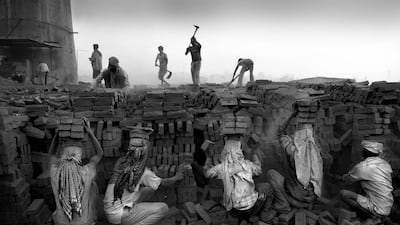
'Stratum'. Kristine says: "Entire families are in bonded labour slavery. Often, families get a loan for an emergency or to pay a broker a fee for getting hired on a new job. Slaveholders, the only people near with any money to lend, trick the borrowers into slavery through illegal, exorbitant interest rates that are impossible to repay. Children inherit the bogus debt from their parents. Generations of families have been enslaved for a loan of just $18." -
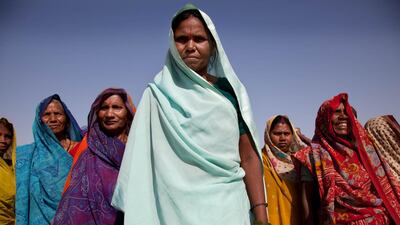
'Pillars'. "Slaveholders burned down the homes of these villagers when they declared their freedom," says Kristine. "Many villagers wanted to give up. The women in front rallied their frightened neighbors and led them to freedom. Grassroots activists helped the village get a quarry lease of their own. The women say, 'This is our quarry, we are the owners, we will never go back to slavery again.' They do the same backbreaking work, but they get paid and they do it for themselves, in freedom. It makes all the difference in the world." -
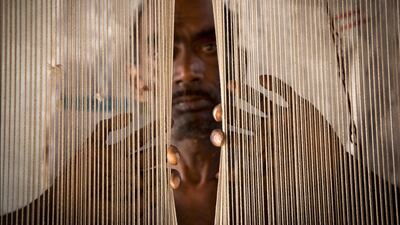
'Threads' by Lisa Kristine. Speaking about the subject of the photograph, she says: "He is more than 50 years old and is enslaved weaving carpets to pay off a modest loan he took 12 years ago. He doesn’t know if he’ll ever be free to work for someone else." -
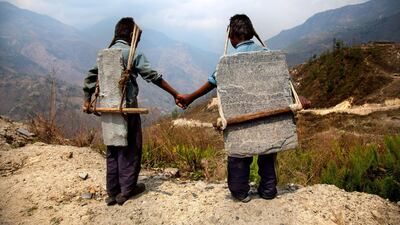
In the Himalayas, Lisa Kristine captured these brothers carrying slate down the mountainside. Below, trucks are waiting to take the slate and eventually sell it. “We all knowingly or unknowingly participate in slavery every day," said Kristine at a conference in London, noting that the slate these boys are carrying may be used in our homes. -
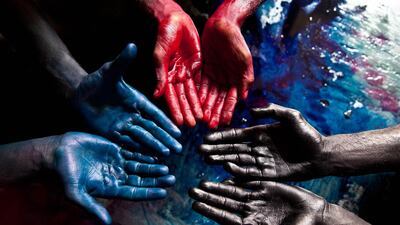
In 'Family Portrait', Kristine depicts how slavery can last through generations. The dyed black hands are of the father's, and the blue red and hands are his sons's. Using their bare hands, these silk dyers in an Indian village dip the cloth in barrels filled with toxic dye. -

'Currency'. Trafficking is rampant around Ghana's Lake Volta, where children work on fishing boats. "Every kid on the lake knows of another child who died in the nets. Most of the children suffer from skin diseases and parasitic worms. Malaria is common. Medical care is not," says Kristine. -

'Fishing Boats' by Kristine, taken in Lake Volta. She says, "The youngest child on this boat is 7; the oldest is 15. It is the end of the day. They have been working since 4am... The nets can weigh as much as 1,000 pounds when they are full." -
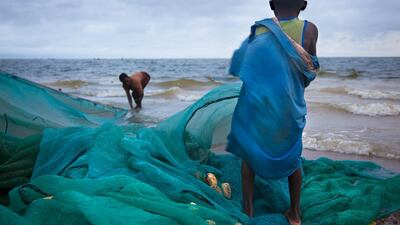
'Fishing Nets' by Lisa Kristine. The children are tasked with untangling nets that get caught underwater. Most of the children are not taught how to swim, and a number die from drowning every year.


The warnings from the government association follow a report earlier this month that outlined how there may be 10 times the reported number of victims of modern slavery in the UK.
According to the Centre for Social Justice (CSJ) and the slavery support network Justice and Care, there were at least 100,000 victims of modern slavery living in the UK, a figure that far surpasses the 10,000 estimated by a government study in 2017.
The LGA has said estimates of the number of victims of modern slavery in Britain range from 13,000 to more than 130,000, with the overall cost to UK society estimated at between £3.3 billion and £4.3bn (Dh15.8bn to Dh20.5bn).

Former UK home secretary Theresa May made the Modern Slavery Act, passed in 2015, one of her flagship policies before she became prime minister.
Since the protections were passed, however, thousands of children have continued to be trafficked in the UK.
The latest statistics show the number of council referrals of suspected child victims of modern slavery to the National Referral Mechanism – the UK’s framework for referring and supporting victims – has risen from 127 in 2014 to 1,971 last year, a staggering increase of more than 1,400 per cent.
The rate of these child referrals increased by 71 per cent in one year alone, with the number of referrals in 2018 standing at 1,152. Children accounted for 91 per cent of all referrals made by councils in England in 2019.
“Modern slavery is happening in local communities everywhere, with high-street services such as car washes and nail bars being high-risk sectors for exploitation,” Nesil Caliskan, chair of the LGA’s Safer and Stronger Communities Board, said.
“The public should look out for telltale signs, including people who may be dressed inappropriately for the work they are doing, or who appear frightened or withdrawn at work.
“Everyone needs to report any suspicious behaviour to help rescue people living wretched lives under coercion,” he added.