The office of possibly the world’s only daily newspaper to be produced by a father-and-son team can be found in the bustling Istanbul neighbourhood of Ferikoy.
But calling Apoyevmatini's premises an "office" is a little misleading. The Greek-language paper – one of the oldest in Turkey – is written, laid out and sent to the printers from the book-lined back room of 81-year-old Mihail Vasiliadis's apartment.
Vasiliadis the elder is a shrewd journalist of the old school and it is easy to be impressed by his determination to keep his paper alive, despite its print run now being limited to just 600 Istanbul-Greek families, a remnant of a once-thriving minority.
His grit has proved useful in a turbulent, six-decade career in Turkey and Greece – wary neighbours who have gone through conflict, social turmoil and military coups. It also fuels him as he and his son Minas, 36, work anywhere between 15 to 18 hours a day to make sure Apoyevmatini's loyal readers get their copy.
“I think you cannot find another example where two guys are publishing a daily newspaper,” Mihail laughs. “I should apply to the Guinness Book of World Records.”
Apoyevmatini is one of the oldest of Istanbul's minority-language papers – Agos (whose chief editor Hrant Dink was murdered in 2007) is published in Armenian and Turkish, and Salom serves the country's Jewish community. The Vasiliadis' paper – founded by Konstantinos and Antonis Vasiliadis, two of Mihail's uncles, in July 1925, less than two years after Turkey became a republic – is an intriguing mix of the local and the international, as Mihail explains.
“When we look today, we see that all the world is watching this area … Turkish-Greek relations; Cyprus; the new developments in the eastern Mediterranean are major issues that I cover.”
But an integral part of the paper is its community focus. News of births, marriages, deaths, graduations, baptisms and church events are part of the glue that binds the Rum (“Romans”) – as Istanbul-Greeks are known – together.
Their priorities dictate how Apoyevmatini's subscribers read their paper. "Our readers first check the last page of the newspaper because that's where the obituaries are," Mihail says. "They want to see if we have lost anyone recently. Then they check the front page."
Many bigger publications would kill to have the deep ties and loyalty that Apoyevmatini's – mostly elderly – readers have for the paper. Even its distributors – all Turks who cannot read Greek – are intimately bound up with the paper's history and survival.
“The guy who's now responsible for distributing the paper says: ‘My father raised six kids by distributing this newspaper and now it's me’.” Mihal says.
If Apoyevmatini's story is anything, it is a story of survival – both of publication and of the Istanbul-Greeks themselves.
“After certain policies that the [Turkish] government practised in the past, the Greek population has diminished greatly,” Mihail says. “It was approximately over 90,000 people in the past; now approximately 600 families remain, more or less.”
A wave of anti-Greek violence in Istanbul in September 1955 led to thousands of Greek families fleeing the country. Fighting over Cyprus in 1974 was another “turning point” for the city’s Greeks, Mihail says.

“State propaganda said that the Greeks in Istanbul are the same as the Greeks in Cyprus. So people called out on the street: ‘Your guys are killing our guys’ and we asked: ‘Who is ‘yours'? I'm from here.’ ... And in a very short time, a large number of the remaining families had to leave.”
Amid the conflict, Mihail was fighting his own battle with the authorities. A decade earlier, when he was running a weekly magazine, he was taken to court, accused of “spreading pro-Greek propaganda in a way that damages national unity”.
“The case lasted for 11 years,” Mihail says. “I was tried three times for the same case in 11 years and three times I was acquitted from the same case, but it took 11 years to get rid of the case.
“One of the Greek lawyers promised that he will take care of my case but he didn't show up at the court hearing … Therefore, at the age of 26, I had to become my own lawyer. I had to defend myself.”
It was a situation that repeated itself when, after proving his innocence in Turkey in 1975, Mihail moved to post-junta Greece and ran a newspaper called Eptalofos ("Seven Hills", another name for Istanbul).
“I published several articles on the pressure that the Muslim-Turkish minority is facing in Thrace [northern Greece],” he says. “They called me a Turkish spy and I was sent to court. Again, I had to defend myself and, of course, I was acquitted once more.”
But he returned to his home city when he received an offer in 2002 to head up Apoyevmatini, whose subscriptions had collapsed. Publishing from offices in the Syria Passage off Istanbul's famous Istiklal Street, Mihail set about rebuilding the paper.
Apoyevmatini has faced mixed fortunes since then. Although subscriptions recovered, and an online version launched in 2007 proved popular with readers overseas, its advertising revenue was hit by the financial crisis in Greece. Old editions carry now-poignant adverts from the pre-crash Bank of Greece.

Despite a 2010 campaign by supporters of the paper which led to 300 new subscriptions from Turkish-speaking readers, in 2014 high rents forced Apoyevmatini from its city-centre office. It survived in rooms inside a nearby Greek-Orthodox church for a time, eventually decamping to Mihail's home.
When Mihail’s son, Minas, came on board his technical know-how revolutionised how the paper was produced. Cobbling together a desktop-publishing system from computer parts bought in an Athens’ Monastiraki flea market, Minas was on hand to make the transition from cut-and-paste to digital publishing as easy as possible – even while he was doing his national service in Greece.
"I used to choose the night shift to stand guard because I knew it was peak time for my father," Minas tells The National. "If necessary, we could communicate and I would give him technical instructions.
“I actually brought two phones to the army. I gambled that once the lieutenant confiscated one device, he’d be less suspicious about me carrying a cell phone. It worked.”
Now Minas is Apoyevmatini's senior editor. Minas – as a self-described "journalist, reporter, editor, columnist, accountant, public relations expert, graphic designer, secretary and errand boy" – works from 9am and finishes an edition by 2am the next morning, "if I am lucky".
He, his father and the paper – which is nearing its 100th anniversary – carry on in the spirit of the Victor Hugo quotation that adorns its masthead: "For new times, new duties". But it is the quote below Hugo's that perhaps fully reflects the paper's ethos: "No one is born, or dies, without Apoyevmatini."
Sitting in his back-room office, the latest spread of the paper on the computer screen behind him, Mihail shows off a recent email from a Greek reporter who wants to come and work for Apoyevmatini for free. Mihail rejects these offers, saying it is "unethical" to have unpaid staff. So he and Minas labour on, their small paper a bridge between two cultures.
“Both cultures are rich and I feel proud to understand them, to be a part of them,” Minas says. “I don’t feel I am being pulled between two states. What matters is being able to uphold international journalistic ethics and standards. The rest is up to politicians.”
Mihail – who somehow also finds the time to discuss current affairs on a Turkish TV show every week – is at pains to point out that despite some turbulent and dangerous times in Turkey he has always found supporters among Turkey’s people.
“When they ask me: ‘Where is your motherland? Greece or Turkey?’, I say: ‘It’s Istanbul'.”
-
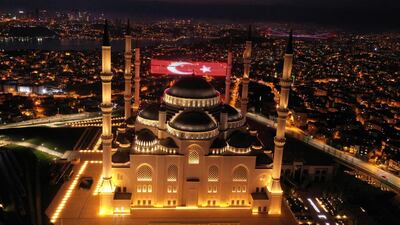
Mahya depicts Turkey's national flag which is installed between the minarets of Camlica mosque, as the outbreak of COVID-19 continues in Istanbul, April 28, 2020. Reuters -
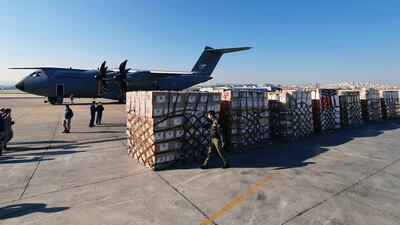
Turkish soldiers load medical protection equipment into a Turkish military cargo plane to be donated to the United States at the Etimesgut airport in Ankara, Turkey, April 28, 2020. EPA -

A flight crew member stands in front of a donation of medical supplies from Turkey on April 28, 2020, at Andrews Air Force Base, Maryland. The donation to help fight the new coronavirus in the United States included surgical masks, sanitisers and protective suits. AP Photo -
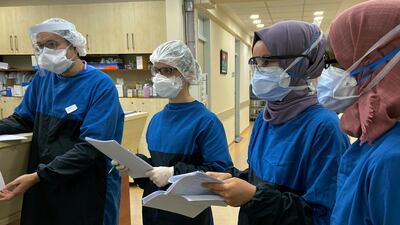
Medical personnel participate in a briefing at Istanbul University Cerrahpasa - Cerrahpasa Medical Faculty Hospital's ward dedicated to patients with coronavirus (COVID-19) in Istanbul, Tuesday, April 28, 2020. Turkey has seen a decline this week in the number of daily deaths and rates of infection since it started to grapple with the novel coronavirus pandemic last month. The government has refrained from imposing a total lockdown, fearing its negative impact on the already fragile economy. (AP Photo/Mehmet Guzel) -
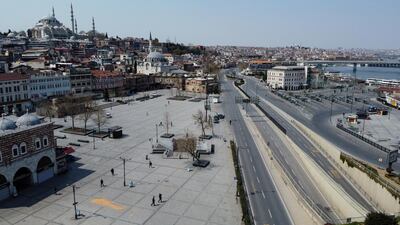
An aerial view of Eminonu district during a two-day curfew imposed to prevent the spread of the coronavirus in Istanbul, Turkey, on April 11, 2020. Reuters -
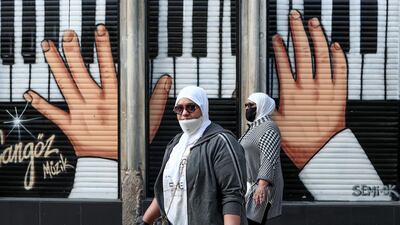
epa08392157 Women walk with face masks in Istanbul, Turkey, 29 April 2020. Turkish President Recep Tayip Erdogan announced that there will be another curfew in 31 big cities, including Istanbul (the country's most populous urban agglomeration), between 01-03 May due to the ongoing pandemic of the COVID-19 disease caused by the SARS-CoV-2 coronavirus. The government has also decreed the cancellation of public events and has temporarily shut down schools and suspended sporting events amid the pandemic. EPA/SEDAT SUNA -
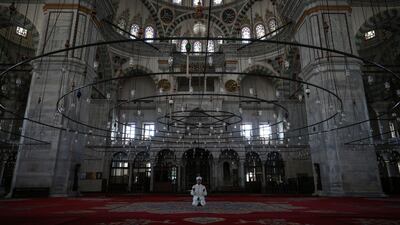
Esat Sahin, Imam of the iconic Fatih Mosque, holds a prayer held without public due to the coronavirus restrictions in Istanbul, April 24, 2020, during the first day of the holy fasting month of Ramadan. (AP Photo/Emrah Gurel) -
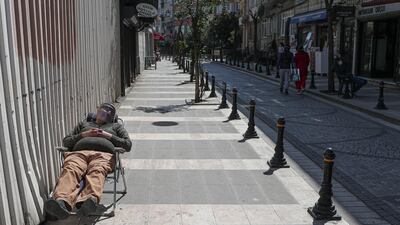
epa08392155 A man sleeps with face protective equipment on street in Istanbul, Turkey, 29 April 2020. Turkish President Recep Tayip Erdogan announced that there will be another curfew in 31 big cities, including Istanbul (the country's most populous urban agglomeration), between 01-03 May due to the ongoing pandemic of the COVID-19 disease caused by the SARS-CoV-2 coronavirus. The government has also decreed the cancellation of public events and has temporarily shut down schools and suspended sporting events amid the pandemic. EPA/SEDAT SUNA -
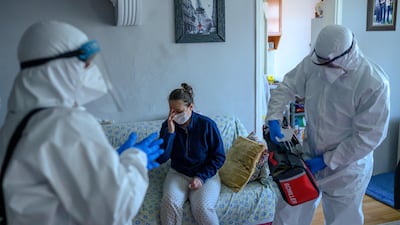
TOPSHOT - Health workers help a woman who tested positive for the novel coronavirus COVID-19, at Bagcilar in Istanbul, on April 28, 2019, in Istanbul. / AFP / Bulent Kilic -
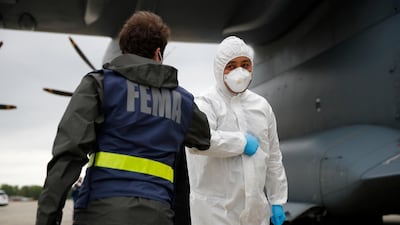
A Turkish military flight crew member, right, bumps elbows with a FEMA worker as crews unload a donation of medical supplies from Turkey, Tuesday, April 28, 2020, at Andrews Air Force Base, Md. The donation to help fight the new coronavirus in the United States included surgical masks, sanitizers and protective suits. (AP Photo/Patrick Semansky) -
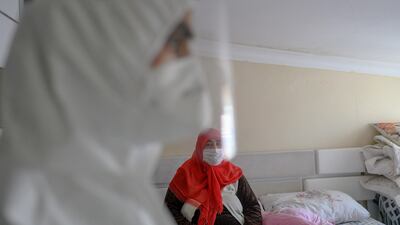
Health workers help a woman who tested positive for the novel coronavirus COVID-19, at Bagcilar in Istanbul, on April 28, 2019, in Istanbul. / AFP / Bulent Kilic -
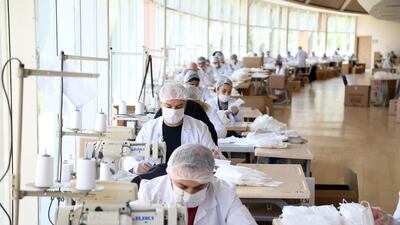
TOPSHOT - Employees of Ankara Metropolitan Municipality youth center sews face masks, in Ankara, Turkey, on April 28, 2020, amid the spread of the novel COVID-19 coronavirus. / AFP / Adem ALTAN -

Employees of Ankara Metropolitan Municipality youth center sews face masks, in Ankara, Turkey, on April 28, 2020, amid the spread of the novel COVID-19 coronavirus. / AFP / Adem ALTAN -
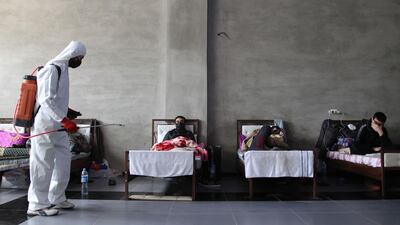
TOPSHOT - A man sanitises the room as Syrians who returned from Turkey rest at a quarantine facility in the countryside of the town of Jisr al-Shughur, west of the mostly rebel-held Syrian province of Idlib, on April 27, 2020 during the coronavirus COVID-19 pandemic. / AFP / Abdulaziz KETAZ -
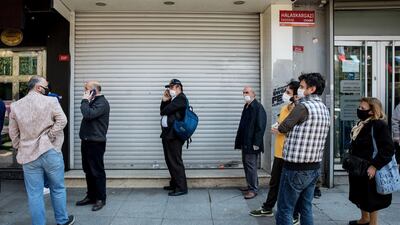
Customers wearing protective face masks maintain social distancing while queuing before the opening of a bank branch in Istanbul, Turkey, on Monday, April 27, 2020. Coming off a brief recession just over a year ago, the urgency is mounting for Turkey to loosen the screws on the economy as its currency and reserves come under pressure more than a month after it introduced social-distancing measures. Photographer: Kerem Uzel/Bloomberg -
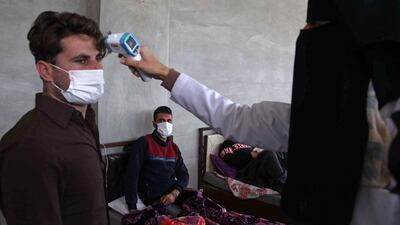
A health worker measures the temperature of a man at a quarantine facility for Syrians who returned from Turkey in the countryside of the town of Jisr al-Shughur, west of the mostly rebel-held Syrian province of Idlib, on April 27, 2020 amid the coronavirus COVID-19 pandemic. / AFP / Abdulaziz KETAZ -
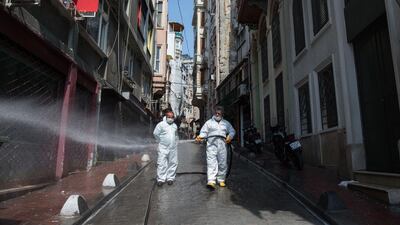
Istanbul Metropolitan Municipality workers spray a street with disinfectant to prevent the spread of coronavirus in Istanbul, Turkey, on Monday, April 27, 2020. Coming off a brief recession just over a year ago, the urgency is mounting for Turkey to loosen the screws on the economy as its currency and reserves come under pressure more than a month after it introduced social-distancing measures. Photographer: Kerem Uzel/Bloomberg -
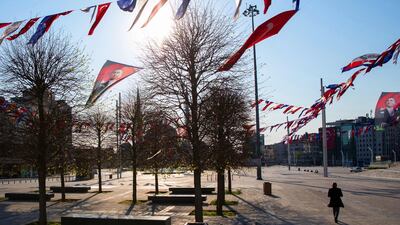
A lone pedestrian walks across an empty Taksim square during curfew in Istanbul, Turkey, on Sunday, April 26, 2020. Coming off a brief recession just over a year ago, the urgency is mounting for Turkey to loosen the screws on the economy as its currency and reserves come under pressure more than a month after it introduced social-distancing measures. Photographer: Kerem Uzel/Bloomberg