Volunteers working in the migrant camps in Calais have warned that the already grim conditions are being exacerbated by the coronavirus pandemic.
Clare Moseley, founder of Care4Calais, told The National that lockdown restrictions in France and the UK meant that charities had fewer volunteers and increased expenses as they tried to provide food and blankets through the crisis.
Aid groups have also confirmed continued police operations against migrants.
The camps at Calais and Dunkirk in northern France house international migrants, many of whom have travelled from North Africa or the Middle East. The camps are often used by migrants who want to reach the UK.
The English Channel is about 30km at its narrowest, but a crossing requires navigating through the busiest shipping lane in the world.
Calais is also home to the Channel Tunnel where migrants try to get rides underneath the sea with lorry drivers.
Care4Calais, a UK-based charity, said that during the French lockdown, which began on March 16, aid distribution had been slashed and government operations, such as waste collection, had reduced.
-

Aid work is back to the emergency priority of keeping people fed. Care4Calais -

A child migrant gets water at one of the camps of Calais and Dunkirk, northern France. Care4Calais -

Social distancing is not always possible in the camps. Care4Calais -

Care4Calais has fewer volunteers working. Care4Calais -

There has been few government services during the French lockdown. Care4Calais -

Forty percent of migrants at the sites have been there less than three months. Care4Calais


“We’re back to an emergency response of getting as much food and blankets as possible,” Ms Moseley said. “Other services like clothes have dropped off, meaning there were people who hadn’t changed clothes for six weeks.
“NGOs and government agencies have pulled out or cut back. Our volunteers are busier than ever just to get the food out.”
The bottom of society
Other services that might help improve circumstances for the migrants, such as English classes or haircuts, have also halted while the charity’s volunteers - down to nine from 20 - focus on the basic need of feeding them.
Ms Moseley said that 40 per cent of migrants in the camp had been there fewer than three months and were at the lowest level of society just trying to stay alive.
-

A migrant speaks to a Greek policeman during minor clashes at the port of Mytilene after locals block access to the Moria refugee camp, on the northeastern Aegean island of Lesbos, Greece. AP Photo -

Migrants travel on a horse carriage near the Turkey's Pazarkule border crossing with Greece's Kastanies, near Edirne, Turkey. REUTERS -
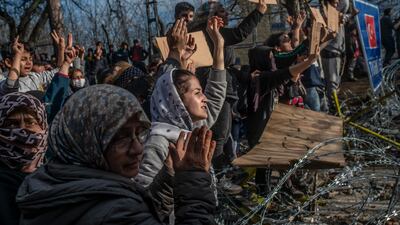
Migrants hold placards as they demonstrate, waiting at the buffer zone in front of the Pazarkule border crossing to Greece, in Edirne. AFP -

An aerial view shows refugees on road at Turkey's Pazarkule border crossing with Greece's Kastanies, southwest of Edirne. REUTERS -
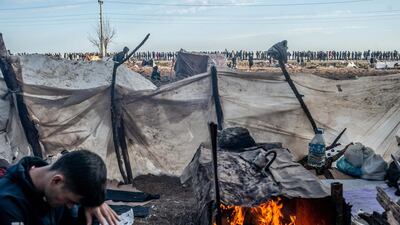
A migrant sits next to a bonfire as others wait for a food distribution in front of the Pazarkule border crossing to Greece, in Edirne. AFP -
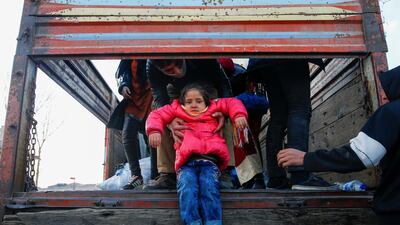
A migrant child is passed from a truck near the Turkey's Pazarkule border crossing with Greece's Kastanies, near Edirne, Turkey. REUTERS -
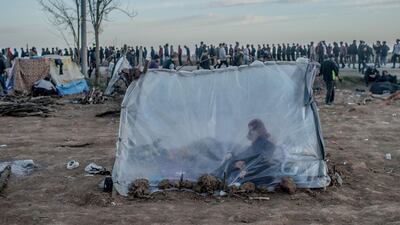
A Syrian woman sits in a tent with her son as others wait for food distribution in front of the Pazarkule border crossing to Greece, in Edirne. AFP -
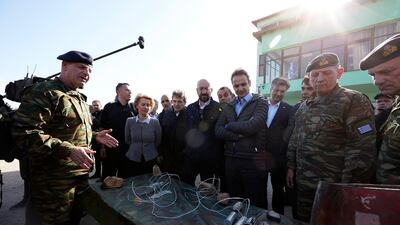
Greek Prime Minister Kyriakos Mitsotakis (4-R) with European Council President Charles Michel (C), European Commission President Ursula von der Leyen (3-L), European Parliament President David Sassoli (2-L) and Croatian Prime Minister Andrej Plenkovic (3-R) during a visit at the Greek-Turkish border in northern Greece. EPA -
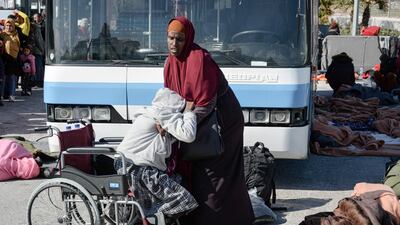
An elderly migrant woman is helped out of a wheelchair at the port of Mytilene on the northeastern Aegean island of Lesbos, Greece. AP Photo -
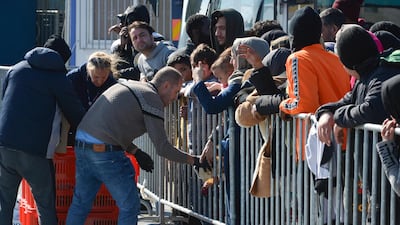
Migrants wait in line for food and water distribution at the port of Mytilene on the northeastern Aegean island of Lesbos, Greece. AP Photo -

Greek police in riot gear advance to push migrants away after minor clashes at the port of Mytilene on the northeastern Aegean island of Lesbos, Greece. AP Photo -

Greek police in riot gear stand before minor clashes with migrants at the port of Mytilene on the northeastern Aegean island of Lesbos, Greece. AP Photo


“When you’re at the bottom, it can be quite nasty,” she said. “It’s base survival.”
Care4Calais, in a report from the French camps, said: “The strain on our small team has been great, but the strain on the refugees is higher. They face great uncertainty and fear.
“We cannot comprehend why [police] clearances are continuing. The refugees cannot leave due to the French travel ban, and there cannot be anything more pointless and cruel than to evict someone who cannot leave.”
Other agencies have suffered similar problems. The German news organisation, DW, reported that at least 70 police evacuation operations have taken place since the start of the lockdown
Yann Manzi, a co-founder of the Utopia 56 charity, said: “You'd have thought we would all stand together in this crisis. But these vulnerable people are being left behind.”