
Turkey’s majority Kurdish south-east is at greater risk from the global coronavirus pandemic because of government neglect, according to the country’s Kurdish opposition party.
As well as a larger concentration of testing kits, ventilators and imported drugs in the cities to the west of the country, the Peoples' Democratic Party (HDP) claim that the medical facilities in the south east are insufficient for combatting the pandemic.
The key challenges facing the region in fighting Covid-19 include high rates of poverty, poor infrastructure, distrust in the government due to widespread government crackdowns on Kurdish mayors and a language barrier.
"For Kurdish cities, the situation is much worse [than the rest of the country]," the HDP's vice co-chair responsible for local administrations, Mr Salim Kaplan, told The National.
“The number of public hospitals in Kurdish cities, intensive care units and the number of doctors per person are quite insufficient for combatting the pandemic. Even now, all intensive care units are full in [the south-eastern city of] Batman.”
Turkey has the eighth highest number of cases in the world, with over 125,000 confirmed and more than 3,300 deaths. No up-to-date regional data is available, but the majority Kurdish south-east borders with Iran, the worst affected country in the Middle East, which has been criticised for not taking tough enough measures to stop the spread of the virus.
-
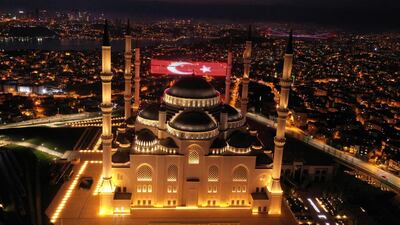
Mahya depicts Turkey's national flag which is installed between the minarets of Camlica mosque, as the outbreak of COVID-19 continues in Istanbul, April 28, 2020. Reuters -
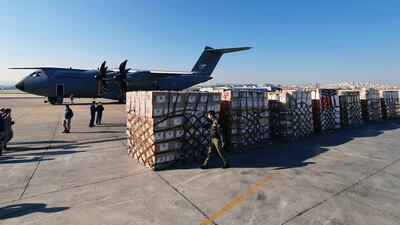
Turkish soldiers load medical protection equipment into a Turkish military cargo plane to be donated to the United States at the Etimesgut airport in Ankara, Turkey, April 28, 2020. EPA -

A flight crew member stands in front of a donation of medical supplies from Turkey on April 28, 2020, at Andrews Air Force Base, Maryland. The donation to help fight the new coronavirus in the United States included surgical masks, sanitisers and protective suits. AP Photo -
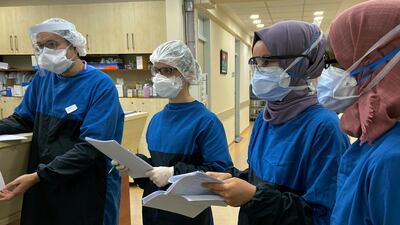
Medical personnel participate in a briefing at Istanbul University Cerrahpasa - Cerrahpasa Medical Faculty Hospital's ward dedicated to patients with coronavirus (COVID-19) in Istanbul, Tuesday, April 28, 2020. Turkey has seen a decline this week in the number of daily deaths and rates of infection since it started to grapple with the novel coronavirus pandemic last month. The government has refrained from imposing a total lockdown, fearing its negative impact on the already fragile economy. (AP Photo/Mehmet Guzel) -
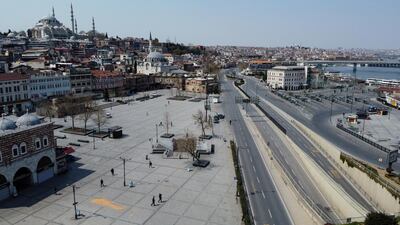
An aerial view of Eminonu district during a two-day curfew imposed to prevent the spread of the coronavirus in Istanbul, Turkey, on April 11, 2020. Reuters -
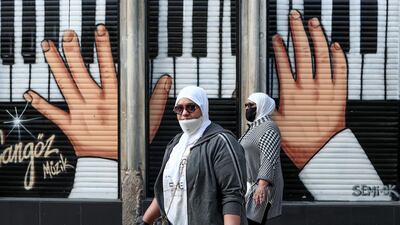
epa08392157 Women walk with face masks in Istanbul, Turkey, 29 April 2020. Turkish President Recep Tayip Erdogan announced that there will be another curfew in 31 big cities, including Istanbul (the country's most populous urban agglomeration), between 01-03 May due to the ongoing pandemic of the COVID-19 disease caused by the SARS-CoV-2 coronavirus. The government has also decreed the cancellation of public events and has temporarily shut down schools and suspended sporting events amid the pandemic. EPA/SEDAT SUNA -
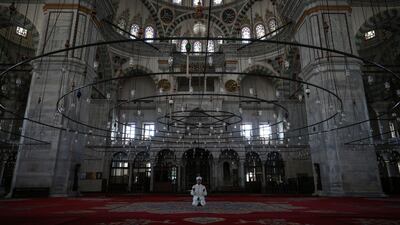
Esat Sahin, Imam of the iconic Fatih Mosque, holds a prayer held without public due to the coronavirus restrictions in Istanbul, April 24, 2020, during the first day of the holy fasting month of Ramadan. (AP Photo/Emrah Gurel) -
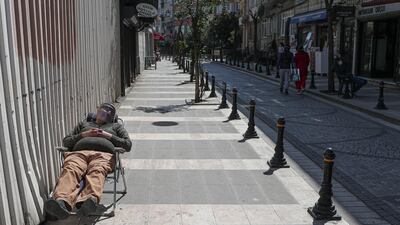
epa08392155 A man sleeps with face protective equipment on street in Istanbul, Turkey, 29 April 2020. Turkish President Recep Tayip Erdogan announced that there will be another curfew in 31 big cities, including Istanbul (the country's most populous urban agglomeration), between 01-03 May due to the ongoing pandemic of the COVID-19 disease caused by the SARS-CoV-2 coronavirus. The government has also decreed the cancellation of public events and has temporarily shut down schools and suspended sporting events amid the pandemic. EPA/SEDAT SUNA -
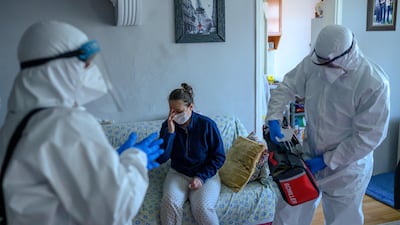
TOPSHOT - Health workers help a woman who tested positive for the novel coronavirus COVID-19, at Bagcilar in Istanbul, on April 28, 2019, in Istanbul. / AFP / Bulent Kilic -
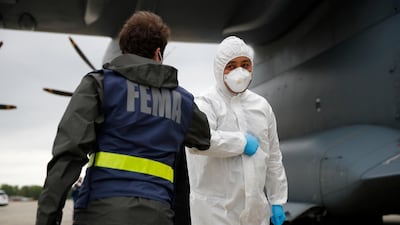
A Turkish military flight crew member, right, bumps elbows with a FEMA worker as crews unload a donation of medical supplies from Turkey, Tuesday, April 28, 2020, at Andrews Air Force Base, Md. The donation to help fight the new coronavirus in the United States included surgical masks, sanitizers and protective suits. (AP Photo/Patrick Semansky) -
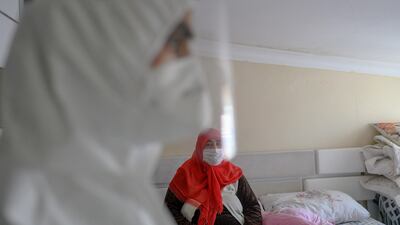
Health workers help a woman who tested positive for the novel coronavirus COVID-19, at Bagcilar in Istanbul, on April 28, 2019, in Istanbul. / AFP / Bulent Kilic -
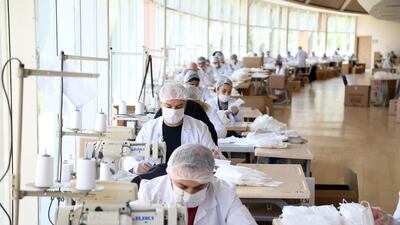
TOPSHOT - Employees of Ankara Metropolitan Municipality youth center sews face masks, in Ankara, Turkey, on April 28, 2020, amid the spread of the novel COVID-19 coronavirus. / AFP / Adem ALTAN -

Employees of Ankara Metropolitan Municipality youth center sews face masks, in Ankara, Turkey, on April 28, 2020, amid the spread of the novel COVID-19 coronavirus. / AFP / Adem ALTAN -
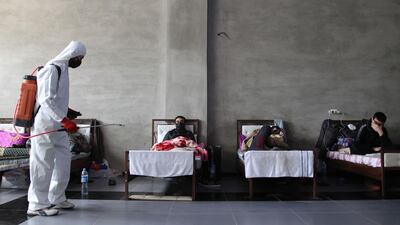
TOPSHOT - A man sanitises the room as Syrians who returned from Turkey rest at a quarantine facility in the countryside of the town of Jisr al-Shughur, west of the mostly rebel-held Syrian province of Idlib, on April 27, 2020 during the coronavirus COVID-19 pandemic. / AFP / Abdulaziz KETAZ -
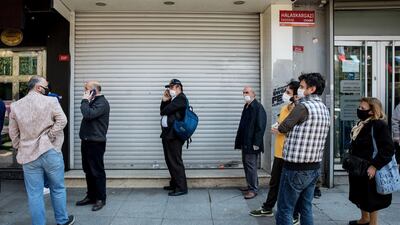
Customers wearing protective face masks maintain social distancing while queuing before the opening of a bank branch in Istanbul, Turkey, on Monday, April 27, 2020. Coming off a brief recession just over a year ago, the urgency is mounting for Turkey to loosen the screws on the economy as its currency and reserves come under pressure more than a month after it introduced social-distancing measures. Photographer: Kerem Uzel/Bloomberg -
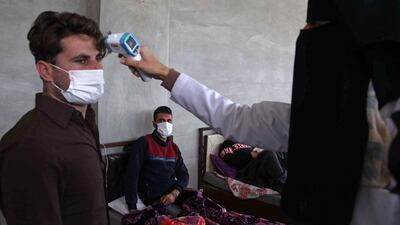
A health worker measures the temperature of a man at a quarantine facility for Syrians who returned from Turkey in the countryside of the town of Jisr al-Shughur, west of the mostly rebel-held Syrian province of Idlib, on April 27, 2020 amid the coronavirus COVID-19 pandemic. / AFP / Abdulaziz KETAZ -
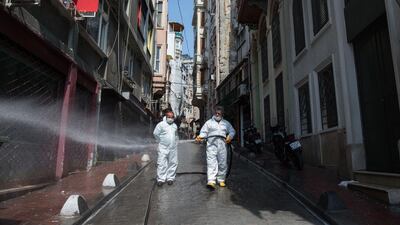
Istanbul Metropolitan Municipality workers spray a street with disinfectant to prevent the spread of coronavirus in Istanbul, Turkey, on Monday, April 27, 2020. Coming off a brief recession just over a year ago, the urgency is mounting for Turkey to loosen the screws on the economy as its currency and reserves come under pressure more than a month after it introduced social-distancing measures. Photographer: Kerem Uzel/Bloomberg -
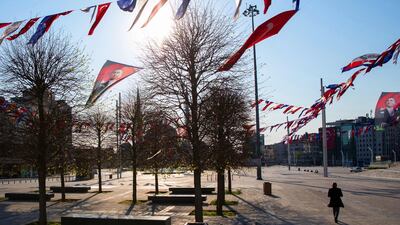
A lone pedestrian walks across an empty Taksim square during curfew in Istanbul, Turkey, on Sunday, April 26, 2020. Coming off a brief recession just over a year ago, the urgency is mounting for Turkey to loosen the screws on the economy as its currency and reserves come under pressure more than a month after it introduced social-distancing measures. Photographer: Kerem Uzel/Bloomberg


Many say the rate of testing in the south-east has been insufficient compared to the risk.
Mr Kaplan said that the distribution of sanitiser and masks, which have been given out for free elsewhere, is as low as 1 per cent in Kurdish regions of the country, despite the average person earning among the lowest wages.
According to the latest regional wage data from the Turkish Statistical Institute in 2018, cities in the Kurdish south east have the lowest disposable income in Turkey at under half of the national average.
Many people do not have the option of working from home and cannot afford to stop work.
“Even though Kurdish cities have the highest levels of poverty in the country, the government did not take economic measures to keep people at home,” said Mr Kaplan.
Widespread mistrust in the government has also hampered efforts to stop the spread of the pandemic, fuelled in part by the removal of elected HDP mayors from their posts by President Recep Tayyip Erdogan’s ruling Justice and Development Party (AKP).
They are detained on what are often described by rights groups as arbitrary charges under the country’s vague terrorism laws and replaced with unelected AKP trustees.
A representative of the ruling AKP declined to comment and the president’s office did not respond to correspondence.
Mehmet Demir, who was elected as co-mayor of Batman in 2019 with 66 per cent of the vote, was one of eight HDP mayors detained for several days and removed from their posts at the end of March. He was held for what the government said was suspicion of links to terrorists, in reference to the Kurdistan Workers' Party (PKK), a group that has fought an insurgency against the Turkish state for more than four decades. He disputes the accusations and says they were without justification.
Two thirds of the 59 municipalities who voted for the HDP at local elections last year have since been dismissed.
“Claims that they are giving out masks do not reflect the truth, and the fight against coronavirus seems to have turned political,” Mr Demir said in Turkish via email.
“There is no state support and people have to work. Since there are large family structures in our region there is a serious threat of the spread of the virus.
“Generally, the state's investment in the Kurdish region is security-led and disregards human life.”
Mr Kaplan said that the lack of services in Kurdish also contribute to distrust.
"Since the government has not provided services in our mother tongue, people can not properly benefit from health services. All the posters and pamphlets on coronavirus precautions are prepared in Turkish and most people do not understand. This has hampered the desired result of ensuring lockdown measures and maintaining social distancing," he said.
Nurcan Baysal, a Kurdish journalist based in Diyarbakir, one of the largest cities in the south-east, said the government's coronavirus response in the region has been the same as in other parts of the country, aside from the prioritised key cities, such as Ankara, the capital, and Istanbul, Turkey's largest. However, the problem is that there is a greater need for support, she said.
She also said that for many Kurdish people in the area, the pandemic is just one in a long line of threats to their way of life.
“After 2015, everything became ‘one language, one nation’ again. The state changed the Kurdish names of our parks and streets. Even wedding singers who sang in Kurdish were put in prison. Not only the language, but Kurdishness was forbidden,” she said.
That year, a ceasefire between the state and the outlawed Kurdistan Workers' Party (PKK) – which is classed as a terrorist organisation by Turkey and the EU – collapsed, leading to a string of deadly attacks and intense government operations.
"Hundreds of doctors were dismissed from their jobs in Kurdish cities with the accusation of having links with 'terrorist groups'. During the military curfews of 2015 and 2016, people witnessed terrible human rights violations and war crimes," said Ms Baysal.
“So there is this mood now in Kurdish people: ‘we have seen terrible things, coronavirus is not so important in comparison.’”

