Britain and the European Union are within touching distance of completing an historic trade agreement after years of negotiation, but an 11th-hour snag over fishing has held up the announcement.
A breakthrough had been expected this morning, but a press conference by UK Prime Minister Boris Johnson is yet to materialise.
It is understood that there has been a last-minute snag but it is not considered insurmountable.
The debate on how to attribute fishing rights in UK waters emerged as the final stumbling block once again, sending negotiators back into intense discussions dealing with quotas line by line, species by species.
Irish Foreign Minister Simon Coveney said on Thursday there appeared to be “some sort of last-minute hitch” over fish, but that it was not surprising.
"Hopefully Brexit for the first time in many, many months can provide us with some good news this Christmas Eve, later on today, that's the expectation," Mr Coveney told RTE in Dublin, as EU capitals waited for news.
Britain formally left the EU in January after a deeply divisive referendum in 2016, the first country to split from the political and economic project that was born as the continent rebuilt in the aftermath of the Second World War.
Mr Coveney, a veteran of the cross-Channel Brexit battles that erupted after the referendum, said a briefing of a working party on fish that had been due in Brussels had "also been postponed until later on today".
"So clearly they're still negotiating and still trying to finalise a deal," he said, as European officials in Brussels warned that any announcement was being pushed back by detailed haggling over quotas for EU crews in UK waters.
"There is a fight over the numbers and that is a bad sign," one European source said.
A French source close to the negotiations told AFP that France's President Emmanuel Macron was holding out against too hasty a settlement. "It is France that is blocking it. It is Macron himself," the source said.
"Nothing will be done if this agreement is not satisfactory for French fishermen, which is very convenient for other European fishermen and some other European countries who do not want to be in the front line and are happy that France is."
Earlier, a Whitehall source told The National it could be only "a matter of hours" before a deal was struck and said the two sides were close to agreeing terms.
The EU said talks are in their "final stages", while another British government source was cautious, saying: "Negotiations are ongoing."
An EU source told AFP that "if all goes well" the two leaders had been due to talk by phone early in the morning to seal the agreement.
"It will hopefully be an early start," European Commission spokesman Eric Mamer tweeted just after midnight, advising reporters and diplomats to grab some sleep as the finishing touches were applied.
A French government source said UK negotiators had made "huge concessions" on fisheries without confirming if it had been enough to clinch the deal.
One high-profile pro-Brexit organisation, the European Research Group, confirmed it would be looking closely at any deal.
As Wednesday evening discussions dragged on, large quantities of pizza were seen being delivered to EU headquarters and Mr Mamer tweeted a picture of the food, questioning which flavours had been ordered, with the caption: "Suspense ..."
UK government sources confirmed that Prime Minister Boris Johnson and EC President Ursula von der Leyen were in contact all day.
If a deal is reached, it would draw a line under almost five years of often tempestuous negotiations since Britain voted by 52 per cent to 48 per cent to withdraw from the EU in 2016 and lay the foundations for the nation to collaborate with the bloc in the future.
Any agreement still faces a race to be signed off by the EU's 27 member states before Britain ends a half-century of economic integration at midnight on December 31.
A deal – which would still need to be translated and tidied up by lawyers – could be approved provisionally before the cut-off date and then scrutinised by EU legislators in the new year to avoid a cliff-edge.
If, as expected, it provides for trade free from tariffs and quotas, the economic shock of breaking away from the EU’s single market and Customs union will be softened.
The Office for Budget Responsibility had forecast that a no-deal Brexit could wipe 2 per cent off gross domestic product – a measure of the size of the economy – in 2021, adding to the damage to jobs and livelihoods already caused by coronavirus.
Hundreds of lorries backed up around the southern English port of Dover this week were a sobering reminder of the potential consequences of ending Britain's transition period on December 31 without a deal.
-
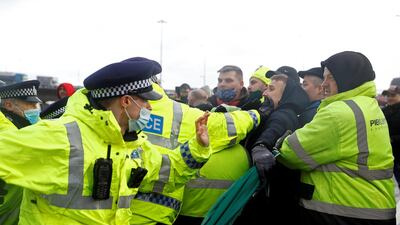
Police officers scuffle with drivers trying to stop trucks leaving the port and keep it closed until they are allowed to travel to Europe, at the Port of Dover, as EU countries impose a travel ban from the UK following the coronavirus disease (COVID-19) outbreak, in Dover, Britain, December 23, 2020. REUTERS/John Sibley -
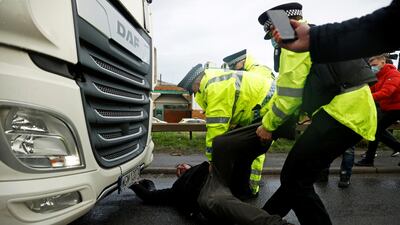
Police officers drag a person lying down in front of a lorry at the Port of Dover, as EU countries impose a travel ban from the UK following the coronavirus disease (COVID-19) outbreak, in Dover, Britain, December 23, 2020. REUTERS/John Sibley TPX IMAGES OF THE DAY -

epa08900880 Police stand at the entrance of the Port of Dover after freight lorries cannot cross by sea or through the Eurotunnel and the Port of Dover has closed to outbound traffic in Dover, Britain, 23 December 2020. France closed its border with the UK for 48 hours over concerns about the new coronavirus variant. Lorry drivers must now obtain negative coronavirus tests before they will be allowed to cross by sea and the Port of Dover remains closed to outbound traffic on the morning of 23 December 2020. EPA/FACUNDO ARRIZABALAGA -
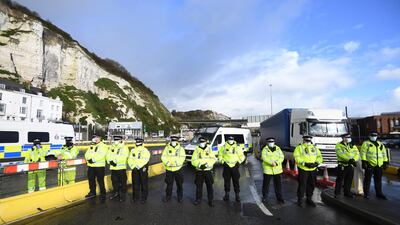
epa08900874 Police stand at the entrance of the Port of Dover after freight lorries cannot cross by sea or through the Eurotunnel and the Port of Dover has closed to outbound traffic in Dover, Britain, 23 December 2020. France closed its border with the UK for 48 hours over concerns about the new coronavirus variant. Lorry drivers must now obtain negative coronavirus tests before they will be allowed to cross by sea and the Port of Dover remains closed to outbound traffic on the morning of 23 December 2020. EPA/FACUNDO ARRIZABALAGA -

DOVER, ENGLAND - DECEMBER 23: Police officers attend to a man at the Port of Dover on December 23, 2020 in Dover, United Kingdom. Nearly 3,000 lorries were stranded around Kent after France banned all travel from the UK on Sunday, citing concerns over a new variant of covid-19. Late Tuesday, the countries reached a deal to restart freight travel for drivers with a recent negative covid-19 test. (Photo by Dan Kitwood/Getty Images) -

A person lies down in front of a lorry to stop it from leaving the Port of Dover, as EU countries impose a travel ban from the UK following the coronavirus disease (COVID-19) outbreak, in Dover, Britain, December 23, 2020. REUTERS/John Sibley -
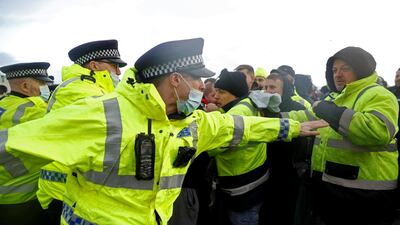
Police officers scuffle with drivers trying to stop trucks leaving the port and keep it closed until they are allowed to travel to Europe, at the Port of Dover, as EU countries impose a travel ban from the UK following the coronavirus disease (COVID-19) outbreak, in Dover, Britain, December 23, 2020. REUTERS/John Sibley -
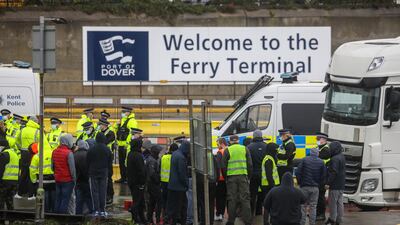
Police officers speak with truck drivers at the Port of Dover Ltd. in Dover, U.K. The European Commission called on member states to reopen critical trade and passenger transport links to the U.K. while discouraging non-essential travel, a step toward ending the chaos at Britain's busiest port. Bloomberg -
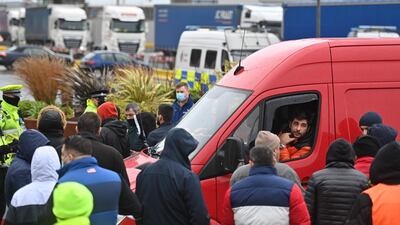
Drivers discuss by their vehicles in the road as they queue trying to enter the port of Dover in Kent, south east England, that is still cordoned after the UK and France agreed a protocol to reopen the border to accompanied freight arriving in France from the UK requiring all lorry drivers to show a negative Covid-19 test. France and Britain reopened cross-border travel after a snap 48-hour ban to curb the spread of a new coronavirus variant threatened UK supply chains. Accompanied frieght will now be allowed to cross the channel from the port of Dover but all lorry drivers will require a lateral flow test and a negative Covid-19 result before the travel. AFP -
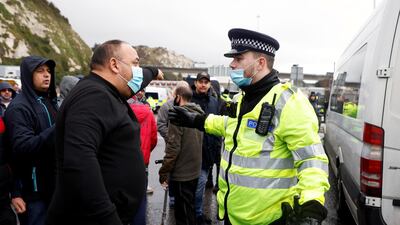
A driver talks with a police officer at the entrance of the Port of Dover, as EU countries impose a travel ban from the UK following the coronavirus disease (COVID-19) outbreak, in Dover, Britain, December 23, 2020. REUTERS/John Sibley -

Drivers talk with police officers at the entrance of the Port of Dover, as EU countries impose a travel ban from the UK following the coronavirus disease (COVID-19) outbreak, in Dover, Britain. REUTERS -
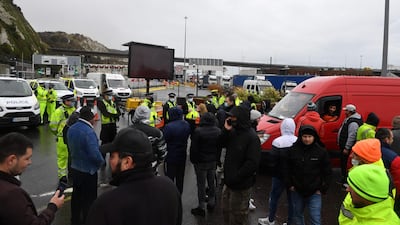
Drivers and their vehicles trying to enter the port of Dover, in Kent, south east England, block the road access as they not allowed to enter after the UK and France agreed a protocol to reopen the border to accompanied freight arriving in France from the UK. France and Britain reopened cross-border travel after a snap 48-hour ban to curb the spread of a new coronavirus variant threatened UK supply chains. Accompanied frieght will now be allowed to cross the channel from the port of Dover but all lorry drivers will require a lateral flow test and a negative Covid-19 result before the travel. AFP -
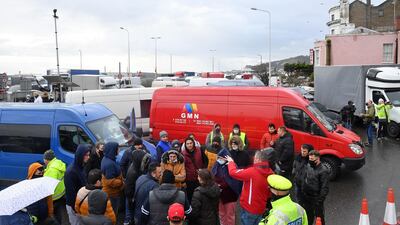
Drivers block the road by the entrance to the Port in Dover, in Kent, south east England on December 23, 2020, as they await lateral flow COVID-19 tests to arrive, before being allowed to enter, following an agreement between the UK and France to reopen the border to accompanied freight arriving in France from the UK. France and Britain reopened cross-Channel travel on Wednesday after a 48-hour ban to curb the spread of a new coronavirus variant but London has warned it could take days for thousands of trucks blocked around the port of Dover to get moving. / AFP / JUSTIN TALLIS -
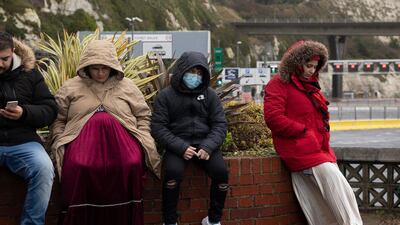
DOVER, ENGLAND - DECEMBER 23: Travellers to Europe wait at the Port of Dover on December 23, 2020 in Dover, United Kingdom. Nearly 3,000 lorries were stranded around Kent after France banned all travel from the UK on Sunday, citing concerns over a new variant of covid-19. Late Tuesday, the countries reached a deal to restart freight travel for drivers with a recent negative covid-19 test. (Photo by Dan Kitwood/Getty Images) -
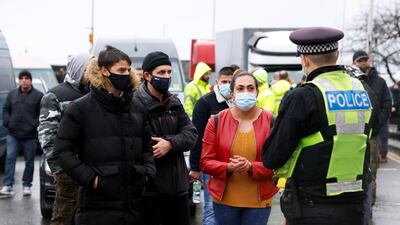
People wearing protective masks talk with a police officer at the entrance of the Port of Dover, as EU countries impose a travel ban from the UK following the coronavirus disease (COVID-19) outbreak, in Dover, Britain. REUTERS -

Police officers form a cordon at the entrance to the port in Dover, in Kent, south east England, after the UK and France agreed a protocol to reopen the border to accompanied freight arriving in France from the UK. France and Britain reopened cross-border travel after a snap 48-hour ban to curb the spread of a new coronavirus variant threatened UK supply chains. Accompanied frieght will now be allowed to cross the channel from the port of Dover but all lorry drivers will require a lateral flow test and a negative Covid-19 result before the travel. AFP -

Travellers to Europe are stopped by police officers at the Port of Dover in Dover, United Kingdom. Nearly 3,000 lorries were stranded around Kent after France banned all travel from the UK on Sunday, citing concerns over a new variant of covid-19. Late Tuesday, the countries reached a deal to restart freight travel for drivers with a recent negative covid-19 test. Getty Images -
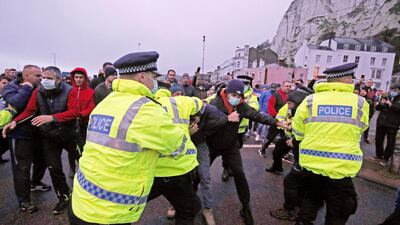
Truck drivers scuffle with police trying to hold them back at the entrance to the Port of Dover, in Kent, England. Freight from Britain and passengers with a negative virus test began arriving on French shores Wednesday, after France relaxed a two-day blockade over a new virus variant that had isolated Britain, stranded thousands of drivers and raised fears of shortages. AP -

Truck drivers discuss with police holding them back at the entrance to the Port of Dover, in Kent, England. Freight from Britain and passengers with a negative virus test began arriving on French shores Wednesday, after France relaxed a two-day blockade over a new virus variant that had isolated Britain, stranded thousands of drivers and raised fears of shortages. AP -

A woman and child stand in front of police officers at the Port of Dover on December 23, 2020 in Dover, United Kingdom. Nearly 3,000 lorries were stranded around Kent after France banned all travel from the UK on Sunday, citing concerns over a new variant of covid-19. Late Tuesday, the countries reached a deal to restart freight travel for drivers with a recent negative covid-19 test. Getty Images -
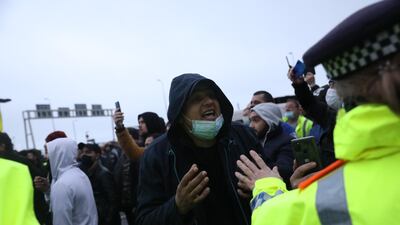
A man speaks to a police officer at the Port of Dover on December 23, 2020 in Dover, United Kingdom. Nearly 3,000 lorries were stranded around Kent after France banned all travel from the UK on Sunday, citing concerns over a new variant of covid-19. Late Tuesday, the countries reached a deal to restart freight travel for drivers with a recent negative covid-19 test. Getty Images -
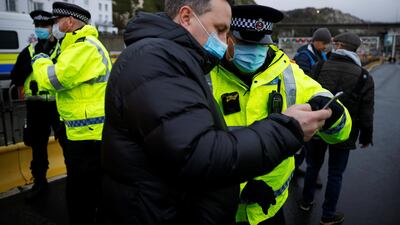
A driver talks with a police officer next the exit of the Port of Dover, as EU countries impose a travel ban from the UK following the coronavirus disease (COVID-19) outbreak, in Dover, Britain, December 23, 2020. REUTERS -

Truck drivers argue with police holding them back at the entrance to the Port of Dover, in Kent, England,. Freight from Britain and passengers with a negative virus test began arriving on French shores Wednesday, after France relaxed a two-day blockade over a new virus variant that had isolated Britain, stranded thousands of drivers and raised fears of shortages. AP -
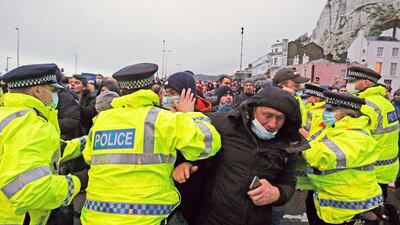
Truck drivers argue with police holding them back at the entrance to the Port of Dover, in Kent, England. Freight from Britain and passengers with a negative virus test began arriving on French shores Wednesday, after France relaxed a two-day blockade over a new virus variant that had isolated Britain, stranded thousands of drivers and raised fears of shortages. AP


Negotiations resumed early on Wednesday in Brussels, with discussions focused on EU boats' access to British waters, and EU rights to impose retaliatory tariffs should Britain limit that access in future.
Both sides made an agreement on fishing a precondition for any wider deal over their future relationship, even if the fish worth £586 million caught by European boats in UK waters each year is a fraction of the £462bn in goods traded annually between Britain and the EU.
Michel Barnier, the bloc’s chief negotiator, told a meeting of ambassadors from the 27 member states on Tuesday that there had been progress and a deal could be signed before Christmas – if the British were prepared to compromise further on fishing, according to diplomats briefed on the discussions.

Senior EU officials said the decision lay with Mr Johnson, while sources on the British side said the onus was on the Europeans.
Diplomats in the EU’s working group discussed how a potential agreement could be put into effect by January 1, even though there is not enough time for formal ratification by the EU Parliament.

If an agreement is struck, the commission will publish the draft text and send it to member states and the European Parliament, which will have two days to discuss and approve the draft.
Watching for Brexit details
The ERG said it would examine any deal carefully. “Assuming a deal between UK and the EU is officially confirmed, the European Research Group will reconvene the panel of legal experts, chaired by Sir William Cash MP, to examine the details of the deal and legal text,” the group said.
The team of highly-experienced lawyers, previously known as the star chamber, was first assembled in 2019 to examine the legal aspects of Theresa May’s original Withdrawal Agreement.
“Given that the new agreement is also highly complex, the star chamber will scrutinise it in detail to ensure that its provisions genuinely protect the sovereignty of the United Kingdom after we exit the transition period at the end of this year.”
But it is not only hardcore Eurosceptics who could be critical of a deal.
Lord Barwell, former UK prime minister Theresa May’s chief of staff, said “the truth is the deal means the introduction of significant barriers to free trade” through customs and regulatory checks.
But he said: “It is better than no deal and we could certainly do with some good news."