Iranian Foreign Minister Javad Zarif accused the US of "fuelling mayhem" in the Middle East because of its "arrogance and ignorance" as tensions between the two countries peak following the killing of a top military commander Qassen Suleimani.
Speaking at a gathering of global diplomats and policymakers on the second day of India's flagship geopolitical Raisina Dialogue in New Delhi, Mr Zarif said that the US harboured a myopic vision of the region and expected people in Tehran to celebrate the killing of the military leader.
Instead, it rallied support for the leadership, although there were protests later over the mistaken downing of a Ukrainian passenger flight, which killed 176 Iranian and foreign nationals.
Mr Zarif and Russian Foreign Minister Sergey Lavrov attended the event as global efforts to de-escalate tensions between the US and Iran are under way.
"This ignorance and arrogance has been fuelling mayhem in the region, not just in Iraq,” Mr Zarif said.
“The US looks at everything from their own perspective and not from the perspective of the people in (the) region."
Sulemani, the head of Iran’s elite Quds Force, was killed in a drone strike by US forces outside Baghdad airport in early January, leading to fraught relations across the region.
Iran retaliated by launching over a dozen ballistic missiles strikes at least two bases where US military and coalition forces are stationed in Iraq.
Mr Zarif said Suleimani had been in Iraq to deliver a diplomatic message to its prime minister and to calm Iraqis who were enraged by the US killing of 25 members of Iran-backed militia forces in response to the death of an American contractor.
He also claimed that the killing was not in response to attacks on the US embassy in Baghdad in the preceding days, but had been organised seven months before.
-
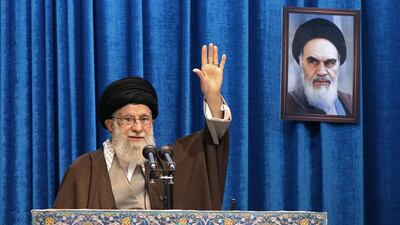
Iran's Supreme Leader Ayatollah Ali Khamenei greets the crowds during Friday prayers in the capital Tehran. AFP -
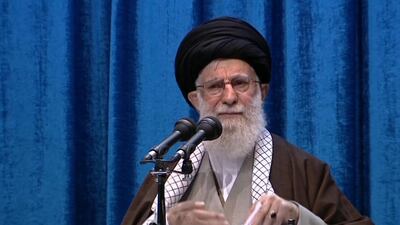
An image grab from footage obtained from the state-run Iran Press news agency on January 17, 2020 shows Iran's supreme leader Ayatollah Ali Khamenei leading the main weekly prayers in Tehran. AFP -
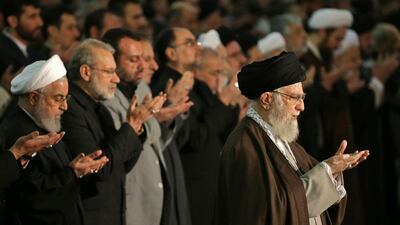
Khamenei used this platform to attack the US and Europe and to defend the IRGC over the downing of a Ukrainian passenger plane in Tehran, killing all 176 on board. AFP -
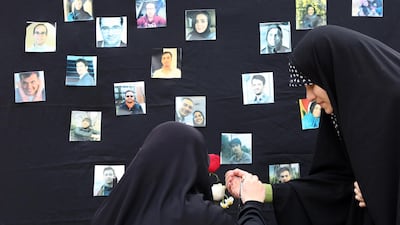
Students light candles during a memorial ceremony for passengers of Ukraine airplane, at the Tehran university in Iran. EPA -
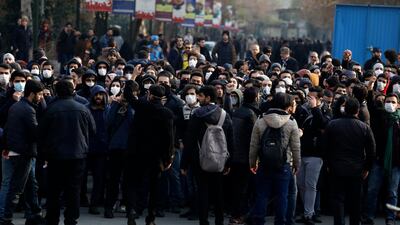
Anti-government protesters attend a demonstration blaming the government for the delayed announcement of the unintentional downing of a Ukrainian plane last week, at the Tehran University campus. AP Photo -
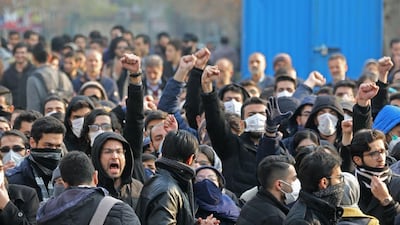
Students gather for a demonstration over the downing of a Ukrainian airliner at Tehran University. AFP -
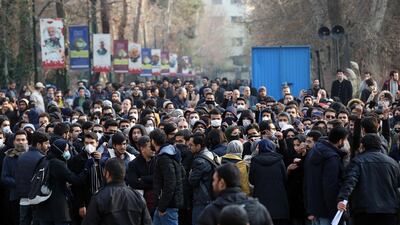
Students protest to show their sympathy to victims of Ukraine International Airlines Boeing 737-800 at the Tehran University. EPA -

Students gather for a demonstration over the downing of a Ukrainian airliner at Tehran University. AFP -
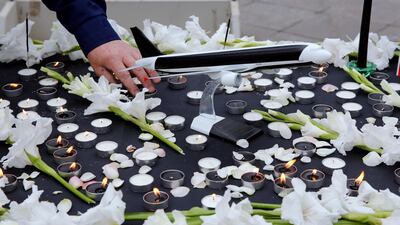
Students light candles during a memorial ceremony for passengers of Ukraine airplane at the Tehran university. EPA -
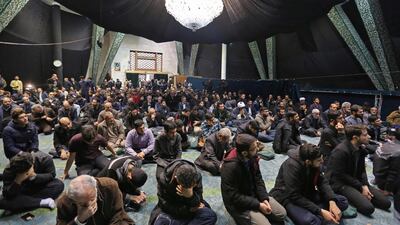
Students attend a memorial for the victims of the Ukraine plane crash, in University of Tehran. AFP -
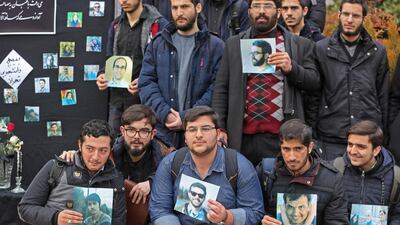
Students hold pictures of victims during a memorial for the passengers of the Ukraine plane crash in University of Tehran. AFP


On the shooting down of the Ukrainian flight, he said it had been a "mistake" but blamed the unrest created by the US for the disaster.
“Why did that happen? Because there was a crisis,” he said, adding that Suleimani’s assassination has come as a setback in the war against ISIS, which he helped to fight against.
He also spoke of the despair among the young generation in Iran as the country has incurred hundreds of billions of dollars in damages since the US imposed sanctions two years ago, crippling the economy.
The International Monetary Fund estimated that Iran’s economy is contracting at a rate of 9.5 per cent a year. Oil exports were effectively zero in December and inflation is running at nearly 40 per cent.
“The US has never brought peace and stability in the region,” he said.
His views were echoed by his Russian counterpart Mr Lavrov, who expressed concerns over the unrest in the region and promised Russia would make efforts to maintain peace.
“We are very concerned with what is going on in the [Arabian] Gulf," he said, suggesting that the Gulf countries collaborate on a joint security mechanism.
“We have been suggesting to the Gulf countries that they start thinking about collective mechanisms, starting with confidence building measures and military exercises,” he said.
Mr Lavrov also expressed hopes for a resolve in Libya, a day after Field Marshal Khalifa Haftar, who is fighting to push militias out of the capital Tripoli, left Moscow without signing an agreement that would have formalised a tentative ceasefire.
Russia and Turkey attempted to broker a ceasefire between Field Marshal Haftar and Fayez Al Sarraj, prime minister of the Government of National Accord in Tripoli.