India began relocating thousands of villagers and halted port operations ahead of an "extremely severe" cyclone expected to hit its east coast this week, piling pressure on emergency services grappling with the coronavirus pandemic.
Cyclone Amphan, expected to make landfall on Wednesday, comes as India eases the world's longest lockdown, imposed in April against the virus, which has infected more than 96,169 people and killed 3,029.
"The extremely severe cyclonic storm Amphan ... is likely to gain more strength and intensify further into a super cyclonic storm in the next 12 hours," weather officials said, forecasting heavy rain in eastern and southern areas.
The storm is expected to bring winds of 155-165 kilometres per hour, with gusts of up to 185kph.
The eastern states of Odisha and West Bengal sent disaster management teams to move families from homes of mud and thatch to places of shelter from the cyclone, which is expected to gain strength as it moves across the Bay of Bengal.
"We have to evacuate people from low-lying areas, and protect them from the coronavirus too," said a senior official of India's home ministry.
"It's not an easy task."
Authorities at the port of Paradip in Odisha ordered ships to move out to sea to avoid damage as the cyclone formed over the Bay of Bengal was likely to intensify into a super cyclonic storm.
"Operations have been wound down," said Rinkesh Roy, chairman of the Paradip Port Trust. "We are clearing the port."
Prime Minister Narendra Modi is set to hold a meeting in New Delhi to plan how to mitigate damage and injuries from the storm.
India's meteorological department said Amphan was very likely to cross the coast between Digha in West Bengal and Bangladesh's Hatiya Islands during the afternoon or evening of May 20. Weather officials in Bangladesh said the cyclone could make landfall there between the major cities of Khulna and Chittagong as early as Tuesday night.
The cyclone season in the Bay of Bengal usually runs from April to December, with severe storms displacing tens of thousands, causing widespread death and damage to crops and property, both in India and neighbouring Bangladesh.
India, with a coastline of 7,516 kilometres, gets hit by more than a tenth of all the world's tropical cyclones, the bulk of them hitting its eastern coast around the Bay of Bengal.
_____________
Gallery: Typhoon Vongfong hits the Philippines
-
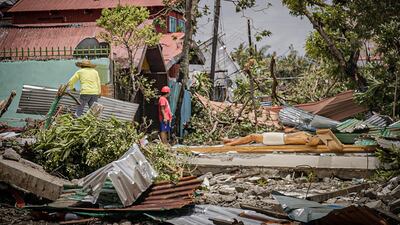
Residents stand amongst debris and next to a huge crucifix blown from the church after it was destroyed at the height of Typhoon Vongfong in Arteche town, Eastern Samar province. AFP -
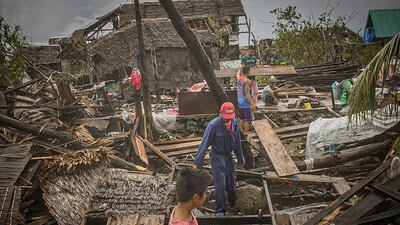
Residents try to salvage belongings in San Policarpio town, Eastern Samar province. AFP -

Filipino villagers reinforce their homes in anticipation of Typhoon Vongfong at a coastal village in Cavite, Philippines. EPA -

Residents try to salvage belongings in San Policarpio town, Eastern Samar province. AFP -
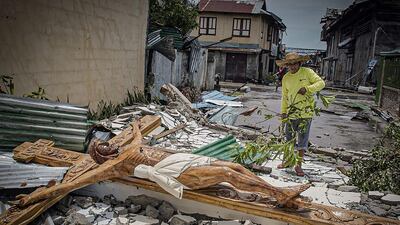
A resident clears a street of debris in Arteche. AFP -
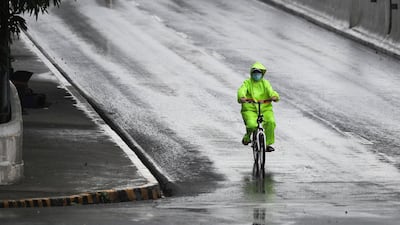
A man wearing a protective mask and raincoat rides his bicycle during rain caused by Typhoon Vongfong in Manila, Philippines. AP -

Residents ride a boat along a flooded village as Typhoon Vongfong passes by Sorsogon province, Philippines. AP -
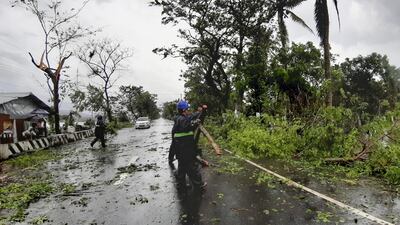
Workers clear a road of trees and branches in Sorsogon province, eastern Philippines. AP -
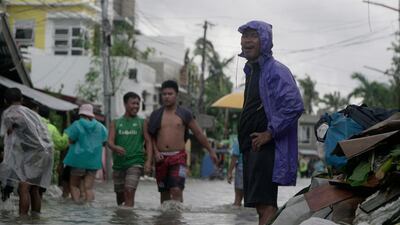
Residents wade from floodwaters in a flooded village in Sorsogon province. AP -

A general view of trees being blown by heavy winds during Typhoon Vongfong in San Francisco, Quezon province, Philippines. Reuters