


Indian Prime Minister Narendra Modi will this weekend launch the country’s most ambitious wildlife project as the nation reintroduces long-extinct cheetahs to the wild after seven decades.
Eight cheetahs — five females and three males — are being flown from Namibia to central Madhya Pradesh state where they will initially be kept in safe enclosures before being released into the 748-square-kilometre protected area of Kuno National Park.
Mr Modi will launch the cheetah reintroduction project on Saturday afternoon at a glitzy event that coincides with the leader’s 72nd birthday.
“A mistake should be rectified. Cheetahs became extinct in India due to overhunting. We have decided to bring the large carnivore back. This ecological wrong is being undone," Environment Minister Bhupender Yadav said on the eve of the ceremony on Friday.
A 12-kilometre fence has been erected to keep predators away from the park and a 50-metre by 30-metre enclosure has been set up for the animals who will be in quarantine for a month while they adapt to their new environment before being released into a larger enclosure.
At Sheopur, 20 kilometres from the sprawling park, a habitat of leopards, a huge stage has been set and giant posters of Mr Modi erected next to a motorway.
Thousands of security force personnel are deployed and huge crowds of locals have already started gathering at the site to witness the moment Mr Modi will inaugurate the much-awaited project.
India has a remarkable track record in the conservation of endangered wild cats, including Asiatic lions and tigers ― which reached the point of extinction but have steadily increased over the past decade.
The country is home to nearly 80 per cent of the world’s tiger population and is the only home of the majestic Asiatic lion.
The extraordinary plan to reintroduce the cheetahs into the wild will further boost the country's wildlife conservation efforts.
The Indian sub-continent was once home to thousands of Asiatic cheetahs but centuries of rampant hunting resulted in their extinction.
An estimated 10,000 cheetahs were hunted, including the last three cats, which were killed by a local king in central India in 1947.
The animal was declared extinct in India in 1952.
-
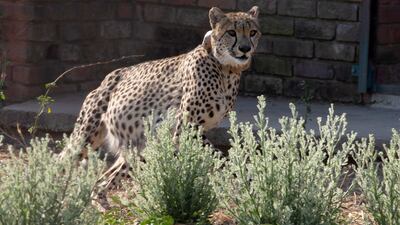
A cheetah runs inside a quarantine section before being relocated to India next month, at a reserve near Bella Bella, South Africa. South African wildlife officials have sent four cheetahs to Mozambique this week and plan to send more cheetahs to India next month. All photos by AP -

Wildlife veterinarian Andy Frasier darts a cheetah to be tranquilised and loaded into a crates, at a reserve near Bella Bella, South Africa. -
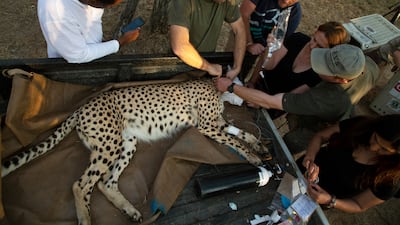
A tracking device is fitted onto a cheetah's neck by manager of the Cheetah Metapopulation Initiative, Vincent van Der Merwe, second from left, at a reserve near Bella Bella, South Africa. -
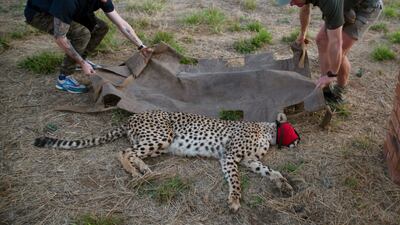
A male cheetah is loaded onto a stretcher after being tranquilised by wildlife veterinarian, Andy Frasier, right, at a reserve near Bella Bella, South Africa. -

A tranquilised cheetah is loaded into a cage by wildlife veterinarian staff at a reserve near Bella Bella, South Africa. -
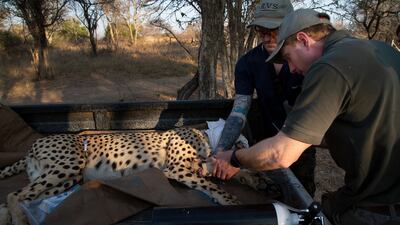
A tranquilised cheetah is attended to on the back of a vehicle after being darted at a reserve near Bella Bella, South Africa. -
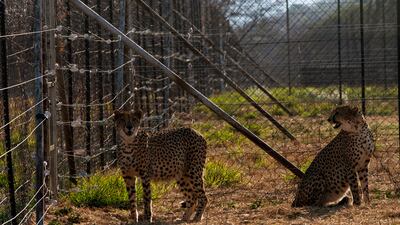
Two cheetahs inside a quarantine section at a reserve near Bella Bella, South Africa.


The large exotic carnivorous cats are known for having impressive athletic frames and their remarkable running speed, which can reach up to 110-120 kilometres per hour.
About 7,000 of them remain worldwide, mostly distributed in the grasslands of South Africa, Namibia and Botswana.
An estimated 70 cats from the Asian sub-species are in Iran.
For decades, the Indian government has been making efforts to reintroduce the animals from Africa in an attempt to diversify the ecosystem, because the predators are one of the most successful hunters.
“Predators play an important role in any ecosystem. They keep prey species healthy by killing the weak and old individuals,” according to the Cheetah Conservation Fund, the Namibian partner agency helping the Indian government to relocate the animals.
“They also act as a population check, which helps plants-life by preventing overgrazing,” the fund said.
India has previously lobbied the Iranian government unsuccessfully to translocate a few animals, which led to a long legal battle before the country’s top court that initially stalled relocation plans.
But, after the court’s approval for the reintroduction in 2018, India signed a pact with the Namibian government in July this year to bring 50 cheetahs from the African nation.
More cats from South Africa are scheduled to arrive in the coming months.
The animals will be brought to western Jaipur city in a customised plane from Windhoek on Saturday. Covering more than 8,000 kilometres in 20 hours, they will later be transported in helicopters to the sprawling park.

