A spate of odd headlines is dominating the US news cycle, thanks to fighter jets shooting down a Chinese "spy balloon" and the subsequent destruction of three still-to-be-identified aerial objects that were spotted floating high across North America.
President Joe Biden addressed the phenomena on Thursday, saying he hoped to speak to Chinese President Xi Jinping to "get to the bottom" of things. China says its balloon, which US F-22 jets shot down off the coast of South Carolina on February 4, was being used only to monitor the weather.
But the US says the huge vessel — 60m across — was carrying a surveillance platform the size of three buses and was being used to snoop on sensitive military installations and over nuclear sites across America's heartland.
“I make no apologies for taking down that balloon,” Mr Biden said.
According to US officials, the three subsequent shoot-downs were of much smaller objects, and these are not thought to be Chinese.
At first, the Pentagon could not identify how they were being kept aloft, prompting internet speculation that they may have been extraterrestrial in origin.
But the White House moved to debunk these theories, and Mr Biden on Thursday said the objects are not Chinese spy craft but are "most likely balloons tied to private companies, recreation or research institutions".
We won't know what the three objects were until the US military finds wreckage from the vessels, which were shot down over rugged, remote and frigid terrain in Canada, the US state of Alaska, and over Lake Huron, which straddles the two countries.
Americans are alarmed that China, a top economic and potential military rival, was able to send a balloon over the US.
But this is not the first time an adversary has taken advantage of the prevailing winds from Asia to North America. And Americans have long been enthralled with the idea of alien spaceships visiting the country.
Japanese exploding balloons
During the Second World War, the Japanese tried to use the powerful west-to-east jet stream, which rips across the northern part of the Pacific Ocean, to bomb America.
Working day and night for more than two years, Japanese engineers developed a type of large balloon that could carry a payload of explosives and incendiary devices over more than 5,000km of open ocean.
The bombs were designed to explode over American cities, setting off fires and bringing terror and destruction to the civilian population. Ultimately, however, strict US government censorship of the balloons meant few Americans knew about them.
-

In this January 10, 1945 photo, military personnel re-inflate and inspect a recovered Japanese explosive balloon. Photo: US Army -

Japanese girls helping to make explosive balloons. Photo courtesy of the Robert Mikesh Collection, National Museum of the Pacific War. -
A Japanese explosive balloon is inflated. Photo courtesy of the Robert Mikesh Collection, National Museum of the Pacific War. -
A US description of a recovered incendiary bomb found in California. Photo courtesy of the Robert Mikesh Collection, National Museum of the Pacific War. -
The payload of an explosive balloon shows sandbags and a bomb. Photo courtesy of the Robert Mikesh Collection, National Museum of the Pacific War.


According to the Smithsonian Institution, the Japanese built nearly 10,000 of these vessels from laminated paper glued together with a substance made from potatoes, but only a fraction apparently reached the US. Many were shot down by US warplanes or else blown off course into remote, unpopulated areas.
Much of the labour involved in making these balloons, which were filled with hydrogen, was provided by conscripted school children.
"Nearly 285 sightings and fragment findings have been recorded in North America," the Smithsonian said. "This was the first and only attack upon the American continent directly from an enemy homeland."
An explosive balloon that landed in a wooded area near Lakeview, Oregon, killed six people when an 11-year-old girl found the device. Not knowing what it was, she called other people near and it exploded when she pulled on one of its strings.
A monument to those killed marks the location.
Japan's exploding balloon programme was considered unsuccessful, but it nonetheless was the only time a foreign adversary has bombed America using aircraft.

Mysterious airships
America had a fascination with rogue airships that pre-dated the Japanese attacks by decades.
Between 1876 and 1897, Americans in California, Texas, and midwestern states reported seeing mysterious airships, sometimes festooned with bright lights.
Witnesses reported that the large vessels zipped along at speeds unheard of at the time, and the craft were thought to be years ahead in design and capability compared with any of the clumsy airships that had been built in the 19th century.
Ultimately, the most likely explanation for these airships was that the sightings were hoaxes and newspaper coverage fuelled a sort of mass hysteria, with some purported witnesses even claiming to have seen otherworldly creatures on board.
America has been fascinated by the possibility of UFOs and alien visitors ever since.
The strange events of the past few weeks underscored how unidentified aerial phenomena are now a matter of serious Pentagon study.
Mr Biden started receiving intelligence briefings on the issue in June 2021, the same year that a government report documented more than 140 cases of unidentified aerial phenomena, or UAPs, that US military pilots had observed since 2004.
Mr Biden on Monday directed an interagency team to study the "broader policy implications" of UFOs.
Unexplained aerial phenomena, better known as UFOs - in pictures
-
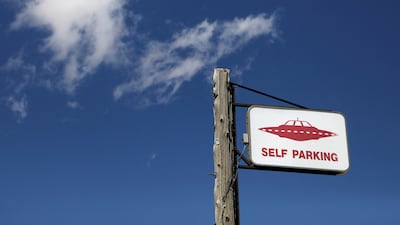
A parking sign at the Little A'Le'Inn in Rachel, Nevada. Reuters -
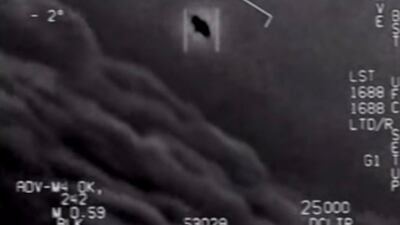
A video grab image obtained on April 28, 2020, shows part of a video taken by Navy pilots in which 'unidentified aerial phenomena' can be seen. AFP -
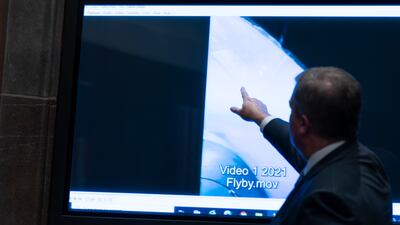
Deputy Director of Naval Intelligence Scott Bray points to a video display of an unexplained aerial phenomenon during a 2022 hearing. AP -
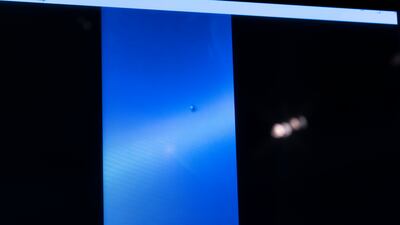
A video of a UAP is paused for display during the hearing. AP -

Mr Bray speaks before a subcommittee of the House Intelligence Committee on 'unidentified aerial phenomena', commonly known as UFOs. EPA -
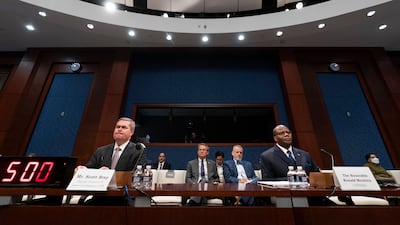
Mr Bray and Mr Moultrie speak during the hearing. AP -
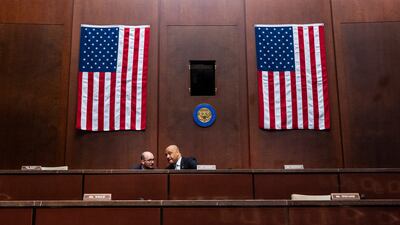
Andre Carson, a Democratic representative from Indiana, waits to lead a subcommittee of the House Intelligence Committee during a hearing on UAPs. EPA -

Under Secretary of Defence for Intelligence and Security Ronald Moultrie speaks at the hearing. EPA -
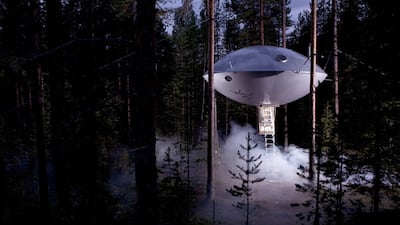
Tree Hotel in Swedish Lapland offers eight unique cabins, including this UFO. Photo: Tree Hotel -
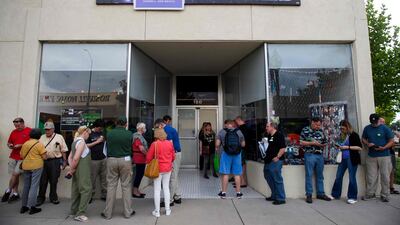
People wait to listen to a panel of UFO experts at the International UFO Museum and Research Centre during the UFO Festival in Roswell, New Mexico. AFP -
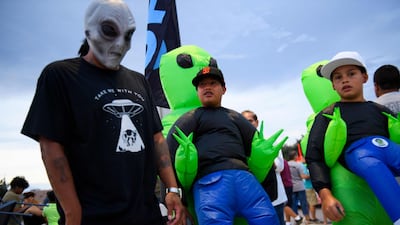
People in costume after the Abduction Parade during the UFO Festival in Roswell. AFP -

People wear tin foil hats during the UFO Festival. AFP -
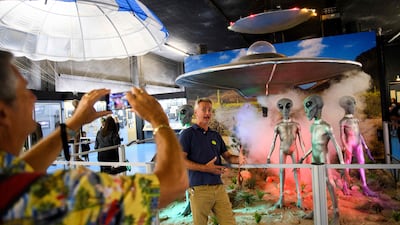
People take pictures of exhibits at the International UFO Museum and Research Centre. AFP -
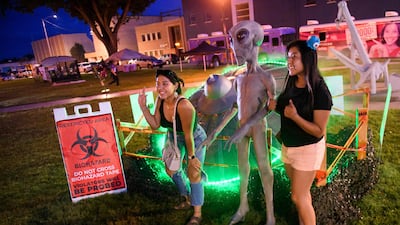
People take pictures at the Roswell festival. AFP -
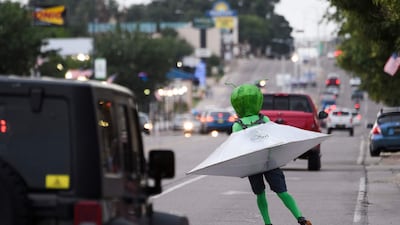
A person wearing an alien costume roller skates through traffic down Main Street during the UFO Festival. AFP -
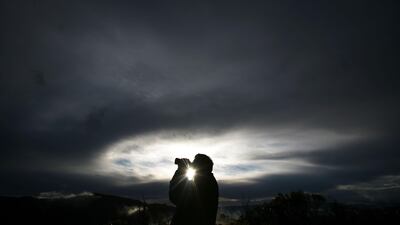
A UFO spotter scans the sky at a popular UFO spotting area in Katoomba, Australia. Photo: Ian Waldie