Musicians Michelle Brown and Mark Lloyd give away a free T-shirt as they perform a two-hour concert in Dubai for the US military on the USS Portland, January, 1991. The ship was docked close to Port Rashid. Courtesy: Michelle Brown
American military personnel on the USS Portland for a concert in January, 1991. Courtesy: Michelle Brown
The Abu Dhabi Choral Group and Barbershop Quintet entertaining US airforce troops at Al Dhafra airbase, Christmas 1990. Courtesy: Christine Rendel
Christine Rendel went from Abu Dhabi to Kuwait in March, 1991, to bring medical assistance. Ms Rendel was director of nursing a major hospital in Abu Dhabi then. Courtesy: Christine Rendel
Fires from uncapped oil wells in Kuwait. Courtesy: Christine Rendel
Kuwait airport was severely damaged during the war. Courtesy: Christine Rendel
Christine Rendel with a burns patient at the Ibn Sina Hospital in Kuwait. Courtesy: Christine Rendel
Life went on in the UAE during the war, and the annual Abu Dhabi Raft Race took place in 1991. Many residents past and present speak of a resilience. Courtesy: Christine Rendel
In the first of a two-part series to mark the 30-year anniversary of the liberation of Kuwait, we speak to residents who lived in the UAE during the time. The second part will focus on the UAE's role in the battle.
In the early hours of January 17, 1991, the phone rang at Christine Rendel’s Abu Dhabi home.
“Ms Rendel,” a grave voice said. “The war has begun.”
The call came from her manager at the city’s Al Jazirah hospital where Ms Rendel was director of nursing. Things would never be the same again.
Thirty years on from Desert Storm - the US-led airwar to drive Iraqi regime forces out of Kuwait – UAE residents have been reflecting on the uncertainty, fear and resilience that pervaded the country then. Some left, others kept the car full of petrol with a supply of water in the back should events turn serious but many stayed.
Military pick-ups with heavy machine guns were parked at most road junctions
“The build-up was very intense,” says Michelle Brown, a UK resident who was a singer at the now demolished Hilton Hotel beside the Dubai World Trade Centre. “The big fear was that the trade centre could be targeted.” The punishing aerial campaign quickly put Saddam Hussein’s forces on the back foot. Within a week, regime forces began dumping Kuwaiti oil into the Gulf and torching hundreds of oil wells as they retreated.
“Shamal winds blew the smoke in a haze down to the Gulf,” says Harry Bonning, a British resident who lived here then. “The sky had a thin, dirty brown appearance and you could smell the smoke. What made it worse was when it rained, your car ended up with oily spots all over it.”
Abu Dhabi TV and Dubai TV began relaying CNN, which was covering the war 24 hours a day. CNN’s coverage was fronted by Bobbie Battista and the news anchor became a household name in the UAE. “We all bought short-wave radios and listened to the BBC with its advice to UK citizens in the Gulf region,” says David Sutton, a British resident who lived in Abu Dhabi from 1984 to 2019. “Short-wave radios disappeared from the market because everyone was buying them.”
The end of this month marks the 25th anniversary of the cease fire that ended the first Gulf War. By February 28, 1991, an international coalition of armed forces had defeated Saddam Hussein and liberated Kuwait. The scale and scope of the multi-national operation was unprecedented in modern military history, involving combat forces from the United States, Saudi Arabia, Great Britain, France, Egypt and nine other nations, with non-combat forces from 18 others. Among those on the battlefield were the armed forces of the UAE, reported by the US State Department at the first Arabian Gulf state to propose military action when Iraq first threatened Kuwait in the summer of 1990. This photograph shows a review of the UAE troops who took part in what was also known as Operation Desert Storm by Sheikh Zayed bin Sultan, President of the UAE. It is reported that six members of the armed forces lost their lives in the liberation of Kuwait. As well as this image, the specially converted camouflaged vehicle, with a platform for Sheikh Zayed survives as a record of that time. It now forms part of the permanent collection at the Sheikh Zayed Centre in Abu Dhabi’s Al Bateen. Courtesy Al Ittihad *** Local Caption *** rv20fe-time frame-p10.jpg
As Saddam Hussein lashed out, Scud missiles rained down on Saudi Arabia and Israel and Ms Rendel recalls attending a Ministry of Health briefing on how to deal with the alarming scenario of chemical attacks. “I remember US officials meeting with the medical chief and myself in the hospital grounds [now Sheikh Khalifa Medical City] to explain how a decontamination unit would be set up outside.” The threat was taken seriously by authorities and this reassured many residents.
“Sandbag emplacements appeared at many locations and around government buildings,” Mr Bonning says. “Security guards we had known were now wearing blue camouflage uniforms and carrying rifles. Military pick-ups with heavy machine guns were parked at most road junctions.
A huge military build up in the region saw thousands of troops pass through the UAE. Ms Brownperformed a unique two-hour gig in January, 1991, on the helicopter deck of the USS Portland that was berthed in Dubai. Images of the concert show men in military fatigues relaxing on the deck of the ship, with Ms Brown serenading the contingent set against the backdrop of Port Rashid and Dubai Drydock. Pizza Hut and ice-cream from Baskin and Robbins was laid on.
“I posed for pictures with each of the crew who asked for a photo with me; the queue stretched as far as I could see.”
Tens of thousands of Kuwaiti refugees streamed into the UAE. Sheikh Zayed offered financial support, accommodation and refuge. Abu Dhabi’s Sheraton Hotel housed hundreds of Kuwaitis and Kuwaiti number plates became a common fixture on the roads. The UAE lost six soldiers in the battle to liberate Kuwait and also sent urgent medical aid in the aftermath.
American airforce F-15 C fighters flying over a Kuwaiti oilfield which had been torched by retreating Iraqi troops during the Gulf War. Getty Images
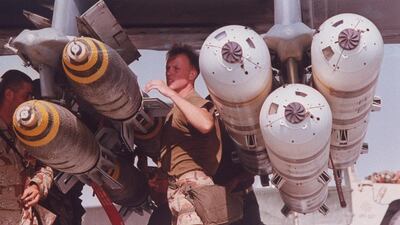
US Air Force ground crew loading 500-pound bombs onto an aircraft during operation Desert Storm - the mission to drive Iraqi forces out of Kuwait, January to February 1991. Mark Peters / Department Of Defence
Gen Norman Schwarzkopf, commander-in-chief, US Central Command, presents the Legion of Merit to Maj Gen Muhammed Al Badi, chief of staff of the UAE Armed Forces, for his role in liberating Kuwait from occupying Iraqi forces during Operation Desert Storm. April 2, 1991. Corbis via Getty Images
British engineers from the 7th armoured brigade in action on January 7 1991 in the Saudi Arabian desert. Patrick Baz / AFP
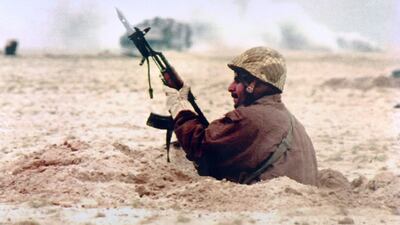
An Egyptian soldier holding a bayonet takes shelter in a hole to protect himself from Iraqi artillery fire on February 25, 1991 while Allied troops launch a ground offensive to free Kuwait from Iraqi invasion. Pascal Guyot / AFP
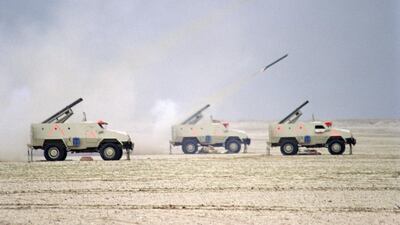
Egyptian army fire missiles on February 25, 1991 on the second day of the massive ground assault of the Allied Forces into Kuwait and Iraq. Pascal Guyot / AFP
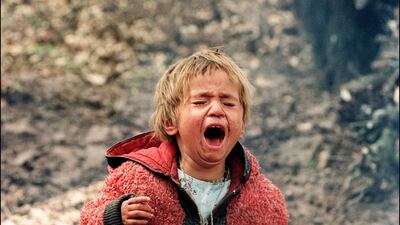
An Iraqi Kurdish refugee child cries on April 11, 1991, in Isikveren refugee camp situated on the Turkish border with Iraq. Nabil Ismail / AFP
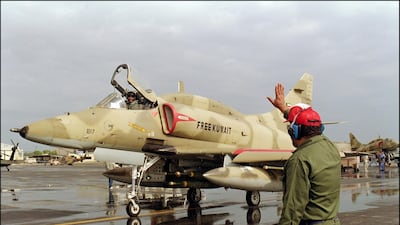
A Kuwaiti airfield worker waves to a departing of a Kuwaiti Air Force A-4 US-made Skyhawk jet fighter pilot 24 January 1991 leaving the Al Hasra air base for a bombing mission over Iraq. Chris Wilkins / AFP
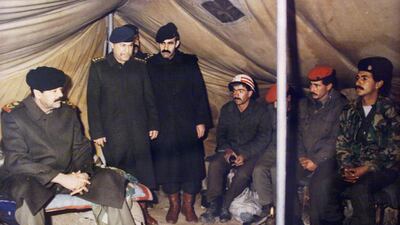
Iraqi President Saddam Hussein (L) is seen sitting in a tent in Najaf (Irak) in 1991 during the Gulf War. AFP
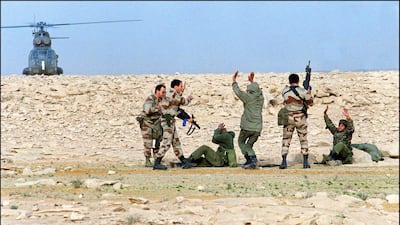
French special forces capture Iraqi soldiers on February 26, 1991 somewhere in Iraqi desert. Mike Nelson /AFP
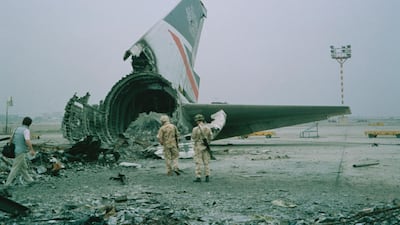
The wreckage of a British Airways Boeing 747-136 at Kuwait City airport, after BA Flight 149 was detained in Kuwait during the Gulf War, 1991. Colin Davey / Getty Images
Ms Rendel was among the first on the ground, leaving Abu Dhabi for Kuwait on March 18 as part of a UAE medical team. Aboard the military transport plane were four doctors, nurses, medical supplies, gas masks and dozens of Kuwaiti families who wanted to return.
“The skies were dark and grey with plumes of orange from burning oil wells all around,” Ms Rendel says. “Coming out of the plane, the air was thick and noxious with the smell of burning oil. I could see the fires all around me in the distance – uncapped wells set on fire and just burning continuously. Everyone was directed to a burnt-out building that was, apparently, the airport arrivals hall. It was black as night and entirely destroyed.”
Ms Rendel was assigned to the burns unit at Ibn Sina Hospital. The work was hard and unrelenting. Water and electricity supplies were intermittent. Staffing was minimal and the sole provision of care for patients was by remaining Palestinian nurses.
Back in the UAE, Ms Brown and many others were determined not to leave. Concerned families back in the UK urged them to return but Ms Brown says she felt strongly she could not leave Dubai when they were needed to keep morale high.
“We didn’t get passports but most who lived there in the 80s or 90s left their hearts there. You don’t turn your back on that.”
Thirty years on, Iraq has yet to recover. More invasions, civil war and violence have followed. Iraq’s people have suffered the most and are still trying to rebuild their shattered country. For the UAE, the war marked the start of a new era.
Rory Keelan, who worked for National Bank of Abu Dhabi at the time, points to the war as a moment when the world intruded. “It was the beginning of the end of a sort of ’age of innocence’ during which international affairs were something that happened to someone else far, far way,” he says. “Security became more of a concern.”

Mercer, the investment consulting arm of US services company Marsh & McLennan, expects its wealth division to at least double its assets under management (AUM) in the Middle East as wealth in the region continues to grow despite economic headwinds, a company official said.
Mercer Wealth, which globally has $160 billion in AUM, plans to boost its AUM in the region to $2-$3bn in the next 2-3 years from the present $1bn, said Yasir AbuShaban, a Dubai-based principal with Mercer Wealth.
“Within the next two to three years, we are looking at reaching $2 to $3 billion as a conservative estimate and we do see an opportunity to do so,” said Mr AbuShaban.
Mercer does not directly make investments, but allocates clients’ money they have discretion to, to professional asset managers. They also provide advice to clients.
“We have buying power. We can negotiate on their (client’s) behalf with asset managers to provide them lower fees than they otherwise would have to get on their own,” he added.
Mercer Wealth’s clients include sovereign wealth funds, family offices, and insurance companies among others.
From its office in Dubai, Mercer also looks after Africa, India and Turkey, where they also see opportunity for growth.
Wealth creation in Middle East and Africa (MEA) grew 8.5 per cent to $8.1 trillion last year from $7.5tn in 2015, higher than last year’s global average of 6 per cent and the second-highest growth in a region after Asia-Pacific which grew 9.9 per cent, according to consultancy Boston Consulting Group (BCG). In the region, where wealth grew just 1.9 per cent in 2015 compared with 2014, a pickup in oil prices has helped in wealth generation.
BCG is forecasting MEA wealth will rise to $12tn by 2021, growing at an annual average of 8 per cent.
Drivers of wealth generation in the region will be split evenly between new wealth creation and growth of performance of existing assets, according to BCG.
Another general trend in the region is clients’ looking for a comprehensive approach to investing, according to Mr AbuShaban.
“Institutional investors or some of the families are seeing a slowdown in the available capital they have to invest and in that sense they are looking at optimizing the way they manage their portfolios and making sure they are not investing haphazardly and different parts of their investment are working together,” said Mr AbuShaban.
Some clients also have a higher appetite for risk, given the low interest-rate environment that does not provide enough yield for some institutional investors. These clients are keen to invest in illiquid assets, such as private equity and infrastructure.
“What we have seen is a desire for higher returns in what has been a low-return environment specifically in various fixed income or bonds,” he said.
“In this environment, we have seen a de facto increase in the risk that clients are taking in things like illiquid investments, private equity investments, infrastructure and private debt, those kind of investments were higher illiquidity results in incrementally higher returns.”
The Abu Dhabi Investment Authority, one of the largest sovereign wealth funds, said in its 2016 report that has gradually increased its exposure in direct private equity and private credit transactions, mainly in Asian markets and especially in China and India. The authority’s private equity department focused on structured equities owing to “their defensive characteristics.”
Obed Suhail of ServiceMarket, an online home services marketplace, outlines the five types of long-term residential visas:
Investors:
A 10-year residency visa can be obtained by investors who invest Dh10 million, out of which 60 per cent should not be in real estate. It can be a public investment through a deposit or in a business. Those who invest Dh5 million or more in property are eligible for a five-year residency visa. The invested amount should be completely owned by the investors, not loaned, and retained for at least three years.
Entrepreneurs:
A five-year multiple entry visa is available to entrepreneurs with a previous project worth Dh0.5m or those with the approval of an accredited business incubator in the UAE.
Specialists
Expats with specialised talents, including doctors, specialists, scientists, inventors, and creative individuals working in the field of culture and art are eligible for a 10-year visa, given that they have a valid employment contract in one of these fields in the country.
Outstanding students:
A five-year visa will be granted to outstanding students who have a grade of 95 per cent or higher in a secondary school, or those who graduate with a GPA of 3.75 from a university.
Retirees:
Expats who are at least 55 years old can obtain a five-year retirement visa if they invest Dh2m in property, have savings of Dh1m or more, or have a monthly income of at least Dh20,000.
Results:
CSIL 2-star 145cm One Round with Jump-Off
1. Alice Debany Clero (USA) on Amareusa S 38.83 seconds
Micro-retirement is not a recognised concept or employment status under Federal Decree Law No. 33 of 2021 on the Regulation of Labour Relations (as amended) (UAE Labour Law). As such, it reflects a voluntary work-life balance practice, rather than a recognised legal employment category, according to Dilini Loku, senior associate for law firm Gateley Middle East.
“Some companies may offer formal sabbatical policies or career break programmes; however, beyond such arrangements, there is no automatic right or statutory entitlement to extended breaks,” she explains.
“Any leave taken beyond statutory entitlements, such as annual leave, is typically regarded as unpaid leave in accordance with Article 33 of the UAE Labour Law. While employees may legally take unpaid leave, such requests are subject to the employer’s discretion and require approval.”
If an employee resigns to pursue micro-retirement, the employment contract is terminated, and the employer is under no legal obligation to rehire the employee in the future unless specific contractual agreements are in place (such as return-to-work arrangements), which are generally uncommon, Ms Loku adds.
Navdeep Suri, India's Ambassador to the UAE
There has been a longstanding need from the Indian community to have a religious premises where they can practise their beliefs. Currently there is a very, very small temple in Bur Dubai and the community has outgrown this. So this will be a major temple and open to all denominations and a place should reflect India’s diversity.
It fits so well into the UAE’s own commitment to tolerance and pluralism and coming in the year of tolerance gives it that extra dimension.
What we will see on April 20 is the foundation ceremony and we expect a pretty broad cross section of the Indian community to be present, both from the UAE and abroad. The Hindu group that is building the temple will have their holiest leader attending – and we expect very senior representation from the leadership of the UAE.
When the designs were taken to the leadership, there were two clear options. There was a New Jersey model with a rectangular structure with the temple recessed inside so it was not too visible from the outside and another was the Neasden temple in London with the spires in its classical shape. And they said: look we said we wanted a temple so it should look like a temple. So this should be a classical style temple in all its glory.
It is beautifully located - 30 minutes outside of Abu Dhabi and barely 45 minutes to Dubai so it serves the needs of both communities.
This is going to be the big temple where I expect people to come from across the country at major festivals and occasions.
It is hugely important – it will take a couple of years to complete given the scale. It is going to be remarkable and will contribute something not just to the landscape in terms of visual architecture but also to the ethos. Here will be a real representation of UAE’s pluralism.
In the Restaurant: Society in Four Courses
Christoph Ribbat
Translated by Jamie Searle Romanelli
Pushkin Press
A widely accepted definition was made by the All Party Parliamentary Group on British Muslims in 2019: “Islamophobia is rooted in racism and is a type of racism that targets expressions of Muslimness or perceived Muslimness.” It further defines it as “inciting hatred or violence against Muslims”.
Engine: Twin electric motors and 95kWh battery pack
Transmission: Single-speed auto
Power: 408hp
Torque: 664Nm
Range: 400 kilometres
How to protect yourself when air quality drops
Install an air filter in your home.
Close your windows and turn on the AC.
Shower or bath after being outside.
Wear a face mask.
Stay indoors when conditions are particularly poor.
If driving, turn your engine off when stationary.
Dubai works towards better air quality by 2021
Dubai is on a mission to record good air quality for 90 per cent of the year – up from 86 per cent annually today – by 2021.
The municipality plans to have seven mobile air-monitoring stations by 2020 to capture more accurate data in hourly and daily trends of pollution.
These will be on the Palm Jumeirah, Al Qusais, Muhaisnah, Rashidiyah, Al Wasl, Al Quoz and Dubai Investment Park.
“It will allow real-time responding for emergency cases,” said Khaldoon Al Daraji, first environment safety officer at the municipality.
“We’re in a good position except for the cases that are out of our hands, such as sandstorms.
“Sandstorms are our main concern because the UAE is just a receiver.
“The hotspots are Iran, Saudi Arabia and southern Iraq, but we’re working hard with the region to reduce the cycle of sandstorm generation.”
Mr Al Daraji said monitoring as it stood covered 47 per cent of Dubai.
There are 12 fixed stations in the emirate, but Dubai also receives information from monitors belonging to other entities.
“There are 25 stations in total,” Mr Al Daraji said.
“We added new technology and equipment used for the first time for the detection of heavy metals.
“A hundred parameters can be detected but we want to expand it to make sure that the data captured can allow a baseline study in some areas to ensure they are well positioned.”
What: Fifa Club World Cup play-off Who: Al Ain v Team Wellington Where: Hazza bin Zayed Stadium, Al Ain When: Wednesday, kick off 7.30pm
US PGA Championship in numbers
1 Joost Luiten produced a memorable hole in one at the par-three fourth in the first round.
2 To date, the only two players to win the PGA Championship after winning the week before are Rory McIlroy (2014 WGC-Bridgestone Invitational) and Tiger Woods (2007, WGC-Bridgestone Invitational). Hideki Matsuyama or Chris Stroud could have made it three.
3 Number of seasons without a major for McIlroy, who finished in a tie for 22nd.
4 Louis Oosthuizen has now finished second in all four of the game's major championships.
5 In the fifth hole of the final round, McIlroy holed his longest putt of the week - from 16ft 8in - for birdie.
6 For the sixth successive year, play was disrupted by bad weather with a delay of one hour and 43 minutes on Friday.
7 Seven under par (64) was the best round of the week, shot by Matsuyama and Francesco Molinari on Day 2.
8 Number of shots taken by Jason Day on the 18th hole in round three after a risky recovery shot backfired.
9 Jon Rahm's age in months the last time Phil Mickelson missed the cut in the US PGA, in 1995.
10 Jimmy Walker's opening round as defending champion was a 10-over-par 81.
11 The par-four 11th coincidentally ranked as the 11th hardest hole overall with a scoring average of 4.192.
12 Paul Casey was a combined 12 under par for his first round in this year's majors.
13 The average world ranking of the last 13 PGA winners before this week was 25. Kevin Kisner began the week ranked 25th.
14 The world ranking of Justin Thomas before his victory.
15 Of the top 15 players after 54 holes, only Oosthuizen had previously won a major.
16 The par-four 16th marks the start of Quail Hollow's so-called "Green Mile" of finishing holes, some of the toughest in golf.
17 The first round scoring average of the last 17 major champions was 67.2. Kisner and Thorbjorn Olesen shot 67 on day one at Quail Hollow.
18 For the first time in 18 majors, the eventual winner was over par after round one (Thomas shot 73).
Emirates (www.emirates.com) flies directly to Hanoi, Vietnam, with fares starting from around Dh2,725 return, while Etihad (www.etihad.com) fares cost about Dh2,213 return with a stop. Chuong is 25 kilometres south of Hanoi.
MATCH INFO
Uefa Champions League quarter-final, second leg (first-leg score)
Porto (0) v Liverpool (2), Wednesday, 11pm UAE
Match is on BeIN Sports
MATCH INFO
Fixture: Thailand v UAE, Tuesday, 4pm (UAE)
TV: Abu Dhabi Sports
ONCE UPON A TIME IN GAZA
Starring: Nader Abd Alhay, Majd Eid, Ramzi Maqdisi
"They see their tomorrows slipping out of their reach. And though it seems to them that everything outside this reality is heaven, yet they do not want to go to that heaven. They stay, because they are afflicted with hope." - Mahmoud Darwish, to attendees of the Palestine Festival of Literature, 2008
His life in brief: Born in a village near Galilee, he lived in exile for most of his life and started writing poetry after high school. He was arrested several times by Israel for what were deemed to be inciteful poems. Most of his work focused on the love and yearning for his homeland, and he was regarded the Palestinian poet of resistance. Over the course of his life, he published more than 30 poetry collections and books of prose, with his work translated into more than 20 languages. Many of his poems were set to music by Arab composers, most significantly Marcel Khalife. Darwish died on August 9, 2008 after undergoing heart surgery in the United States. He was later buried in Ramallah where a shrine was erected in his honour.
Desert Warrior
Starring: Anthony Mackie, Aiysha Hart, Ben Kingsley
Tuan Phan of SimplyFI.org lists five signs you have been mis-sold to:
1. Your pension fund has been placed inside an offshore insurance wrapper with a hefty upfront commission.
2. The money has been transferred into a structured note. These products have high upfront, recurring commission and should never be in a pension account.
3. You have also been sold investment funds with an upfront initial charge of around 5 per cent. ETFs, for example, have no upfront charges.
4. The adviser charges a 1 per cent charge for managing your assets. They are being paid for doing nothing. They have already claimed massive amounts in hidden upfront commission.
5. Total annual management cost for your pension account is 2 per cent or more, including platform, underlying fund and advice charges.
Quick pearls of wisdom
Focus on gratitude: And do so deeply, he says. “Think of one to three things a day that you’re grateful for. It needs to be specific, too, don’t just say ‘air.’ Really think about it. If you’re grateful for, say, what your parents have done for you, that will motivate you to do more for the world.”
Know how to fight: Shetty married his wife, Radhi, three years ago (he met her in a meditation class before he went off and became a monk). He says they’ve had to learn to respect each other’s “fighting styles” – he’s a talk it-out-immediately person, while she needs space to think. “When you’re having an argument, remember, it’s not you against each other. It’s both of you against the problem. When you win, they lose. If you’re on a team you have to win together.”
Juventus v Napoli, Sunday, 10.45pm (UAE)
Match on Bein Sports
The five new places of worship
Church of South Indian Parish
St Andrew's Church Mussaffah branch
St Andrew's Church Al Ain branch
St John's Baptist Church, Ruwais
Church of the Virgin Mary and St Paul the Apostle, Ruwais
Ahmad El Sayed is Senior Associate at Charles Russell Speechlys, a law firm headquartered in London with offices in the UK, Europe, the Middle East and Hong Kong.
Experience: Commercial litigator who has assisted clients with overseas judgments before UAE courts. His specialties are cases related to banking, real estate, shareholder disputes, company liquidations and criminal matters as well as employment related litigation.
Education: Sagesse University, Beirut, Lebanon, in 2005.