

With final launch preparations underway, a series of important tests will be carried out on UAE’s Mars spacecraft, including switching on the probe’s power button.
The ‘aliveness test’ is a process where the spacecraft is turned on to ensure the scientific instruments and the probe is working as it should.
It could be up to 30-minutes-long and is the first and last performance test run the spacecraft undergoes before lifting off.
The launch will take place from Japan’s Tanegashima Space Centre and is scheduled for July 15, 12.51am, UAE time.
“The final checks are important steps to ensure that all systems are functioning and meeting the requirements before the fuelling,” said Suhail Al Dhafri, deputy project manager of the Emirates Mars Mission and spacecraft lead.
“Getting these parameters are vital prior to getting the probe ready for the lift off as per our launch window.”
The fuelling of the spacecraft will begin next week, followed by properly sealing the components of the craft and then the aliveness test.
-
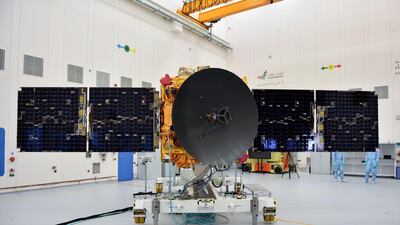
The final version of UAE's Hope spacecraft, which launched to space on July 20. Courtesy: Dubai Media Office -
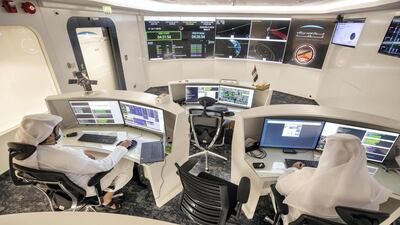
The operations control centre at Mohammed bin Rashid Space Centre in Dubai. Antonie Robertson / The National -
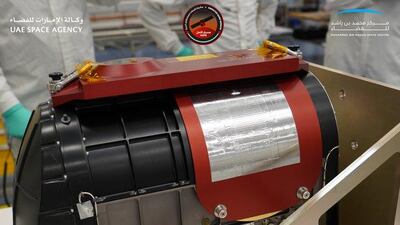
The Hope probe has three scientific instruments. This is the Emirates Mars Infrared Spectrometre, which will measure the global distribution of dust, ice clouds, water vapour and the temperature of the Martian atmosphere. All photos courtesy of MBRSC -
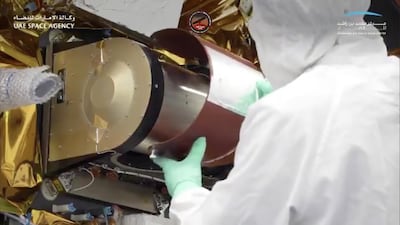
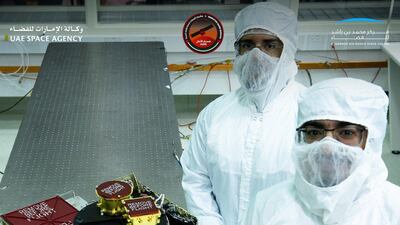
Engineers had installed the Mars infrared spectrometre on the Hope probe at Mohammed bin Rashid Space Centre' clean room -
The Emirates Eploration Imager will take high-resolution images of Mars and will study its lower atmosphere -
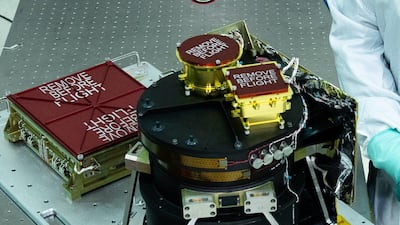
The exploration imager has an autonomous digital camera and will send back high-resolution colour images -

The Emirates Mars Ultraviolet Spectrometer will study the upper atmosphere and traces of oxygen and hydrogen -

Emirati engineers have worked with three American universities for this mission


Mitsubishi Heavy Industries – the firm providing its H-IIA rocket for the launch – will carry out joint operations with the Emirati engineers to ensure the spacecraft batteries are fully charged and will help set it for lift off.
“The commencement of the final checks and tests on the Hope probe in line with our schedule reiterates our commitment and detailed planning process to ensure the success of this mission,” said Dr Ahmad bin Abdullah Humaid Belhoul Al Falasi, Minister of State for Higher Education and the chairman of UAE Space Agency.
The team working on the mission were divided into three sub-teams because of the Covid-19 travel restrictions.

The first set of Engineers arrived in Japan on April 6 and the second team arrived on April 21. Both were required to complete a 15-day mandatory quarantine period.
The third team is still in the UAE, offering the necessary back-up support to the mission.
In the past three months, the engineers have carried out several functional tests on the spacecraft’s subsystems.
These include electrical power, communication, altitude control, command and control, propulsion, thermal control and software systems.
Hope will placed on the rocket next week and once weather and spacecrafts checks are completed, the rocket will be rolled out to the launch pad.
There is a launch window until August 3, as this is the period Earth and Mars align favourably for missions as such. If missed, the next launch opportunity will not be available for another two years.

