The Hubble Space Telescope has captured a striking image of three distant galaxies merging into one.
Known as galaxy merger IC 2431, the phenomenon is taking place 681 million light years from Earth in the constellation Cancer.
The image shows the triple galaxy merger in progress, as well as a mixture of star formation and tidal distortions caused by the interactions of their gravitational forces.
There are billions of galaxies in the universe and it is common for them to interact when they drift too close to each other.
A merger is a major interaction that occurs when galaxies eventually collide. The largest destroys the smaller ones and ultimately a much larger galaxy is formed.
The galactic chaos causes the formation of many new stars.
“It is during rare merging events that galaxies undergo dramatic changes in their appearance and in their stellar content. These systems are excellent laboratories to trace the formation of star clusters under extreme physical conditions,” the European Space Agency said on its website.
“The Milky Way typically forms star clusters with masses that are 10 thousand times the mass of our Sun. This doesn’t compare to the masses of the star clusters forming in colliding galaxies, which can reach millions of times the mass of our Sun.”
The new James Webb Space Telescope, which was launched into space in December, will be able to study galaxy mergers in detail.
Top space missions in 2022 - in pictures
-

From launching the first Arab mission to the Moon to looking into the early universe using the world’s most powerful telescope – the new year is going to be a busy one for space exploration. The National looks at some of the most exciting missions scheduled for 2022. Photo: Nasa -
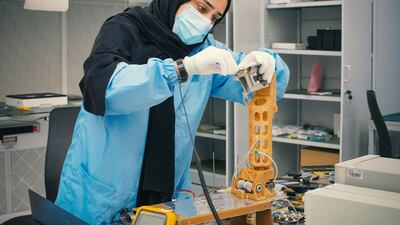
Engineers at the Mohammed bin Rashid Space Centre have been planning a Moon mission since 2017. They have built a 10-kilogram rover called Rashid that will study lunar soil and its properties. It is scheduled for a launch sometime between August to December 2022. Photo: Mohammed bin Rashid Space Centre -
The final prototype of the UAE's Rashid Moon rover. Photo: Mohammed bin Rashid Space Centre -

Two Emirati candidate astronauts are to begin training at Nasa’s Johnson Space Centre in Houston, Texas, in January. Mohammed Al Mulla, a Dubai Police helicopter pilot, and Nora Al Matrooshi, a mechanical engineer, will spend two years in training. Chris Whiteoak / The National -
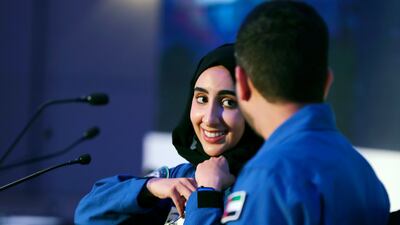
Nora Al Matrooshi and Mohammed Al Mulla will learn the systems of the International Space Station, the Russian language, robotics and how to perform spacewalks. Once they graduate, both astronauts would become eligible for space missions. AP -

Nora Al Matrooshi and Mohammed Al Mulla are the generation of astronauts that could go to the Moon one day. The UAE has its sights set on human missions to the lunar surface. Chris Whiteoak / The National -

US space agency Nasa is preparing the space launch system and Orion spacecraft for the Artemis 1 launch on March 12, which will involve a three-week, uncrewed test flight to the Moon. AFP / Nasa -
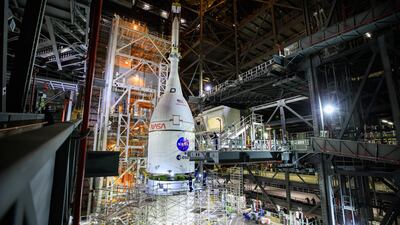
During the mission, the Orion spacecraft will fly 100 kilometres above the Moon’s surface and then use its gravitation force to become captured in an opposite orbit about 70,000 kilometres from the Moon. EPA / Nasa -
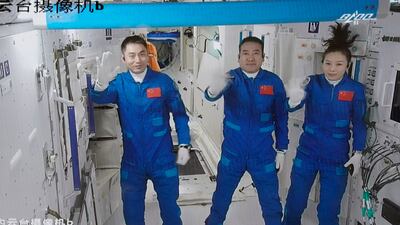
Completion of China’s space station is scheduled for the end of 2022. The Tiangong’s core module Tianhe is already in orbit and has been hosting astronauts, including Wang Yaping, its first female astronaut. Xinhua / AP -
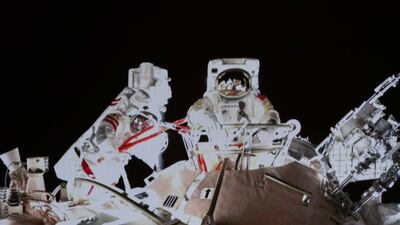
Wang Yaping was sent to the station earlier this year. On November 8, the 41-year-old also became the first Chinese female astronaut to perform a spacewalk. Xinhua / AP -
South Korea plans to launch its first lunar mission in 2022. The Korea Pathfinder orbiter will be launched on a SpaceX Falcon 9 rocket. Photo: Korea Aerospace Research Agency -
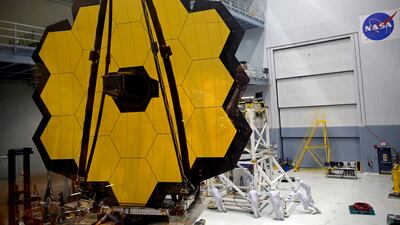
The James Webb Space Telescope will be capable of 'looking back' 13.5 billion years to see the first stars and galaxies of the universe and search for signs of life. It was launched on Saturday, December 25, 2021, and it is expected to make several discoveries when it becomes operational in 2022. Reuters