Related: 1 in 5 report job loss as Covid-19 wreaks havoc on Arab economies
Sheikh Mohammed bin Rashid said it was "painful" that so many young Arabs want to emigrate from their home country.
The Vice President and Ruler of Dubai criticised "corrupt" government officials that had brought about an economic situation that left many without a job or livelihood.
Sheikh Mohammed was commenting on the Arab Youth Survey 2020, which found nearly half of young Arabs had considered or were actively trying to leave their home country.
Many blamed poor leadership, endemic corruption and deepening economic malaise.
The study further found that 77 per cent of young Arabs said there was government corruption in their country, with Yemen and Iraq at the top of the chart.
"It is painful [to know] that half of our Arab resources wish to emigrate," Sheikh Mohammed wrote on social media.
"It is painful when the Arab youth do not find a homeland, safety and livelihood in their homeland.
"We say that if governments become corrupt, the country will be ruined, its security diminished and its citizens will leave it. Every official will be responsible [held accountable] before God. The story does not end here."
The comprehensive survey found the UAE had been named as the most desirable country for young Arabs to live in for a ninth year in a row.
The country's safety, long history and the promise of higher salaries were among the main reasons for the country’s continuing popularity.
"The UAE is everyone's country," said Sheikh Mohammed.
"We have tried to build a successful model and our experience, doors and books will remain open to all."
The survey also found that one in five young Arabs said they or someone in their family has lost their job due to coronavirus. A huge 72 per cent said it was “much more difficult” or a “little more difficult” to find a job now.
In the UAE, 41 per cent said finding a new job is harder now than before the pandemic.
Shamma Al Mazrui, Minister of State for Youth, said hopelessness is directly linked to unemployment and this needed to change.
"The growing gaps in youth education, employment and positive engagement create ripe conditions for extremist recruits," she said. "Nature, after all, abhors a vacuum."
Ms Al Mazrui said many Arab youth don't believe they have a voice and this was not acceptable.
"Youth tell us that transparent and cooperative leadership is the number one issue," she said. "Arab Youth have a demand for integrity and a hope for positive change ... They believe that their voice can make a difference.
"Their answers are in plain sight ... [and we can] forge a new path forward by letting data lead the way."
Ms Al Mazrui pointed to the fact that more Arab youth were considering the private sector rather than government job. Authorities needed to think about these changes, she said.
"A wave of innovation is coming and youth is leading the way. The opportunities youth present are phenomenal."
She welcomed the fact the UAE was again voted the country to emulate and said the country had put youth central in its growth strategy.
"The Arab Youth Survey is an unmistakable call to work together as Arab nations," she said.
"The greater risk is not taking radical risks to engage and empower youth."
-
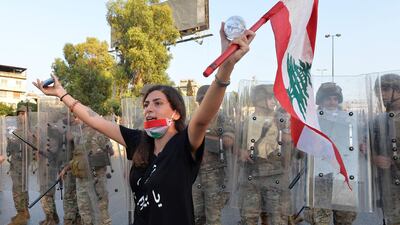
An anti-government protester carries a national flag as she shouts slogans in front of the Lebanese army soldiers during a protest on the road leading to the Presidential palace in Baabda, east Beirut, Lebanon. EPA -
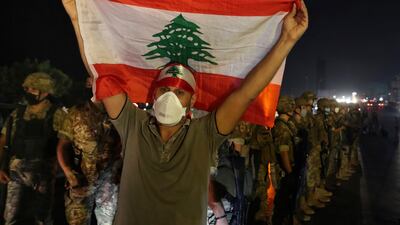
An anti-government protester holds up a Lebanese flag as army soldiers stand guard during a demonstration against deteriorating economic conditions as politicians are deadlocked over forming a new government, in the town of Jal el-Dib, north of Beirut, Lebanon. AP -
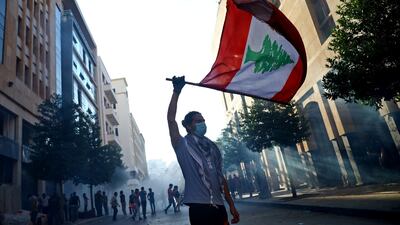
A demonstrator waves a Lebanese flag during anti-government protests on August 8, which were ignited by a massive explosion in Beirut's port. Lebanon's economy was already tanking due to a currency crisis, economic mismanagement and politicial turmoil when the blast hit. Reuters -
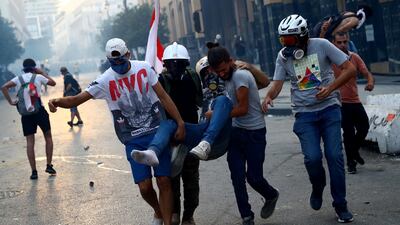
Demonstrators carry an injured man during anti-government protests that were ignited by a massive explosion in Beirut, Lebanon. Reuters -
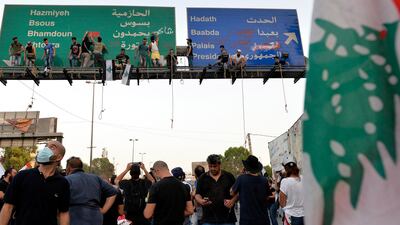
nti-government protesters write on a road sign as they hang mock gallows symbol to execute Lebanese politicians during a protest on the road leading to the Presidential palace in Baabda, east Beirut, Lebanon. EPA -
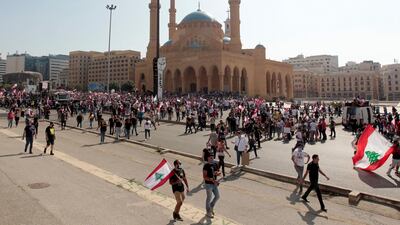
Demonstrators gather as they hold Lebanese flags during a protest against the government performance and worsening economic conditions, in Beirut, Lebanon. Reuters -
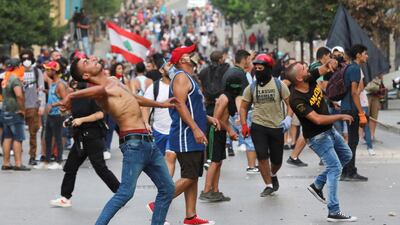
Demonstrators throw stones during anti-government protests in Beirut. A perfect storm of economic woes and political turmoil has given the country's well-educated, often multilingual, young people little hope of a viable future there. Reuters -
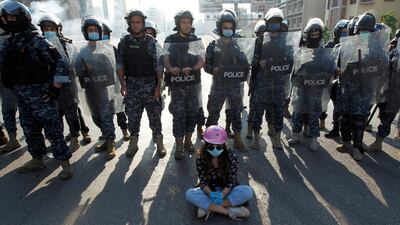
A demonstrator sits on the ground in front of Lebanese police officers during a protest against growing economic hardship in Beirut, Lebanon. Reuters -
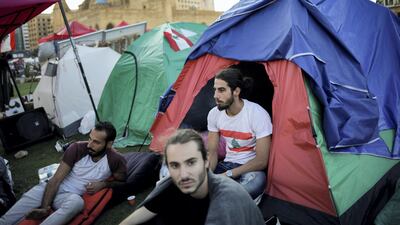
Protesters sit outside tents at Martyr's square in downtown Beirut in August. The Arab Youth Survey found 77 per cent of Lebanese 18 to 24-year-old's had considered or were actively trying to emigrate in hope of a better life. Reuters