• The first image of Mars as taken by the UAE's Hope probe, which arrived at the planet on February 9.
    The first image of Mars as taken by the UAE's Hope probe, which arrived at the planet on February 9.
  • This image taken by the Hope probe's ultraviolet spectrometer (one of its three scientific instruments) shows sunlight reflecting off the extended cloud of atomic hydrogen gas that surrounds the planet Mars. The sunlight is visible only as a dark disk hidden inside the fog of gas. The Emirates Mars Mission team said that no other mission have made such kind of recordings before.
    This image taken by the Hope probe's ultraviolet spectrometer (one of its three scientific instruments) shows sunlight reflecting off the extended cloud of atomic hydrogen gas that surrounds the planet Mars. The sunlight is visible only as a dark disk hidden inside the fog of gas. The Emirates Mars Mission team said that no other mission have made such kind of recordings before.
  • The UAE's Hope probe captured a high-resolution photo of Mars.
    The UAE's Hope probe captured a high-resolution photo of Mars.
  • The Hope probe has shared new images from its journey in the orbit of Mars.
    The Hope probe has shared new images from its journey in the orbit of Mars.
  • This image was taken by the infrared spectrometer, another instrument on the Hope probe, from an altitude of about 15,000 kilometres. The image shows the surface temperature (left), centred on the Tharsis region of Mars. Dawn can be seen towards the right side. The low surface temperatures observed are due to the dusty nature of the Martian surface. An elevated nighttime atmospheric temperature at 25 km altitude (right) is also observed over the Tharsis region.
    This image was taken by the infrared spectrometer, another instrument on the Hope probe, from an altitude of about 15,000 kilometres. The image shows the surface temperature (left), centred on the Tharsis region of Mars. Dawn can be seen towards the right side. The low surface temperatures observed are due to the dusty nature of the Martian surface. An elevated nighttime atmospheric temperature at 25 km altitude (right) is also observed over the Tharsis region.
  • These images were captured by the eXploration imager, a high-resolution camera on the Hope probe. The red channel clearly shows the dark and light features of the Martian surface, while the water ice clouds stand out in the ultraviolet channel.
    These images were captured by the eXploration imager, a high-resolution camera on the Hope probe. The red channel clearly shows the dark and light features of the Martian surface, while the water ice clouds stand out in the ultraviolet channel.
  • Hope probe sent back an image of the Cerberus Fossae, an area on the planet known for 'Marsquakes'.
    Hope probe sent back an image of the Cerberus Fossae, an area on the planet known for 'Marsquakes'.
  • Surface and atmospheric temperature readings collected by the UAE's Hope probe.
    Surface and atmospheric temperature readings collected by the UAE's Hope probe.
  • Discrete aurora on Mars captured by UAE's Hope probe
    Discrete aurora on Mars captured by UAE's Hope probe
  • Discrete aurora on Mars captured by UAE's Hope probe
    Discrete aurora on Mars captured by UAE's Hope probe

Historic UAE Mars mission wins Sir Arthur Clarke Award


Sarwat Nasir
  • English
  • Arabic

The Emirates Mars Mission has been honoured at a prestigious awards ceremony for its history-making journey to the Red Planet.

The fate of the Hope probe had a nation holding its collective breath before joyous scenes were sparked when it was confirmed it had reached Mars orbit on February 9.

The successful Mars project – a first for the Arab world and only the fifth by a space agency – also made an impact around the world.

Emirates Mars Mission received the Sir Arthur Clarke Award from the British Interplanetary Society and the Arthur C Clarke Foundation, which recognises remarkable achievements in space.

The awards are named after science fiction writer and futurist Clarke, renowned for co-writing the screenplay for the film 2001: A Space Odyssey.

Mansoor Abulhoul, the UAE's ambassador to the UK, accepted the award during a special ceremony held at the British Interplanetary Society’s Reinventing Space Conference Dinner in Westminster this week.

Mansoor Abulhoul, the UAE's ambassador to the UK, accepted the Sir Arthur Clarke Award on behalf of the Emirates Mars Mission. Courtesy: Emirates Mars Mission

“The Emirates Mars Mission is a significant achievement for our young nation, and our partners around the world, having successfully sparked innovation across space science, exploration and research,” Mr Abulhoul said.

“Marking the 50th anniversary of our nation, the mission is indicative of the leaps and bounds we have made in developing our research and innovation capacities, and how we have developed a culture with pioneering youth and risk-taking at its core. We’re incredibly proud of the entire team that made this possible.”

Hope probe enhances our understanding of Mars

Since reaching Mars orbit on February 9, the Hope probe has been capturing data on the planet’s upper and lower atmospheres.

On Wednesday, groundbreaking images of the night-time aurora taken by the probe were released.

The spacecraft will spend two years in Mars orbit to help scientists around the world better understand why the planet lost its atmosphere and is unable to sustain life.

Omran Sharaf, project director of the mission, said it was “a great honour” to receive the award from the UK space community.

“With the first set of data expected to be released in October, Hope will provide us with a full picture of the planet’s climate for the first time, which has previously been mostly unknown.

“This is not just an exciting moment in history for space scientists globally, who will be able to analyse the data, but for the Emirates too, as we progress our nation’s ambition to become a knowledge-based economy with a commercial space sector at its core.”

Years of hard work is rewarded

The Emirates Mars Mission was launched in 2014 and was given a tight budget of nearly Dh735 million ($200m) – one of the lowest costs for an interplanetary mission.

More than 100 Emirati engineers worked on the mission for six years, alongside three US universities.

The British Interplanetary Society (BIS) presented the award to Mr Abulhoul.

“The International Space Achievement award celebrates progress in important international aspects of space activity,” the society said.

“The BIS, and our partners at the Arthur C Clarke Foundation, recognise Omran [and the Emirates Mars Mission team for their historic accomplishment in sending a deep space probe to Mars, and the Emirates’ commitment to advancing science, technology, and education through international collaboration.”

UAE's Hope probe captures stunning night-time aurora on Mars – in pictures

  • A rendering from the United Arab Emirates Space Agency of the Mars aurora. Courtesy Emirates Mars Mission
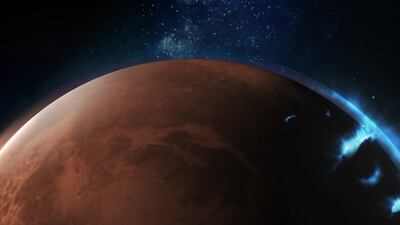
    A rendering from the United Arab Emirates Space Agency of the Mars aurora. Courtesy Emirates Mars Mission
  • A rendering of how the Mars aurora would look from the planet surface. Courtesy Emirates Mars Mission
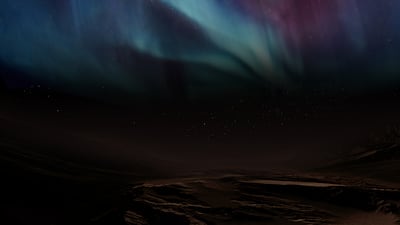
    A rendering of how the Mars aurora would look from the planet surface. Courtesy Emirates Mars Mission
  • The observations exceed the original science goals of the Emirates Mars Mission. Courtesy Emirates Mars Mission
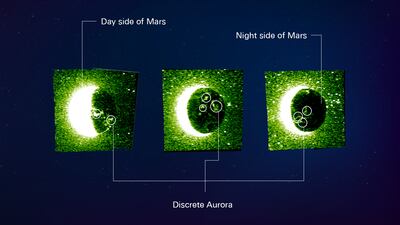
    The observations exceed the original science goals of the Emirates Mars Mission. Courtesy Emirates Mars Mission
  • How the effect of the Sun causes Mars to display its aurora. Courtesy Emirates Mars Mission
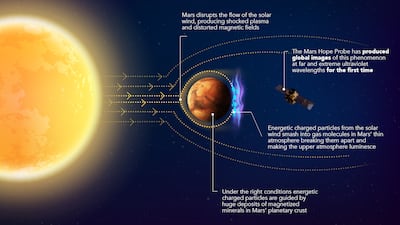
    How the effect of the Sun causes Mars to display its aurora. Courtesy Emirates Mars Mission
Updated: July 01, 2021, 6:42 PM