Last month, German Chancellor Friedrich Merz described his country’s decision to phase out nuclear power following the 2011 Fukushima power plant accident in Japan as a “strategic mistake”. His statement is indicative of a global shift in attitudes towards nuclear energy.
Incidentally, this change of narrative is happening exactly four decades after the worst-ever nuclear disaster. Back in April 1986, the Chernobyl nuclear power plant in present-day Ukraine experienced a reactor meltdown and ultimately undermined the public’s perception of nuclear power, deeming it as an unsafe technology. That perception gradually appears to be shifting, especially as the technology itself has become safer through design improvements as well as the enforcement of stricter regulatory frameworks globally.
Safety aside, the revitalisation of interest in nuclear power is being driven by at least three interdependent dynamics.

First, the imperative of decarbonisation has fundamentally altered the energy debate. As countries commit to net-zero emissions targets, the need to transition away from fossil fuels has become more apparent.
The intermittency of renewables such as wind and solar continues to pose a structural challenge to the stability of national grids. By contrast, nuclear energy contributes to baseload capacity and thus provides a valuable alternative to carbon-based energy sources like coal and natural gas. In addition, there is growing recognition that achieving deep decarbonisation without nuclear energy would require either large-scale overbuilding of renewables and storage, or continued reliance on fossil fuels.
The first option is costly, and the second is politically difficult.
As a result, a renewed focus on nuclear energy is increasingly being framed as compatible with the objectives of the green transition. A case in point is the growing availability of public finance for such investments. In the US, new nuclear plants have become eligible for investment and production tax credits. In the EU, the European Investment Bank has, for the first time, allocated funding for small modular reactors – or SMRs – as part of its €75 billion (almost $88 billion) financial package for the clean energy transition.
The green transition is also affecting the economics of energy systems in ways that favour nuclear power. The proliferation of carbon pricing mechanisms, including carbon border adjustment measures, is strengthening the economic case for low-emission energy sources.
These measures also create competitiveness challenges. The carbon intensity of national energy systems is set to become a key benchmark of international competitiveness. Energy-intensive manufacturing risks becoming a liability in global markets. To protect the competitiveness of their exports, developing countries will therefore find it necessary to gradually shift to cleaner energy sources.
In this context, nuclear power is likely to become an increasingly viable option for countries seeking to reduce the emissions intensity of their economies.
Second, geopolitical vulnerabilities have intensified concerns about energy security. Both the war in Ukraine and, more recently, tensions around the Strait of Hormuz have exposed the fragility of hydrocarbon supply chains. In a post-Iran war environment, energy-dependent countries will almost certainly reassess their approach to supply security and reconsider how to diversify their energy portfolios.
Compared to dependence on continuous energy imports, nuclear power offers a higher degree of sovereignty to energy-importing nations. In this sense, nuclear power is unique. Once a plant is built and fuelled, it can operate for long periods with relatively stable supply chains. Its core fuel, uranium, is a globally traded commodity that can be sourced from a more diversified set of countries and stockpiled more easily.
As such, nuclear energy infrastructure provides a strategic hedge for nations seeking to reduce exposure to geopolitical risks and enhance their energy security.
Third, technological innovation is reshaping the nuclear landscape. The traditional model of large, capital-intensive reactors with long construction timelines has been a major barrier to expansion. The emergence of the aforementioned SMRs offers the potential to overcome this constraint.
-
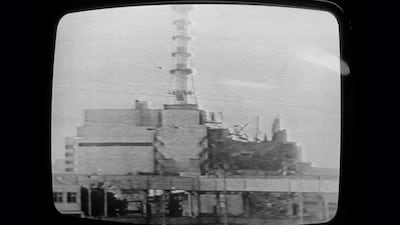
Soviet television showed, on April 30, 1986, this picture of the Chernobyl plant on which a half-destroyed building could be seen, but commentary said there had been "no destruction, nor gigantic fires nor thousands of casualties". AFP -
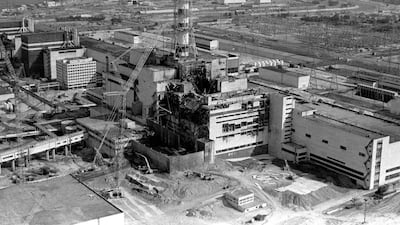
Aerial view of the Chernobyl nuclear power plant's fourth reactor, in this May 1986 file photo. Chernobyl's Number Four reactor caught fire and exploded in April 1986, sending a radioactive cloud of dust over Ukraine, Belarus, Russia and other parts of Europe. Reuters -
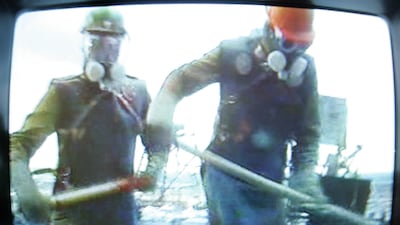
"liquidators", some 600,000 front line soldiers, firemen and civilians who were deployed over four years to clean up after the Chernobyl nuclear meltdown. AFP -
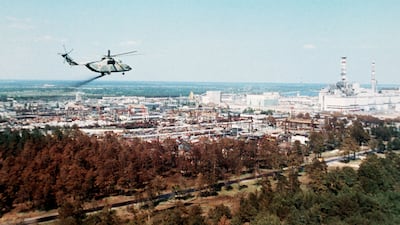
Undated picture of a military helicopter spreading a substance supposed to reduce the contamination of the air full of radioactive elements above the Chernobyl nuclear plant, a few days after its No. 4 reactor's blast. AFP -

An engineer working at the Ukrainian nuclear plant of Chernobyl is checked by doctors of the sanatorium of Lesnaya Polyana on May 15, 1986. AFP -

Oxana Gaibon (R), 17, and Alla Kozimierka, 15, both victims of the 1986 Chernobyl nuclear disaster, receive infrared radiation treatment on December 12, 1994 at the Tarara Children Hospital in Havana, Cuba, as along with hundreds of other contaminated Russian and Ukranian adolescents they have been receiving free medical treatment in Cuba as part of a humanitarian project. AFP -
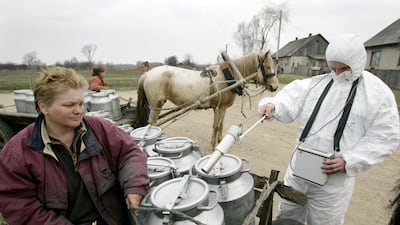
An employee from the Belarussian radiation ecology reserve measures the level of radiation on milk canisters 20 April 2006 in the village of Gubarevichi, outside the 30-km exclusion zone around the Chernobyl nuclear reactor. AFP -
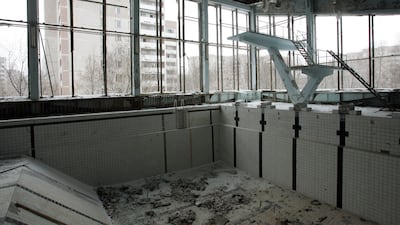
A swimming pool in the ghost town of Pripyat near Chernobyl's nuclear power plant 27 February, 2006. AFP -
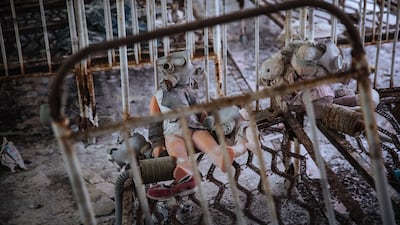
Toys with gas masks sit on bed frames in a former kindergarten in the deserted city of Pripyat, near the Chernobyl nuclear power plant, Ukraine, 22 April 2016. EPA -

Damage to the containment vessel at the New Safe Confinement (NSC), which protects the remains of reactor 4 of the former Chernobyl Nuclear Power Plant to contain radiation, following a drone attack, in Chernobyl, on February 14, 2025, amid the Russian invasion of Ukraine. AFP -
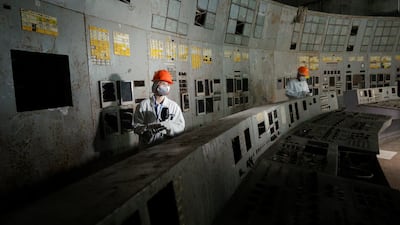
Visitors in the control room of the plant's fourth reactor at the Chernobyl nuclear power plant, in Chernobyl, Ukraine, 23 April 2026. EPA


While this technology is still in its infancy in terms of full commercialisation, it is already attracting significant investment and political support. SMRs promise lower costs, reduced construction risks and greater flexibility in deployment. They can be installed more easily across different regions and closer to industrial and manufacturing hubs.
The data economy is also likely to become a major driver of electricity demand, with the growing energy needs of large data centres increasingly being linked to investments in SMRs.
According to the International Energy Agency, the data economy currently accounts for about 1.5 per cent of global electricity demand. This share is expected to double by the end of the decade, driven by investments in artificial intelligence. Electricity consumption by large servers and the so-called hyperscalers servicing the AI ecosystem is growing at about 30 per cent annually.
Despite these favourable dynamics, the sustainable development of nuclear power will ultimately depend on the integrity of the non-proliferation regime. The Non-Proliferation Treaty, or NPT, remains a near-universal framework for arms control and monitoring, with only a handful of nations including India, Pakistan, Israel, South Sudan and North Korea remaining outside this critical regime.
The NPT also underpins the international framework that enables co-operation in the development of civilian nuclear energy for emerging countries interested in this technology. The quid pro quo is their commitment to non-proliferation principles, particularly transparency.
In this context, a diplomatic resolution of Iran’s nuclear programme is instrumental. Such an outcome would demonstrate the continued viability of the NPT regime and incentivise meaningful progress in the peaceful use of nuclear technology in the years ahead.