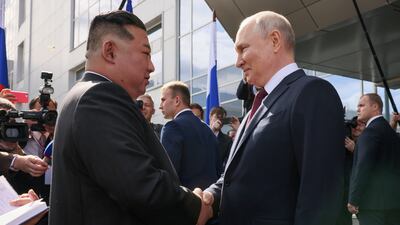
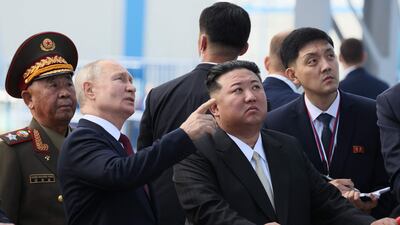
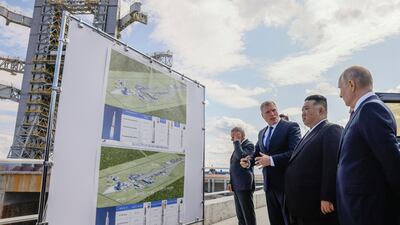
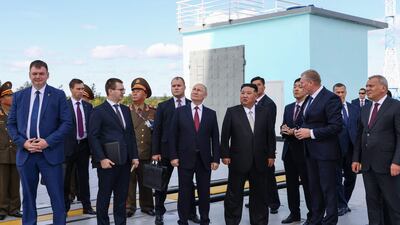
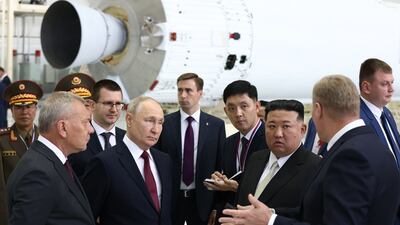
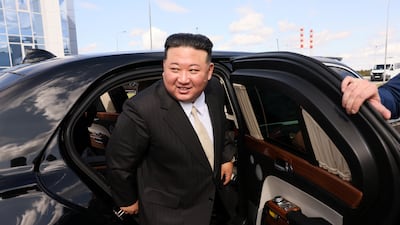
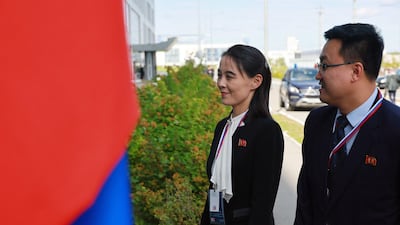
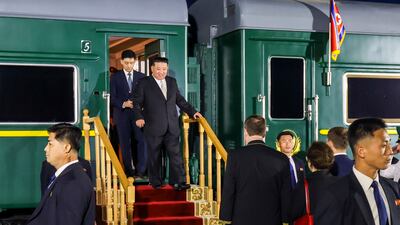
In this photo provided by the North Korean government, Kim Jong-un and Vladimir Putin visit the Vostochny cosmodrome outside the Russian city of Tsiolkovsky on Wednesday. AP Photo
Raghida Dergham is the founder and executive chairwoman of the Beirut Institute, and a columnist for The National
September 17, 2023
North Korean leader Kim Jong-un and Russian President Vladimir Putin have forged an agreement that appears convenient for both parties in the context of their strategic standoff with the US and its allies.
More importantly, a trilateral partnership may be emerging between China, Russia and North Korea that sends a message of defiance to Washington and its partners in the Quad – including Australia, India and Japan – and allies such as South Korea.
The message appears to be that China and Russia now have on their side a country that can cause disruptions in the Asia-Pacific region and beyond.
The Kim-Putin meeting came hot on the heels of US President Joe Biden’s visit to Vietnam, which China will have closely followed. Earlier, at the G20 summit in New Delhi, the Biden administration also announced an economic corridor project involving India, key Arab Gulf countries and Europe. Beijing might view the India-Middle East-Europe Economic Corridor (IMEEC) as a competitor to its own Belt and Road Initiative (BRI), which it launched a decade ago as a fundamental infrastructure component of its strategic vision.
The emergence of these new geopolitical partnerships foreshadows possible global confrontations of indeterminate scope and dimensions.
The China-Russia-North Korea partnership has the potential to alter the balance of power in Asia and the Pacific. Following Mr Kim’s visit to Russia, the Kremlin might be able to essentially convey to the West that if it needs to deal with a capricious, nuclear-armed and occasionally provocative state such as North Korea, it will need to involve Moscow and Beijing.
Russia and China are increasingly committed to enhancing their strategic co-operation in the Asia-Pacific, irrespective of the latter’s stance on the war in Ukraine. Indeed, these are two distinct matters, and the two countries’ focus is squarely on fortifying the strategic, military and political dimensions of their partnership through various means, including their favourable relations with the North Korean regime.
Russian President Vladimir Putin shakes hands with North Korean leader Kim Jong-un during a meeting at the Vostochny Сosmodrome in Russia's far-eastern Amur region on Wednesday. Reuters
Mr Putin and Mr Kim arrived at the Vostochny Cosmodrome ahead of planned talks that could lead to a weapons deal. AFP
Mr Putin and Mr Kim examine an Angara rocket launch pad during their meeting at the Vostochny Cosmodrome. AP
Mr Putin and Mr Kim during the visit to the Vostochny Cosmodrome. AFP
Mr Putin and Mr Kim were accompanied by head of Russian state space corporation Roscosmos Yuri Borisov, left, during the visit. EPA
Mr Kim arrives at the Vostochny Сosmodrome. Reuters
Kim Yo-jong, sister of Mr Kim, arrives at the Vostochny Cosmodrome. AFP
Mr Kim disembarks from his train after crossing the border to Russia at Khasan on Tuesday. AP
BRI is different from IMEEC in that it is Chinese-led and Chinese-funded, while the latter is a multilateral project
Chinese President Xi Jinping is scheduled to welcome Mr Putin to Beijing next month to commemorate the 10-year anniversary of the BRI’s launch. Next week, Chinese Foreign Minister Wang Yi will head to Moscow to monitor the growing co-operation between the two countries.
In the context of the bilateral relationship between Russia and North Korea and the leaders’ meeting at a cosmodrome in the Russian Far East, Mr Kim said: “Russia has risen to a sacred fight to protect its sovereignty and security … and we will be together in the fight against imperialism.”
These strong words were matched with an arms agreement to support the war in Ukraine, including providing millions of Soviet-era artillery shells that Moscow needs in the Donbas campaign. Incidentally, North Korea recognises Russia’s sovereignty over Ukrainian territories.
In return, Mr Kim received a commitment from Russia to develop North Korea’s armed forces and modernise its military industry, in addition to providing assistance to overcome the deadly food crisis in his country. With this commitment, Russia has essentially delivered a blow to the UN sanctions on Pyongyang.
Such steps taken by Moscow have been in response to its being left out in the cold by the West over the past 18 months. Beijing, on the other hand, has resisted the opportunity to announce measures that Washington might consider retaliatory against its moves to consolidate its power in recent weeks and months.
The IMEEC, for instance, is a pragmatic economic project by which the US might be signalling to the rest of the world that there is room to build global infrastructure networks with its support. Many countries will be interested in accessing these networks because they are operationally and economically beneficial. Moreover, this project will give the US and India an enhanced role and influence with a group of important countries in the Middle East and the Asia-Pacific.
This initiative was unveiled not long before the BRI anniversary summit in October.
The BRI is different from the IMEEC in that it is Chinese-led and Chinese-funded, while the latter is a multilateral project. Some might view it as an American ploy to compete with China, while others might point to the potential economic benefits for all the countries involved. Then there are those who might argue that it is aimed at excluding Russia and Iran and thwarting their projects with India, including the International North-South Transport Corridor.
Whatever one’s assessment, the US will hope the project ends up aiding the establishment of ties between Saudi Arabia and Israel, noting that it passes through Jordan and then through the Israeli port of Haifa. Additionally, Washington will hope to further strengthen its relations with New Delhi within the context of their strategic position towards Beijing.
President Sheikh Mohamed attends the India-Middle East-Europe Economic Corridor announcement on the sidelines of the G20 Summit in New Delhi last week. Ryan Carter / UAE Presidential Court
For their part, Emirati and Saudi involvement in the IMEEC does not imply hostility towards or alignment against any country. Rather, the two countries prioritise their interests over provocative alliances and are open to adjusting their policies and positions as long as their national and regional interests are met.
Riyadh will keep an open mind regarding potential normalisation with Israel, provided the US encourages the latter to pursue a two-state solution and accept the establishment of a Palestinian state.
The IMEEC is an infrastructure development and port connectivity project that will facilitate trade. It will include the construction of a cross-border railway and shipping network, connecting ships to trains, and building pipelines for the export and import of electricity and clean hydrogen to enhance global energy security.
It is an ambitious project with the potential to benefit the Middle East. For it represents a new language in international relations that could replace the sterile rhetoric that includes threats as a tactic and recalcitrance as a strategy.
Lebanon remains a victim of this sterile rhetoric.
Indeed, the Beirut Port could have been a part of this project – not just the one in Haifa. However, political instability and the governing class’s inability to make decisions hinder any consideration of a role for Lebanon’s ports and railways.
The 2020 blast makes the port unsuitable for infrastructure projects. Yet if, by some miracle, Lebanon had been able to free itself from the control of its political class and its attempts to siphon off its natural resources, the country could have participated in such a developmental and civilisational project.

GREATEST ROYAL RUMBLE CARD
The line-up as it stands for the Greatest Royal Rumble in Saudi Arabia on April 27
50-man Royal Rumble
Universal Championship
Brock Lesnar (champion) v Roman Reigns
Casket match
The Undertaker v Rusev
Intercontinental Championship
Seth Rollins (champion) v The Miz v Finn Balor v Samoa Joe
SmackDown Tag Team Championship
The Bludgeon Brothers v The Usos
Raw Tag Team Championship
Sheamus and Cesaro v Bray Wyatt and Matt Hardy
United States Championship
Jeff Hardy (champion) v Jinder Mahal
Singles match
Triple H v John Cena
To be confirmed
AJ Styles will defend his WWE World Heavyweight title and Cedric Alexander his Cruiserweight Championship, but matches have yet to be announced
Abu Dhabi Grand Slam Jiu-Jitsu World Tour Calendar 2018/19
July 29: OTA Gymnasium in Tokyo, Japan
Sep 22-23: LA Convention Centre in Los Angeles, US
Nov 16-18: Carioca Arena Centre in Rio de Janeiro, Brazil
Feb 7-9: Mubadala Arena in Abu Dhabi, UAE
Mar 9-10: Copper Box Arena in London, UK
Tributes from the UAE's personal finance community
• Sebastien Aguilar, who heads SimplyFI.org, a non-profit community where people learn to invest Bogleheads’ style
“It is thanks to Jack Bogle’s work that this community exists and thanks to his work that many investors now get the full benefits of long term, buy and hold stock market investing.
Compared to the industry, investing using the common sense approach of a Boglehead saves a lot in costs and guarantees higher returns than the average actively managed fund over the long term.
From a personal perspective, learning how to invest using Bogle’s approach was a turning point in my life. I quickly realised there was no point chasing returns and paying expensive advisers or platforms. Once money is taken care off, you can work on what truly matters, such as family, relationships or other projects. I owe Jack Bogle for that.”
• Sam Instone, director of financial advisory firm AES International
"Thought to have saved investors over a trillion dollars, Jack Bogle’s ideas truly changed the way the world invests. Shaped by his own personal experiences, his philosophy and basic rules for investors challenged the status quo of a self-interested global industry and eventually prevailed. Loathed by many big companies and commission-driven salespeople, he has transformed the way well-informed investors and professional advisers make decisions."
• Demos Kyprianou, a board member of SimplyFI.org
"Jack Bogle for me was a rebel, a revolutionary who changed the industry and gave the little guy like me, a chance. He was also a mentor who inspired me to take the leap and take control of my own finances."
"Obsessed with reducing fees, Jack Bogle structured Vanguard to be owned by its clients – that way the priority would be fee minimisation for clients rather than profit maximisation for the company.
His real gift to us has been the ability to invest in the stock market (buy and hold for the long term) rather than be forced to speculate (try to make profits in the shorter term) or even worse have others speculate on our behalf.
Bogle has given countless investors the ability to get on with their life while growing their wealth in the background as fast as possible. The Financial Independence movement would barely exist without this."
"Jack Bogle was one of the greatest forces for wealth democratisation the world has ever seen. He allowed people a way to be free from the parasitical "financial advisers" whose only real concern are the fat fees they get from selling you over-complicated "products" that have caused millions of people all around the world real harm.”
• Tuan Phan, a board member of SimplyFI.org
"In an industry that’s synonymous with greed, Jack Bogle was a lone wolf, swimming against the tide. When others were incentivised to enrich themselves, he stood by the ‘fiduciary’ standard – something that is badly needed in the financial industry of the UAE."
Gender equality in the workplace still 200 years away
It will take centuries to achieve gender parity in workplaces around the globe, according to a December report from the World Economic Forum.
The WEF study said there had been some improvements in wage equality in 2018 compared to 2017, when the global gender gap widened for the first time in a decade.
But it warned that these were offset by declining representation of women in politics, coupled with greater inequality in their access to health and education.
At current rates, the global gender gap across a range of areas will not close for another 108 years, while it is expected to take 202 years to close the workplace gap, WEF found.
The Geneva-based organisation's annual report tracked disparities between the sexes in 149 countries across four areas: education, health, economic opportunity and political empowerment.
After years of advances in education, health and political representation, women registered setbacks in all three areas this year, WEF said.
Only in the area of economic opportunity did the gender gap narrow somewhat, although there is not much to celebrate, with the global wage gap narrowing to nearly 51 per cent.
And the number of women in leadership roles has risen to 34 per cent globally, WEF said.
At the same time, the report showed there are now proportionately fewer women than men participating in the workforce, suggesting that automation is having a disproportionate impact on jobs traditionally performed by women.
And women are significantly under-represented in growing areas of employment that require science, technology, engineering and mathematics skills, WEF said.
* Agence France Presse
Uefa Champions League last 16 draw
Juventus v Tottenham Hotspur
Basel v Manchester City
Sevilla v Manchester United
Porto v Liverpool
Real Madrid v Paris Saint-Germain
Shakhtar Donetsk v Roma
Chelsea v Barcelona
Bayern Munich v Besiktas
INFO
What: DP World Tour Championship When: November 21-24 Where: Jumeirah Golf Estates, Dubai Tickets:www.ticketmaster.ae.
INFO
Everton 0
Arsenal 0
Man of the Match: Djibril Sidibe (Everton)
Third Test
Result: India won by 203 runs
Series: England lead five-match series 2-1
UK's plans to cut net migration
Under the UK government’s proposals, migrants will have to spend 10 years in the UK before being able to apply for citizenship.
Skilled worker visas will require a university degree, and there will be tighter restrictions on recruitment for jobs with skills shortages.
But what are described as "high-contributing" individuals such as doctors and nurses could be fast-tracked through the system.
Language requirements will be increased for all immigration routes to ensure a higher level of English.
Rules will also be laid out for adult dependants, meaning they will have to demonstrate a basic understanding of the language.
The plans also call for stricter tests for colleges and universities offering places to foreign students and a reduction in the time graduates can remain in the UK after their studies from two years to 18 months.
Dubai is on a mission to record good air quality for 90 per cent of the year – up from 86 per cent annually today – by 2021.
The municipality plans to have seven mobile air-monitoring stations by 2020 to capture more accurate data in hourly and daily trends of pollution.
These will be on the Palm Jumeirah, Al Qusais, Muhaisnah, Rashidiyah, Al Wasl, Al Quoz and Dubai Investment Park.
“It will allow real-time responding for emergency cases,” said Khaldoon Al Daraji, first environment safety officer at the municipality.
“We’re in a good position except for the cases that are out of our hands, such as sandstorms.
“Sandstorms are our main concern because the UAE is just a receiver.
“The hotspots are Iran, Saudi Arabia and southern Iraq, but we’re working hard with the region to reduce the cycle of sandstorm generation.”
Mr Al Daraji said monitoring as it stood covered 47 per cent of Dubai.
There are 12 fixed stations in the emirate, but Dubai also receives information from monitors belonging to other entities.
“There are 25 stations in total,” Mr Al Daraji said.
“We added new technology and equipment used for the first time for the detection of heavy metals.
“A hundred parameters can be detected but we want to expand it to make sure that the data captured can allow a baseline study in some areas to ensure they are well positioned.”
Brief scores:
Manchester United 4
Young 13', Mata 28', Lukaku 42', Rashford 82'
Fulham 1
Kamara 67' (pen),
Red card: Anguissa (68')
Man of the match: Juan Mata (Man Utd)
In numbers
- Number of children under five will fall from 681 million in 2017 to 401m in 2100
- Over-80s will rise from 141m in 2017 to 866m in 2100
- Nigeria will become the world’s second most populous country with 791m by 2100, behind India
- China will fall dramatically from a peak of 2.4 billion in 2024 to 732 million by 2100
- an average of 2.1 children per woman is required to sustain population growth
Scotland 371-5, 50 overs (C MacLeod 140 no, K Coetzer 58, G Munsey 55)
England 365 all out, 48.5 overs (J Bairstow 105, A Hales 52; M Watt 3-55)
Result: Scotland won by six runs
The Melbourne Mercer Global Pension Index
Mazen Abukhater, principal and actuary at global consultancy Mercer, Middle East, says the company’s Melbourne Mercer Global Pension Index - which benchmarks 34 pension schemes across the globe to assess their adequacy, sustainability and integrity - included Saudi Arabia for the first time this year to offer a glimpse into the region.
The index highlighted fundamental issues for all 34 countries, such as a rapid ageing population and a low growth / low interest environment putting pressure on expected returns. It also highlighted the increasing popularity around the world of defined contribution schemes.
“Average life expectancy has been increasing by about three years every 10 years. Someone born in 1947 is expected to live until 85 whereas someone born in 2007 is expected to live to 103,” Mr Abukhater told the Mena Pensions Conference.
“Are our systems equipped to handle these kind of life expectancies in the future? If so many people retire at 60, they are going to be in retirement for 43 years – so we need to adapt our retirement age to our changing life expectancy.”
Saudi Arabia came in the middle of Mercer’s ranking with a score of 58.9. The report said the country's index could be raised by improving the minimum level of support for the poorest aged individuals and increasing the labour force participation rate at older ages as life expectancies rise.
Mr Abukhater said the challenges of an ageing population, increased life expectancy and some individuals relying solely on their government for financial support in their retirement years will put the system under strain.
“To relieve that pressure, governments need to consider whether it is time to switch to a defined contribution scheme so that individuals can supplement their own future with the help of government support,” he said.
RESULTS
1.45pm: Handicap (TB) Dh80,000 (Dirt) 1,400m Winners: Hyde Park, Royston Ffrench (jockey), Salem bin Ghadayer (trainer)
2.15pm: Conditions (TB) Dh100,000 (D) 1,400m Winner: Shamikh, Ryan Curatolo, Nicholas Bachalard
2.45pm: Conditions (TB) Dh100,000 (D) 1,200m Winner: Hurry Up, Royston Ffrench, Salem bin Ghadayer.
3.15pm: Shadwell Jebel Ali Mile Group 3 (TB) Dh575,000 (D) 1,600m Winner: Blown by Wind, Xavier Ziani, Salem bin Ghadayer
7.30pm: Handicap (D); Dh150,000; 2,200m
Winner: Grand Dauphin, Gerald Mosse, Ahmed Al Shemaili
8.05pm: Handicap (T); Dh190,000; 1,800m
Winner: Good Trip, Tadhg O’Shea, Ali Rashid Al Raihe
if you go
The flights
Etihad and Emirates fly direct from the UAE to Seoul from Dh3,775 return, including taxes
The package
Ski Safari offers a seven-night ski package to Korea, including five nights at the Dragon Valley Hotel in Yongpyong and two nights at Seoul CenterMark hotel, from £720 (Dh3,488) per person, including transfers, based on two travelling in January
Favourite car: Koenigsegg Agera RS or Renault Trezor concept car.
Favourite book:I Am Pilgrim by Terry Hayes or Red Notice by Bill Browder.
Biggest inspiration: My husband Nik. He really got me through a lot with his positivity.
Favourite holiday destination: Being at home in Australia, as I travel all over the world for work. It’s great to just hang out with my husband and family.
COMPANY PROFILE
Name: Qyubic Started: October 2023 Founder: Namrata Raina Based: Dubai Sector: E-commerce Current number of staff: 10 Investment stage: Pre-seed Initial investment: Undisclosed
Dubai Bling season three
Cast: Loujain Adada, Zeina Khoury, Farhana Bodi, Ebraheem Al Samadi, Mona Kattan, and couples Safa & Fahad Siddiqui and DJ Bliss & Danya Mohammed
Rating: 1/5
MATCH INFO
What: India v Afghanistan, first Test When: Starts Thursday Where: M Chinnaswamy Stadium, Bengalaru
How to improve Arabic reading in early years
One 45-minute class per week in Standard Arabic is not sufficient
The goal should be for grade 1 and 2 students to become fluent readers
Subjects like technology, social studies, science can be taught in later grades
Grade 1 curricula should include oral instruction in Standard Arabic
First graders must regularly practice individual letters and combinations
Time should be slotted in class to read longer passages in early grades
Improve the appearance of textbooks
Revision of curriculum should be undertaken as per research findings
Conjugations of most common verb forms should be taught
Mercer, the investment consulting arm of US services company Marsh & McLennan, expects its wealth division to at least double its assets under management (AUM) in the Middle East as wealth in the region continues to grow despite economic headwinds, a company official said.
Mercer Wealth, which globally has $160 billion in AUM, plans to boost its AUM in the region to $2-$3bn in the next 2-3 years from the present $1bn, said Yasir AbuShaban, a Dubai-based principal with Mercer Wealth.
“Within the next two to three years, we are looking at reaching $2 to $3 billion as a conservative estimate and we do see an opportunity to do so,” said Mr AbuShaban.
Mercer does not directly make investments, but allocates clients’ money they have discretion to, to professional asset managers. They also provide advice to clients.
“We have buying power. We can negotiate on their (client’s) behalf with asset managers to provide them lower fees than they otherwise would have to get on their own,” he added.
Mercer Wealth’s clients include sovereign wealth funds, family offices, and insurance companies among others.
From its office in Dubai, Mercer also looks after Africa, India and Turkey, where they also see opportunity for growth.
Wealth creation in Middle East and Africa (MEA) grew 8.5 per cent to $8.1 trillion last year from $7.5tn in 2015, higher than last year’s global average of 6 per cent and the second-highest growth in a region after Asia-Pacific which grew 9.9 per cent, according to consultancy Boston Consulting Group (BCG). In the region, where wealth grew just 1.9 per cent in 2015 compared with 2014, a pickup in oil prices has helped in wealth generation.
BCG is forecasting MEA wealth will rise to $12tn by 2021, growing at an annual average of 8 per cent.
Drivers of wealth generation in the region will be split evenly between new wealth creation and growth of performance of existing assets, according to BCG.
Another general trend in the region is clients’ looking for a comprehensive approach to investing, according to Mr AbuShaban.
“Institutional investors or some of the families are seeing a slowdown in the available capital they have to invest and in that sense they are looking at optimizing the way they manage their portfolios and making sure they are not investing haphazardly and different parts of their investment are working together,” said Mr AbuShaban.
Some clients also have a higher appetite for risk, given the low interest-rate environment that does not provide enough yield for some institutional investors. These clients are keen to invest in illiquid assets, such as private equity and infrastructure.
“What we have seen is a desire for higher returns in what has been a low-return environment specifically in various fixed income or bonds,” he said.
“In this environment, we have seen a de facto increase in the risk that clients are taking in things like illiquid investments, private equity investments, infrastructure and private debt, those kind of investments were higher illiquidity results in incrementally higher returns.”
The Abu Dhabi Investment Authority, one of the largest sovereign wealth funds, said in its 2016 report that has gradually increased its exposure in direct private equity and private credit transactions, mainly in Asian markets and especially in China and India. The authority’s private equity department focused on structured equities owing to “their defensive characteristics.”