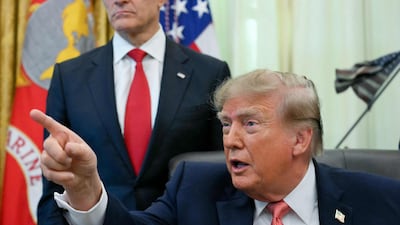

Vice President JD Vance on Wednesday said the US war with Iran was to blame for the Republican Party’s crushing defeat in the midterm elections, arguing that the conflict was the main reason voters across the country swung hard towards the Democrats.
“The reason we lost is the war. The President himself said so last night,” Mr Vance wrote on X, referring to an interview in which Donald Trump told Fox News that the Iran war was “a part” of why the Republicans had lost.
Mr Trump on Wednesday said his deputy's comments were “largely true”, but added that “if I had to do again, I'd have to do it again because long term, it's the only answer”.
The Democrats trounced the Republicans in the midterm elections, securing control of Congress and making gains beyond even their wildest expectations.
Mr Vance said a trusted pollster had warned him before the election that many people who voted for Mr Trump in 2024 were now angry with the administration. Those voters wanted the President to end the Iran war, tackle inflation and the cost of living, put “America First” and “change our relationship to Israel”, he added.
US support for Israel emerged as a significant foreign policy issue in the midterms, with growing scepticism among voters across the political spectrum about continued American military assistance.
Mr Trump appeared to recognise the issue’s political costs on Tuesday, announcing Washington would end about $4 billion in annual aid to Israel by the end of this year.
But he said Israel would still be able to buy American weapons and that Washington would help the country, if necessary. Some critics suggested the announcement was merely sleight of hand, if the US simply changes the channels through which it funds its ally.

Ross Harrison, a senior fellow at the Middle East Institute, said Israeli Prime Minister Benjamin Netanyahu may see the period before a new Israeli government takes office as an opportunity to push Mr Trump towards renewed military action against Iran.
“There's generally a sense in Israel this might be the last pro-Israeli [US] government that's willing to abide by Israeli interests – and sometimes at the expense of US interests – and that that's a window of opportunity,” he told a briefing hosted by the institute.
“My general understanding is that there's been an encouragement by Jerusalem by 'Bibi' Netanyahu for Trump to reignite this war in some fashion.”
'A little bit different'
Mr Vance has previously expressed frustration over the decision to attack Iran and Mr Trump said in March that his deputy was “philosophically a little bit different” and “maybe less enthusiastic” about going to war.
In October 2024 during the presidential campaign, Mr Vance said: “Our interest, I think very much, is in not going to war with Iran.”
Mr Vance's comments highlight a debate within the Republican Party over the cost of military intervention in the Middle East. When the Democrats take control of Congress in January, they will use their power of the purse to demand answers about how much the war has cost so far.
Ryan Crocker, a former US ambassador to Iraq and other countries in the region, said the Democrats’ control of both chambers will give them “unprecedented leverage”, particularly through their power over government spending.
“We have seen the [Pentagon's] request for dramatically increased funding to support the war with Iran,” Mr Crocker said at the briefing. “So I think that'll be the first battleground.”
Democrats could use their control of congressional appropriations to scrutinise or seek to restrict funding for further military operations against Iran. They could also use committee hearings and investigations to demand answers about the war and to grill its architects.
Beyond the immediate question of the Iran war, Mr Crocker said the conflict had exposed the vulnerability of the traditional US military presence in the Gulf, raising wider questions about how Washington projects power in the region.
“The whole nature of American force projection in the region and indeed globally has to be rethought and reconsidered,” he said, arguing that any reassessment should be undertaken with Gulf allies and on a bipartisan basis.
John Herbst, the senior director of the Atlantic Council’s Eurasia Centre, said officials in Saudi Arabia, the UAE and Qatar were probably relieved for some breathing space from the midterm results, but remained deeply anxious about the prospect of renewed conflict with Iran.
"They were really worried about about a immediate escalation and a return to a return to war," Mr Herbst said.
The war had so far avoided attacks on critical energy, electricity and water infrastructure, he noted, warning that a new escalation could put those assets in the firing line.
"They are very concerned about the lack of predictability from Washington these days, about the very small circle of decision-makers and influencers on the decisions that directly affect them, and very happy to get another another week or two to continue to work these issues," Mr Herbst said.
The election will not give Democrats control of the White House or the power to dictate military strategy and Mr Trump remains commander-in-chief, with the power of veto.
But a Democratic-led Congress will be able to subject his Middle East policy to much closer scrutiny and make it harder to secure the funding needed to pursue it.