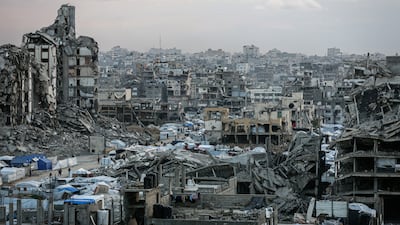

The US-backed Board of Peace on Wednesday proposed a six-month $2.45 billion plan to begin rebuilding Gaza and restoring basic services, as efforts to implement President Donald Trump’s ceasefire plan face major challenges.
At a meeting in New York on the sidelines of the UN General Assembly, the board of governors unveiled a blueprint covering 66 projects aimed at supporting Mr Trump’s 20-point plan to end the Israel-Hamas war.
These include infrastructure, education and healthcare initiatives, with the first phase designed to address some of Gaza’s most urgent needs and lay the groundwork for longer-term reconstruction and eventual governance.

But the board acknowledged the scale of the challenge ahead.
It estimates that rebuilding physical infrastructure across Gaza will cost about $35.2 billion in the medium term and another $71.4 billion over the next decade.
“A year ago, none of this existed,” said Jared Kushner, executive board member and son-in-law of the Us President, referring to the creation of the Board of Peace, an International Stabilisation Force and a national committee for Gaza.
-

Palestinian Mohammed Al Hasanat shows his inked finger after voting in the Gaza municipal elections at a polling station in the city of Deir Al Balah. Reuters -

Palestinian President Mahmoud Abbas casts his vote at a polling station in Ramallah on the occupied West Bank. AFP -

Palestinians wait to vote in the municipal elections at a polling station in the occupied West Bank town of Yabad near Jenin city. EPA -

A Palestinian assesses a candidate list at a polling station during municipal elections in Deir Al Balah. AFP -

An officer of the Palestinian security forces on duty at a polling station in the village of Beit Furik, south-east of the occupied West Bank city of Nablus. AFP -

Palestinian electoral workers begin counting votes after the close of polling at a makeshift voting station during municipal elections in Deir Al-Balah, Gaza. AFP -

Palestinian electoral employees begin counting votes for the municipal elections after the close of polling stations in the Israeli-occupied West Bank city of Al Bireh. AFP


“We’re building something that is really a platform to enable the Palestinian people in Gaza to finally focus on improving their livelihoods and improving their lives.”
Mr Kushner said the aim was ultimately to create a Gaza that could “thrive and reach its full potential” but he acknowledged that would require the territory to be fully demilitarised.
“Hamas has agreed to give up the weapons but we need to implement that,” he added.
He described the effort as an “impossible task” and appealed for international support and ideas, as officials work through delays and other obstacles.
“We have to stick with it, we have to be committed,” Mr Kushner said, warning that, without sustained efforts, Gaza was at risk of returning to the same cycle of violence. “Whether we’ll succeed, I think we’re going to need all of your help and all your partnership to do it,” he said.
The six-month blueprint is largely aimed at potential international donors, as the board seeks financing for its first projects and tries to build momentum behind a much larger reconstruction effort.
Nickolay Mladenov, the Board of Peace’s High Representative for Gaza, said the next challenge was moving from planning to implementation, acknowledging that talks with Israel remained difficult during the country’s election campaigning.
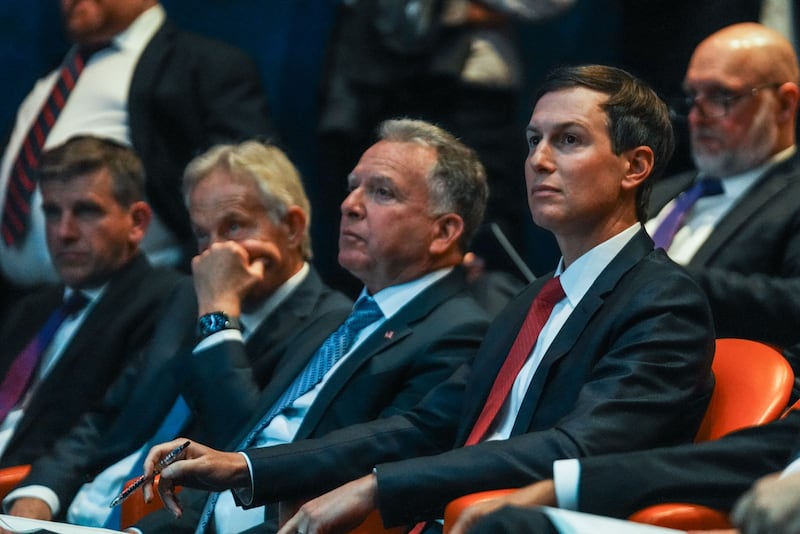
“Our goal is to get through the next stage of actually moving from planning to implementation,” Mr Mladenov said.
He said the ultimate goal was a demilitarised Gaza under civilian control, allowing reconstruction to proceed alongside an Israeli withdrawal.
Mr Mladenov said talks with Israel were continuing, while progress had been made in recent weeks on water, sanitation and hygiene services in Gaza.
Ali Shaath, chief commissioner of the National Committee for the Administration of Gaza, said reconstruction would eventually cover the entire 365-square-kilometre Gaza Strip rather than focusing on areas divided by current military lines.
Mr Shaath said the plan envisaged work proceeding sector by sector, beginning in Rafah before moving to Khan Younis, the central camps, Gaza city and northern Gaza, as Hamas relinquishes governance, weapons are decommissioned and Israeli forces withdraw.
“The National Committee for the Administration of Gaza is luckily colour blind,” Mr Shaath said, before adding plans would cover the entire territory “with no bias among the people of Gaza”.

Asked by The National how he saw the future for Palestinians in Gaza, Mr Shaath said the committee wanted to restore basic services and give Palestinians the ability to shape their own future.
He also rejected the displacement of Palestinians from the enclave. “We are against evacuation of Gazans out of Gaza,” he said. “We want them to stay and live in Gaza, with hope and prosperity.”
The committee was established as a Palestinian technocratic body responsible for Gaza’s day-to-day civil administration and public services under the oversight of the Board of Peace.