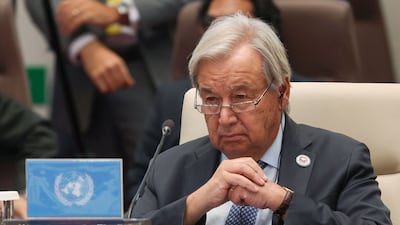

UN Secretary General Antonio Guterres on Wednesday described the situation in Sudan as “absolutely horrible” and called for countries supplying weapons in the conflict to be held to account.
Speaking before next week’s UN General Assembly gathering in New York, Mr Guterres said Sudan's warring sides bore responsibility for the conflict but also highlighted the role of foreign powers.
“What is happening in Sudan is absolutely horrible. The humanitarian situation in Sudan is devastating. The level of suffering of the Sudanese people is intolerable,” he said.

“In my opinion, there should be accountability for the kind of interference in which some countries provide weapons to parties to a conflict when those weapons are used massively to attack civilians."
Several countries have been accused of supporting one side or the other in Sudan's civil war.
Massad Boulos, US President Donald Trump’s senior adviser on Arab and Middle Eastern affairs, said on Tuesday that there was “no future” political role for either of Sudan’s two warring generals, throwing Washington’s support behind a rapid transition to civilian rule.
“We see a future in the civilian transition. It needs to happen quickly and seamlessly, away from the two warring generals. We support this track only,” he said.
Mr Boulos added that Mr Trump had been “very clear” on Sudan and that addressing the humanitarian crisis remained a US priority.
Artificial intelligence
Mr Guterres also warned against a global “race to the bottom” on artificial intelligence safety, calling for international guardrails as increasingly powerful AI systems develop faster than our understanding of their risks.
He said governments had a responsibility to protect their citizens from potential AI threats and that national measures alone would not be enough.
“AI does not stop at borders and neither do its risks,” he said. “Voluntary pauses that are isolated, unverifiable and unevenly applied will not address the problem.
“We cannot afford to ignore concerns that have been raised, especially by those on the front lines of the development of AI."
The UN chief said AI would be a major subject of his meetings with world leaders next week. He acknowledged that geopolitical divisions could complicate efforts to establish common rules, but said international co-ordination was essential.
“The world cannot afford a race to the bottom on AI safety,” Mr Guterres said. “We need guardrails to build trust and that make AI safe, transparent, accountable, with human dignity at the centre.”
Former Anthropic researcher Jacob Coxon said last week that he had resigned partly because some people developing AI believe the technology could pose an existential threat by the end of the decade.
West Bank and Gaza
On Palestine, Mr Guterres said he was “extremely worried”, citing continued Israeli strikes in Gaza and growing settlement violence and activity in the occupied West Bank.
He said Israel was not accepting the peace plan “as it is conceived now”, while civilians in Gaza continued to face serious threats.
Mr Guterres said it was time to stop the “creeping annexation” of the West Bank, driven by settler violence that he said was sometimes supported by Israeli security forces and was “absolutely intolerable”.
He also warned that if the proposed E1 Israeli settlement project was completed, it could split the territory in two. He said it was “entirely against international law” and a threat to Middle East peace.
Mr Guterres said actions that could lead to “ethnic cleansing” must also stop and that conditions should be created to put a two-state solution “seriously on the table”.