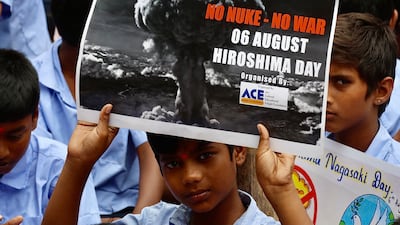

UN Secretary General Antonio Guterres has warned that the world is entering its most dangerous nuclear period in decades.
The US and Israel launched renewed strikes on Iran's nuclear sites earlier this year, with the regional conflict reigniting global concerns about the risks of military action involving states with advanced nuclear capabilities.
"Eighty-one years ago, Hiroshima was reduced to ruins. Tens of thousands of people were killed. And our world came face to face with the catastrophic power of nuclear war," Mr Guterres said in a video message marking the anniversary of the bombing of the Japanese city on August 6, 1945.

"Have we learnt the lessons forged in flame here 81 years ago? Will humanity choose a future of peace? Or will we continue to live under the shadow of nuclear annihilation?"

The US dropped the world's first wartime atomic bomb on Hiroshima, killing an estimated 140,000 people by the end of 1945. A second bomb destroyed Nagasaki three days later, killing 74,000, forcing Japan to surrender and bringing the Second World War to an end.
Mr Guterres said that decades after the Hiroshima bombing, worsening geopolitical rivalries and renewed reliance on nuclear deterrence had pushed humanity closer to catastrophe.
After the Hiroshima and Nagasaki bombings, nuclear arms control agreements, diplomatic engagement and the gradual reduction of nuclear eased lowered fears of another atomic confrontation. Mr Guterres said the trend was now reversing.
He noted that worldwide military spending surged to $2.9 trillion in 2025. "Nuclear sabres are being rattled once again in the name of power and coercion," he added.
The UN leader called on governments, “especially nuclear-armed states”, to reverse the current trajectory and abandon “the zero-sum logic that nuclear weapons are the ultimate guarantee of security, when they are in fact the very opposite".

The appeal comes after months of concerns over nuclear risks linked to the conflict with Iran.
Last month, the UN warned the Security Council that its nuclear watchdog had lost its ability to fully monitor or access facilities tied to Iran's nuclear programme, after successive US and Israeli strikes.
The International Atomic Energy Agency's June report said Iran remained the only state without nuclear weapons that is party to the Nuclear Non-Proliferation Treaty that has enriched uranium to 60 per cent purity. It warned that the agency's year-long loss of continuity of knowledge over declared nuclear material was “a matter of proliferation concern” that required urgent action.