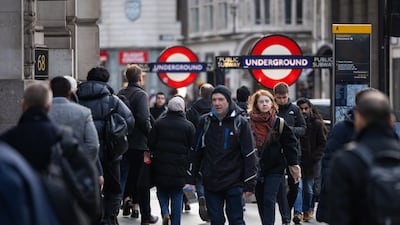

The first of eight 24-hour strikes on London Underground is due to begin today, causing disruption for travellers across the capital city.
Although the Tube strike takes place from midday on Thursday until midday on Friday, the disruption will be felt for several more hours either side.
The industrial action is due to a long-running dispute between Transport for London and the RMT union over a voluntary four-day working week planned for train drivers.

Separately, a surprise strike by Eurostar staff resulted in the cancellation of at least seven trains between London and Paris on Wednesday. As staff had not announced the action it was not clear whether the disruption would last into Thursday.
When are the London Underground strikes?
This week's strike runs from midday on Thursday to midday on Friday. However, services will be reduced from around 10am on Thursday and are not expected to be back to normal until around 6pm on Friday.
The next strike is due to cause even more chaos as two days of industrial action are being pushed together just before Christmas. Services will be disrupted from Thursday, December 17 to Friday, December 18, then Saturday, December 19 to Sunday, December 20.
Similar disruption will follow in the first full week of 2027, with further action on January 4 to 5 and 6 to 7. This will be followed by strikes on February 17 to 18, 23 to 24, and 25 to 26. The stoppages start and finish at midday.
Which lines will be disrupted?
There is no service on the Circle or Piccadilly lines all day, affecting Tube travel from Heathrow Airport into central London.
Experience from previous 24-hour strikes suggests travellers should be braced for problems on all lines from early morning. TfL says a normal service should operate on “most” lines until 10am before they start to be reduced, which would probably affect the Victoria, Jubilee, Bakerloo, Central and Metropolitan lines.
From midday, there will be disruption on all lines with no service on the Waterloo & City line.
No service is expected on any lines after 9pm.

What are the alternatives?
During the strikes, all other TfL services such as Elizabeth line (which runs to Heathrow and beyond), DLR, London Overground, buses and trams will be operating as normal but will inevitably be busy. The Heathrow Express from Paddington is also expected to operate as normal.
For travellers heading to Gatwick Airport, the Gatwick Express from Victoria will be running as will the Thameslink which runs through St Pancras International, Farringdon, City Thameslink and London Bridge. However, you may struggle to reach those stations on public transport so a taxi or bus is the likely alternative.
The same applies for those heading to Stansted airport. Stansted Express trains will still run from Liverpool Street and Tottenham Hale.
Why is there industrial action?
Last-ditch talks to avoid the strike failed on Tuesday. It is part of a dispute between London Underground, run by TfL, and the RMT. The union objects to a proposed four-day working week, saying train drivers would face longer hours driving, earlier starts and later finishes. It also said it would affect rights on travelling between depots as well as annual leave arrangements.
TfL says the changes are voluntary, which the RMT disputes. The changes are backed by the Aslef train drivers’ union.
TfL says the reforms would give drivers, many of whom earn more than £70,000, more time off and would reduce weekly working hours from an average of 36 to 34.