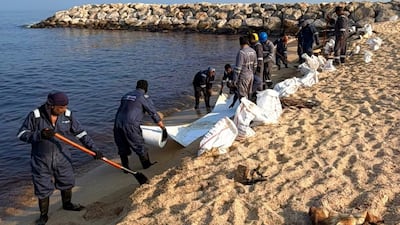

Hundreds of workers are continuing to clean up oil spills around the UAE, and equipment has been flown in from as far away as the US to help with efforts.
The work – with one company reporting “overwhelming" demand for its services – is taking place even as some beaches have been reopened after cleaning.
Among the companies involved is Evogreen, a joint venture between Sharjah-based Beeah Group and Polygreen, a Greek-owned company with offices in Dubai.

Dr Vassilios Mamaloukas Frangoulis, director of oil spill response services at Beeah Group, said the firm had about 1,000 people working in Umm Al Quwain, Sharjah and Ras Al Khaimah.
Although a large length of coastline has been affected, Dr Frangoulis said the clean-up was “quite manageable” and “technically straightforward”.
Flushing sand
Among the processes being carried out is flushing sand – using a low-pressure hose to release “huge quantities of water” in the upper parts of beaches to clean out the oil.
Washing equipment is also being used to clean oil off hard surfaces, such as stone walls, Dr Frangoulis said.
“Whatever we collect from the sand or the rocks, we collect with absorbent material or mechanical methods, like skimmers,” he added.
“It’s a very large operation. We have 1,000 people working every day in the sites. With all this we need a lot of qualified personnel. We employ workers, but qualified personnel are needed to train the people and guide them.”
Dr Frangoulis said the company had almost 100 pieces of equipment being used, including three oil skimmer boats.
“It’s a lot of equipment in the various sites,” he said. “All this has to be supported logistically. The spill is a big one.”

There is also a lot of pumping equipment deployed, including hoses to wash down the sand, Dr Frangoulis said.
Large amounts of hazardous waste – oil, contaminated beach material, oil-saturated absorbents, debris and personal protective equipment – are generated and processed at Beeah’s site in Sharjah.
Particular areas are being prioritised for cleaning, Dr Frangoulis said, including beaches in Sharjah and those in front of hotels in Ras Al Khaimah.
Operations continue
In some locations, the company will complete its operations within the next few days, while in others the work is likely to take “a few months at least” and will continue into next year.
A complicating factor, Dr Frangoulis said, is that strong winds can move oil that is very close to the shore.
Because of their sensitivity, areas such as mangroves that have been affected by oil need to be dealt with using “less drastic interventions”.
He said that in other locations that had been affected by oil spills, such as Mauritius, mangroves had been flushed with large quantities of water, making the clean-up process quicker.
Some flushing may be tried in the UAE, Dr Frangoulis said, although he added that, as the mangroves were tidal, they naturally had some circulation.
As reported in The National, seven public and hotel beaches in Ras Al Khaimah were deemed safe for visitors after cleaning on Wednesday, while Sharjah opened its beaches on Thursday.
The presence of the oil spill was confirmed by the Ministry of Climate Change and Environment on October 22 following reports in the previous days of a fuel-like smell.
A supertanker, Gem No 2, whose crew were rescued after it was hit by a suspected Iranian drone in early October, was the source of the spill.
More recently, beaches on the east coast were closed because of oil contamination, although the source of the pollution has not been confirmed.

Also helping with efforts is Ecocoast, a company in Dubai that produces booms, the floating structures used to contain oil. Ecocoast was established in the UAE in 2009, and its production plant is in Umm Al Quwain.
“There’s a lot of proactive [action] to contain the oil before the oil reaches the coastline. It’s definitely helping to reduce the impact of the slick,” said the chief executive, Joachim De Jenlis.
The booms, consisting of PVC panels, aluminium connectors and flotation devices, are modular and can be built to whatever length is required.
The company has increased production and has focused exclusively on oil containment booms, Mr De Jenlis said.
“This is the first time we’ve experienced a spill of that amplitude, that scale,” he added. “In order to cope with demand we have managed to double the production output by adding machines, by adding resources. We manufacture everything locally.
“The priority was to keep the standard the same, so we ensure the integrity of the production remains the same.”
The booms are used to divert the oil to skimmers or locations where absorbent materials can be used to absorb the oil.
Mr De Jenlis said the company had its own teams of divers and boats to install booms, but demand had been “overwhelming”.
“Boats have been at sites constantly for the last two weeks,” he said. “We support the oil response teams working day and night.”
After the recent spills, he said there was more “preparedness and interest in case the spill reaches other locations”.
“There are developers, ports, marinas also contacting in order to be ready in case something happens,” he said.
Winds complicate clean-up
A key to limiting the impact of oil spills is containing them early on, said Rob Mortimer, chief executive of Dubai-based Fuelre4m, which supplies vegetable-based substances used to disperse oil slicks. The company has not been involved in the local operations.
Once winds – which he said could be strong in the Arabian Gulf – began dispersing oil, clean-up work became “quite challenging”, especially when it reached the coast.
It was important, he said, that substances used to clean up after oil spills were not themselves harmful to the environment.
“It’s regulated to make sure when you’re doing the clean-up you’re not doing more damage to the environment,” he said.
When the oil is in the sea, an important task is to make it as light as possible so that it remains on the surface for removal and heavier components do not sink.
If oil has polluted a sandy beach, the aim is to clean the sand so that pollution accounts for less than one per cent of the volume of sand, Mr Mortimer said.
“The smaller you can get it, nature can start playing its part – algae and bacteria can start eating the oil,” he added.