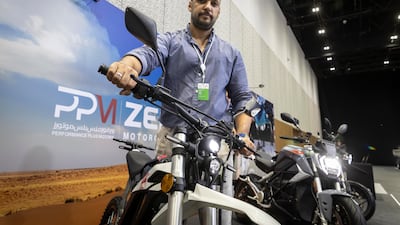

A new electric bike approved for use on high-speed roads has been showcased at the EV World exhibition in Dubai. But its top-speed of 110kph has led to renewed concerns over the safety and regulation of high-performance electric two-wheelers.
The Zero XE recently went on sale in Abu Dhabi for Dh25,000 ($6,800). It comes fitted with lights, indicators, a horn and a number plate. Zero Motorcycles, its US manufacturer, said the bike has been registered with the Roads and Transport Authority and Abu Dhabi Police.
The e-bike has a range of around 100km on one charge. Its top speed allows it to be registered for use on public roads with a higher speed limit than the usual 60kph for e-bikes.

Thomas Edelmann, founder of RoadSafetyUAE, said electric two-wheelers capable of exceeding 100kph should be treated as motorcycles rather than micromobility devices.
He warned their speed and performance could increase the risk of collision and serious injury, particularly when ridden by inexperienced young people.
The growing popularity of modified electric bikes has become a concern in residential communities, where young riders have been reported travelling at high speeds and performing stunts.
Their use is restricted to designated tracks, while riding on main roads can incur a Dh300 fine.
Shehab Al Zainy, Middle East brand manager for Zero Motorcycles, said the model was built to meet road requirements and cannot be modified or upgraded to increase performance. “These bikes are made from the factory to be road legal,” he said.
He said this was intended to address concerns about young riders altering electric bikes to make them faster.
According to Mr Al Zainy, the Zero XE is safer than many rival models. “Parents are complaining that their kids buy the bikes based on the numbers that they see but then they download software, change the parts and they become very unsafe to use on the road.”
Safety concerns raised
Mr Edelmann said existing regulations need to address the emergence of high-performance electric bikes and called for clearer rules governing their use.
“These devices are very close to conventional motorcycles, so they need to be registered, you have to have a licence and these vehicles need to be inspected,” he said.
He also called for stronger enforcement, and pointed out that young riders have been seen travelling at speed on walkways and main roads, sometimes without lights.
“There are many viral videos also going around, with guys on the streets performing all kinds of stunts with these e-motorbikes and people are ignoring the rules.”
In Dubai, conventional e-bikes are subject to speed limits of between 20kph and 25kph in public and designated areas, and are prohibited on roads with higher speed limits.
Mid-powered electric bikes capable of reaching speeds of up to 45kph require a permit but cannot be ridden on main roads. Faster and more powerful vehicles require a full motorcycle licence and insurance.
Mr Edelmann said the growing range of electric two-wheelers meant regulations needed to evolve to distinguish between conventional bicycles, micromobility devices and vehicles with motorcycle-level performance.
The UAE has recorded a sharp increase in accidents involving motorcycles, bicycles, scooters and e-bikes, Ministry of Interior data shows.
Major accidents involving e-bikes rose from 20 in 2023 to 62 last year. E-scooter accidents increased over the same period, from 46 to 120, amid wider access to personal EVs.
Lithium-powered batteries and programmable motor controllers can significantly increase the speed and performance of electric bikes. Modified models have been reported to reach speeds approaching 100kph.
“In the micromobility segment, we see the number of accidents going up very strongly, which substantiates that more needs to be done in this critical segment of road safety,” Mr Edelmann said.
The e-bike was among a range of electric transport solutions showcased at the three-day EV World exhibition, which brought together companies working on the next generation of mobility technology.

Dawood Al Shezawi, president of EV World, said Dubai was making progress towards its electric mobility ambitions.
“Electric buses and taxis are in our fleets, charging networks are being built across the country, and robotics and autonomous driving are moving into daily life,” he said. “It's no longer a question whether the transition will happen, but how fast it will happen and who will lead it.”
UAE's electric mobility goals
The UAE's national EV policy aims to have 50 per cent of vehicles on the country's roads powered by electricity by 2050.
Achieving the target will require advances in battery technology and substantial investment in charging infrastructure, while addressing concerns about driving range remains a challenge for motorists considering switching to EVs.
Mansoor Rahma Alfalasi, group chief executive of Dubai Taxi Company, said the shift towards electric public transport had accelerated since the company introduced its first hybrid taxi in 2008.
Almost 91 per cent of the company's fleet is now fully electric or hybrid, he said. Mr Alfalasi added that he hoped it would be entirely electric by the end of 2027.

Dubai's taxis are shared between two drivers, with breaks between shifts allowing vehicles to recharge at one of about 200 dedicated charging stations. This enables the fleet to operate round the clock.
Autonomous taxis are also expected to play a growing role in the emirate's transport network.
Mr Alfalasi said Dubai Taxi Company was testing the technology with a partner and expected more autonomous vehicles to appear on the roads in the near future, with services expanding across various zones.
He said safety, reliability and ease of use would be central to their introduction.