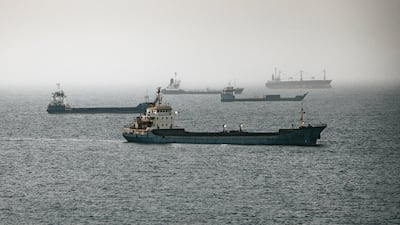

UAE authorities are working to tackle an oil spill from a supertanker in the Arabian Gulf.
The Ministry of Climate Change and Environment confirmed the incident early on Friday morning. The spill is the cause of a strong smell that residents of Dubai and the northern emirates have reported in recent days, it said.
The ministry did not name the vessel, but international maritime agencies say the Gem No.2 was struck in a suspected Iranian drone attack on October 9 to 10. Twenty-two Indian sailors were rescued from the 330-metre vessel at the time.

The extent of the oil slick is unclear, but confirmation of the incident came amid growing concerns about the environmental impact of the Iran war on the Gulf and the Arabian Sea.
People in the UAE have in recent days reported an acrid and strong fuel smell in the air. The ministry said there was no health risk from the odour, but advised the public to stay away from any oil that washes ashore.
"The Ministry of Climate Change and Environment confirms the UAE’s technical monitoring and environmental assessment system detected a tanker oil spill affecting Umm Al Quwain’s beaches," it said in a statement. "Odours noticed in Sharjah, Ajman and Umm Al Quwain pose no health risks to residents.
"Teams immediately began containment, cordoning, clean-up and remediation with local and federal authorities to limit environmental impacts. Precautionary coastal surveys, monitoring and assessments continue to gauge impacts and protect the marine environment.
"With relevant authorities, the ministry has temporarily closed all Umm Al Quwain beaches and coastal areas until technical teams complete assessments and identify safety and marine protection measures. Fishermen and sea users are urged to follow authorities’ instructions and avoid fishing in affected areas."
Lingering effect of oil spills
Dr Diana Francis, an associate professor and head of the Environmental and Geophysical Sciences Lab at Khalifa University in Abu Dhabi, said oil spills caused by the regional conflict could create odours.
“When an oil spill happens, it continues to move with the currents unless it is removed and cleaned completely,” she told The National before the ministry confirmed the oil slick incident. “Several spills can also move with the currents and accumulate in favourable gyre [rotating ocean current] areas. Then with time, heat and winds, they evaporate into the air and give off fuel-like odours.
“Oil doesn't mix with water. It continues to float until it is removed or evaporate with time.”
Prashant Kumar, professor of air quality and health at the University of Surrey in the UK, said air pollution – and the smells that it brings with it – can travel over long distances.
“The smell can travel tens of kilometres,” he said, in comments also made before the ministry's statement on Friday. “It depends on the meteorological conditions, it depends on the wind speed and the wind direction. You can easily have the longer-range transport of pollutants from one place to another.”
Additional reporting by Daniel Bardsley