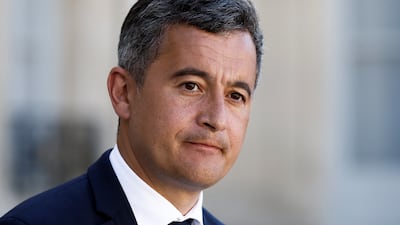

The UAE’s relationship with France in combating organised crime is the perfect model for the international community to adopt, the French Justice Minister has said.
Gerald Darmanin told The National that France and the UAE had developed complete co-operation against drug trafficking and the financial networks that prop up organised crime gangs, including money laundering through cryptocurrencies and property.
He suggested the partnership could provide a potential model for the Abu Dhabi Declaration, a framework announced for international efforts on crime prevention, criminal justice and the rule of law through to 2031.

“The work we completed with the UAE must be replicated at the multilateral level, fighting traffickers, fighting money laundering, and seizing and confiscating the proceeds of crime,” said Mr Darmanin.
The French Justice Minister was speaking on the sidelines of the 15th UN Congress on Crime Prevention and Criminal Justice, which opened in Abu Dhabi on Saturday.
There were 28 French citizens extradited from the UAE since January 2025, while 33 apartments owned by a suspected French drug traffickers were seized in the UAE last year, he said.
Abdullah Al Nuaimi, Minister of Justice, previously told the congress that “crime has no borders”, referring to alleged kingpin Daniel Kinahan, who was arrested in the Emirates 48 hours after an extradition request from Irish authorities and is now in custody in Ireland awaiting trial.
Mr Al Nuaimi said the UAE is party to 16 universal and regional multilateral agreements and has more than 140 bilateral agreements in force with 53 countries.
These cover extradition, mutual legal assistance, asset freezing and confiscation, evidence gathering and the transfer of people who have been sentenced.
Throughout 2025, the UAE received a total of 576 extradition requests. Courts issued decisions in 178 cases, while the remaining requests were either under review or awaiting additional information.
Mr Al Nuaimi also highlighted co-operation with authorities in France involving four people, which led to the identification, tracing of assets and the seizure of 82 properties in the UAE last November.

Different approaches
International criminal gangs are increasingly exploiting differences between national judicial systems, added Mr Darmanin.
“Organised crime has no border,” he said. “It thrives on differences between judicial systems and on the lack of international judicial co-operation.”
The UAE partnership was now focused not only on capturing suspects but also on following the money behind criminal networks.
“With the UAE, we have built comprehensive 360-degrees co-operation,” the French minister said. “It means tackling drug trafficking in both our countries and also going after drug money, which is the lifeblood of these networks.”
This would include targeting money laundering through cryptocurrencies and property, he added.
France wants the Abu Dhabi Declaration to translate those efforts into broader international action, Mr Darmanin said.
The minister’s comments come as governments debate how to respond to criminal networks that increasingly operate across borders and use technology to conceal their activities.
He warned criminals were operating at the cutting edge of technology, putting pressure on governments and law-enforcement agencies to adopt new measures quickly.
“The whole challenge for public authorities is to adapt to technological change in order to fight criminals on equal terms and not fall behind,” he said.
One concern is the use of encrypted messaging services by criminal networks. “It is necessary for us to have access to them in order to carry out our investigations,” Mr Darmanin said.
He said the fight against organised crime must involve the pursuit of alleged offenders and the assets generated by their activities.
“We must go after criminals so that everyone knows that turning to crime comes at a heavy price, which acts as a deterrent,” he said.
“But we must also go after the money from crime and drugs, and seize everything acquired with that money like financial assets, cars, luxury goods and real estate.”