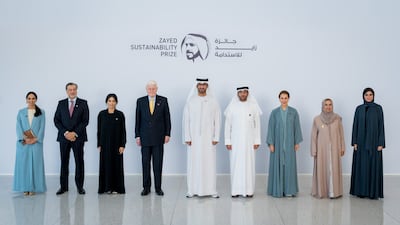
The Zayed Sustainability Prize has announced its 2027 finalists after a record 10,233 entries from 177 countries, a 32 per cent increase on last year and the most competitive cycle in the award's history.
The shortlisted innovators include AI that predicts pregnancy complications months in advance, robots that inspect water pipes and heat-resilient corals that rebuild reefs.
They are spread across the categories of health, food, energy, water, climate action and global high schools.

Winners will be announced on January 12 at the awards ceremony during the Abu Dhabi Sustainability Week.
Dr Sultan Al Jaber, UAE Minister of Industry and Advanced Technology and director general of the Zayed Sustainability Prize, said: "The finalists' work demonstrates that the most powerful solutions are those rooted in real-world needs, breaking down barriers and delivering meaningful, measurable impact."
Every finalist is guaranteed funding, extending the prize's support beyond the eventual winner.
Organisational finalists across health, food, energy, water, and climate action will receive $100,000 (Dh367,250) each, while global high school finalists will receive $25,000 each. Those who go on to win their category will receive the winner's award: $1 million for organisational categories and $150,000 for Global High Schools.
Introduced in 2026, the increased funding recognises both the proven impact and the potential of solutions that reach the Prize’s final evaluation stage.
"Their work shows that meaningful progress is built not only through technology, but through determination, local knowledge and the capacity of communities to adapt and thrive," said Olafur Ragnar Grimsson, chairman of the prize jury.
Zayed Sustainability Prize categories
Now in its 18th year, the prize continues to draw a diverse range of small and medium-sized enterprises, non-profit organisations, and high schools that develop solutions aimed at improving lives.
Health
- Elythea (US) uses AI to predict pregnancy complications six to eight months in advance and has cut adverse maternal outcomes in a five-country trial, reaching more than 63,000 people.
- Goal 3 (Netherlands) pairs bedside vital-sign monitors with tablet-based records to catch deterioration early in children and newborns across 48 hospitals.
- Marsi Bionics (Spain) has helped more than 3,000 children walk with its robotic paediatric exoskeleton.
Food
- Adaptive Symbiotic Technologies (US) uses soil microbes to help crops withstand drought, heat and salinity, raising yields by 30 to 200 per cent across more than 13 million acres.
- ALSEC Alimentos Secos (Colombia) turns by-products of cheese manufacturing into protein ingredients and clean water at a solar-powered plant, recovering 22.7 million litres of whey.
- Towing (Japan) makes a microbe-enhanced biochar that restores soil in about a month instead of three to five years.
Energy
- Energy Assured (Nigeria) supplies pay-as-you-go solar systems, clean-burning stoves and solar irrigation pumps to more than 4.6 million people.
- Flint (Singapore) makes a rechargeable cellulose-based battery free of lithium, cobalt and nickel.
- Sustain Plus (India) has deployed more than 34,000 community-owned clean energy systems, reaching 2.5 million people.
Water
- Aguatuya Foundation (Bolivia) converts wastewater into irrigation water, compost and biofungicides, recovering 1.08 million cubic metres a year.
- Rupantar (Bangladesh) runs women-owned water enterprises that supply safe water to about 450,000 people.
- Solinas (India) sends AI-equipped robots inside water and sewer pipes to find and fix leaks, benefiting 17 million people.
Climate Action
- Aquafondo (Peru) revives ancestral Andean water systems, restoring more than 6,000 hectares and adding 14 million cubic metres of groundwater a year.
- Coral Gardeners (French Polynesia) has planted more than 221,000 heat-resilient corals using AI and 3D reef mapping.
- String Bio (India) makes a microbial treatment for rice paddies that cuts methane emissions by up to half and lifts yields by up to 39 per cent.
Global High Schools
Applied Technology Schools, Ajman, represents the UAE in the Middle East and North Africa region alongside schools from Syria and Lebanon.
The other finalists come from Canada, Colombia and Argentina (Americas), DR Congo, Kenya and Mauritius (Sub-Saharan Africa), Portugal, Kazakhstan and Turkey (Europe and Central Asia), Sri Lanka, Bhutan and Nepal (South Asia), and Indonesia, Fiji and China (East Asia and Pacific).
The Zayed Sustainability Prize has had a positive impact on more than 411 million lives worldwide, expanding access to healthcare, nutritious food, reliable energy and safe water while supporting stronger and more resilient communities.