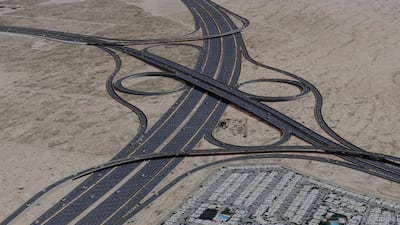
Dubai has approved a new 80km motorway connecting the emirate to Sharjah and Abu Dhabi in a major drive to tackle congestion.
The first phase, which will cost Dh3.5 billion, is expected to cut travel times by up to 60 per cent and strengthen connectivity between emirates. This stretch will run from Al Shanouf Road to Dubai-Al Ain Road.
Announced by Sheikh Hamdan bin Mohammed, Crown Prince of Dubai, on Wednesday, the scheme will serve as an alternative route to the heavily congested Sheikh Zayed Road, Al Ittihad road, Sheikh Mohamed bin Zayed Road and Emirates Road.

The 12-lane road will accommodate up to 24,000 vehicles per hour in both directions and is expected to serve more than 3.1 million people.
The motorway will include 72 bridges, 17 tunnels and 45 stormwater drainage culverts and will form a major new transport link across the UAE. Phase two will extend from Dubai-Al Ain Road to Al Faya Road in Abu Dhabi.

"This project reflects our continued commitment to investing in infrastructure as a driver of economic growth, a foundation for enhancing quality of life, and a key pillar of Dubai’s readiness for the future," said Sheikh Hamdan.
The new road network will connect with Al Maktoum International Airport and Etihad Rail, linking road, air and rail journeys.
The scheme seeks to tackle road congestion and boost public transport, serving several residential and development areas, including Madinat Latifa, Madinat Hind, Al Yalayis, Al Awir and Dubailand.
The motorway strengthens Dubai’s road network and its connectivity with the UAE's federal road network, to keep pace with a significant population boom and a surge in registered vehicles.
Current highways are arterial roads through the heart of UAE cities, connecting business districts, providing access to major residential neighbourhoods, and boosting tourism. Sheikh Mohamed bin Zayed Road, for example, stretches from Abu Dhabi to Ras Al Khaimah, connecting key areas such as Expo City Dubai and Al Maktoum International Airport, as well as the Northern Emirates.
Emirates Road allows motorists to travel between the Northern Emirates and Abu Dhabi without going through central Dubai, but it has become far more congested at peak times than it was a decade ago.
The new route is expected to support the UAE’s logistics and commercial transport sectors by improving connectivity between residential, industrial, commercial and transport hubs.
In November 2025, the UAE announced its intention to build a fourth federal motorway and invest Dh170 billion ($46 billion) in major upgrades to existing motorways under a five-year action plan.
The plan includes adding six lanes to Al Ittihad Road, three in each direction, which connects Sharjah with Dubai and becomes gridlocked daily.
Emirates Road is to be expanded to 10 lanes, increasing capacity by 65 per cent and reducing average travel time by 45 per cent. Sheikh Mohamed bin Zayed Road is to be widened to 10 lanes, increasing capacity by 45 per cent.