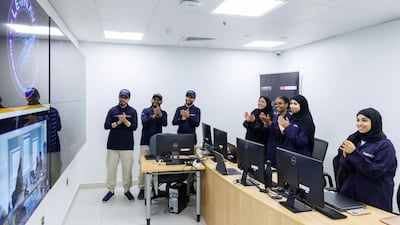
The United Arab Emirates University has launched a satellite to support environmental protection work.
The SEO satellite was launched on Sunday aboard a carrier rocket from the Taiyuan Satellite Launch Centre in China, state news agency Wam reported on Monday.
The launch was announced by the National Space and Science Technology Centre at the university.

The satellite will play an important role in the centre's work to develop national space projects and support UAE ambitions in science, technology and innovation, Wam reported.
The mission is designed to support research and technology related to sustainability and future development by providing data for environmental protection, natural resource management, planning and decision-making, it added.
Salem Al Qubaisi, director general of the UAE Space Agency, said the launch was in line with the UAE's vision and National Space Strategy to strengthen the country's position among global leaders in the sector and expand the contribution of advanced science and technology to sustainable development and the knowledge economy.
Mr Al Qubaisi said the mission highlighted the importance of co-operation between national and academic institutions in building an advanced space ecosystem and developing Emirati capabilities.
The SEO project will also provide researchers and engineers with practical expertise in satellite design, development and operations, said Dr Nabil Mohammed Al Bastaki, director of the National Space and Science Technology Centre.
The satellite project, developed in co-operation with partners in China, set out to involve Emirati engineers, researchers and students in all stages.
Another satellite designed by the national centre was launched in July. Leonav-1, supported and funded by the UAE Space Agency, is part of a mission to develop satellite navigation systems that can operate in low-Earth orbit.
A booming satellite industry is central to maintain the growth of the UAE's space sector.
In June, Abu Dhabi-based Space42 announced that a cluster of satellites primed to bolster disaster responses and tackle climate change were now fully operational.
The trio of satellites, called Foresight-3, Foresight-4 and Foresight-5, harness advanced-radar technology to capture high-resolution images of the Earth's surface in all conditions, day or night.
They were launched into orbit aboard a SpaceX rocket from Cape Canaveral in Florida. They expanded Space42's Foresight Earth Observation constellation to five synthetic aperture radar (SAR) satellites.
The UAE launched its first satellite on October 21, 2000. Thuraya-1, a communications satellite built by Boeing and commissioned by Thuraya Telecommunications Company in Abu Dhabi, was propelled into the skies on board a Sea Launch Zenit-3SL rocket from a mobile platform in the Pacific.
Growing space programme
Dozens of satellites and other spacecraft have been launched by the UAE since Thuraya-1.
Some have been built domestically, including the Mohammed bin Rashid Space Centre’s KhalifaSat and MBZ-Sat Earth observation satellites.
In May, Sheikh Hamdan bin Mohammed, Crown Prince of Dubai, Deputy Prime Minister and Minister of Defence, set out the Dh1 billion ($272.2 million) International Space Co-operation Programme.
In October 2025, the UAE Space Agency unveiled a digital platform to allow researchers, students and start-ups access to satellite images for their projects.
The agency teamed up with Space42 to connect users to data from more than 300 satellites operated by partners such as Nasa, the European Space Agency and Maxar.
It also offered users access to some of the UAE’s high-resolution satellites built by the Mohammed bin Rashid Space Centre.