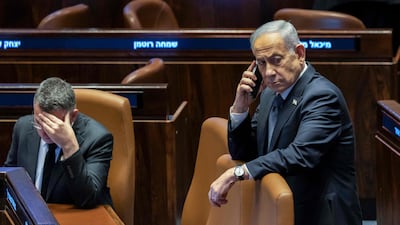
Israel's caretaker Prime Minister Benjamin Netanyahu has offered opposition leader Gadi Eisenkot the chance to lead the government first in a proposed power-sharing and rotating leadership agreement.
Mr Netanyahu said late on Saturday that he was prepared to set aside the principle that the leader of the largest party should be head of government.
A coalition led by his Likud party won 53 seats in the October 27 election, but fell short of the 61 needed to govern on its own, forcing Mr Netanyahu to seek a deal.
“My responsibility as a leader obligates me to put everything aside, including the principle of the largest party,” he wrote on X, outlining challenges Israel is facing.
"Likud under my leadership is the largest party in the country, with a large lead of a quarter of a million more voters than Eisenkot’s party," he said.
"Naturally, I should lead the unity government or, at least, be first in the rotation.
"But given the gravity of the existential danger and the possibility that a government will be formed that lacks the ability to confront it, my responsibility as a leader requires me to set everything aside, including the principle of the largest party, and agree that Gadi Eisenkot will serve first as prime minister, while I will serve as alternate prime minister at the beginning of the term."
Mr Eisenkot, who has 28 days to form a government following the October 27 election, welcomed the offer and called for immediate talks.
“If Likud is truly ready for genuine unity, I am prepared to test its seriousness over the next 24 hours,” he said.
He added that Mr Netanyahu had received a detailed proposal on policy issues a week earlier. The two leaders agreed to meet on Sunday morning, Likud said.
Mr Netanyahu's proposal comes as Mr Eisenkot tries to secure a parliamentary majority and end the long-serving Prime Minister's hold on power.
Mr Eisenkot's centrist Yashar party and three other opposition parties won a combined 48 seats in the 120-member Knesset, compared with 53 for Mr Netanyahu's bloc. Neither side has enough seats to govern alone.
Mr Eisenkot has reached coalition agreements with Avigdor Liberman's Israel Beytenu and Yair Golan's Democrats. Talks have also continued with ultra-Orthodox legislators whose support could help secure a majority.
But the power-sharing proposal is being opposed by some within the anti-Netanyahu camp. Several influential politicians have ruled out joining a government with the Likud leader, while potential partners are demanding concessions including a state commission of inquiry into the October 7, 2023 Hamas-led attacks and legislation on military conscription.
Mr Golan dismissed Mr Netanyahu's offer as a political gimmick, saying the election result should be respected and a change of government was needed.
Naftali Bennett, a former prime minister and the only opposition leader openly supporting a unity arrangement with Mr Netanyahu, welcomed the proposal, but said the Likud leader would have to demonstrate that he was serious.
Yair Lapid, also a former prime minister whose Yesh Atid party won 19 seats, rejected the offer, describing it as a political move by a leader who had repeatedly broken agreements.
"Netanyahu’s proposal is yet another transparent con by a serial fraudster who has cheated every partner and broken every agreement," he said on X.
Mr Lapid said the proposal could be tested only after a government led by Mr Eisenkot was sworn in, with negotiations on expanding the coalition to follow.
Two Arab-led political alliances won a combined 19 seats, giving them potential influence over government formation. Most Jewish parties, however, have ruled out relying on their support.