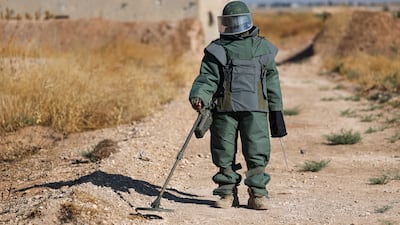

Landmines and unexploded weapons killed or wounded more people in 2025 than any of the previous five years, a report has found.
According to the Landmine Monitor 2026 report, civilians continue to bear the brunt. The increase was fuelled by newly laid mines, particularly in Myanmar, as well as the return of refugees to Syria.
At least 6,929 people were killed or wounded by landmines or explosive remnants of war in 2025, a rise of 10 per cent on 2024. Civilians made up 84 per cent of the casualties, half of whom were children.

Myanmar reported the highest number of casualties for the third consecutive year, followed by Syria, where casualties rose by more than half as people returned to contaminated land following the fall of the Assad regime.
Syrian casualties have increased each year, rising from 834 in 2022, to 933 the following year and 1,015 in 2024. The figure surged to 1,602 casualties in 2025.
The Halo Trust has previously warned that civilians in Syria are facing an unprecedented threat from millions of mines and other discarded munitions.
Loren Persi Vicentic, Landmine Monitor editor for casualties and victim assistance, said people were returning to areas “where they were once familiar and now the hazards were detrimental”.
He said casualties rose during attempts to remove the mines. The situation was particularly bad around Aleppo and Idlib, regions with lots of contamination.
“The toll in Myanmar and Syria illustrates clearly why the majority of countries have adopted the ban and worked to rid the world of mines," he said.
“The weapons can’t distinguish civilians from combatants, cause unnecessary suffering, injuring people returning home long after conflict has ended. The consequences can last a lifetime.”
Katrin Atkins, editor of the Landmine Monitor, described Syria as a “black hole” with the extent of contamination across the country unknown as surveys had only just started. The situation was changing each month as populations moved.
She said it would take many years for the situation to be resolved, but the efforts to remove the mines would intensify to allow redevelopment to take place.
“All this work will only be possible with mine action,” she said. Risk education has been increasing at border crossings, while digital and mass media messaging is being used to reach refugees before their return.
Neither Myanmar or Syria is a member of the Mine Ban Treaty, which covers 162 nations. Lebanon recently joined.
Afghanistan was the most affected country that is party to the treaty, with almost 500 casualties.
“It is civilians, especially children, who continue to suffer terrible harm from landmines,” said Mr Vicentic. “This harm is avoidable, but only if all countries commit to preventing any further use.”

The 28th edition of the report said that Ukraine, a member state, attempted to unlawfully suspend the operation of the treaty during its war with Russia. It has been “using and producing antipersonnel mines, including 3D-printed and drone-dropped mines in violation of its treaty obligation never to use or produce mines under any circumstances”.
The treaty ban prohibits the use, stockpiling, production and transfer of antipersonnel landmines and requires members to clear mined areas, destroy stockpiles, and assist victims.
The report said new use was also reported by other states not party to the treaty, including Iran, North Korea, Russia, and "possibly" the US. Mine use was also reported but not yet confirmed in the border region between Thailand and Cambodia.
The report said the treaty faced its greatest test since it came into force in 1999 due to its first withdrawals. Estonia, Finland, Latvia, Lithuania and Poland all withdrew as they faced a renewed threat from Russia.
The report said Poland and Finland were preparing to bring antipersonnel mines back into their arsenals, with Poland intending to acquire almost 15 million units from domestic manufacturers, starting this year. It said Polish officials had raised the prospect of deploying the mines along the country’s borders and exporting them to allies. Finland plans to begin producing one million antipersonnel mines in 2028.
“The withdrawals, new use and new production are dangerous steps backward for the ban, but they do not define the treaty,” said Tamar Gabelnick, director of the International Campaign to Ban Landmines. “Lebanon joined in the midst of conflict, recognising that protecting civilians means upholding international law, not abandoning it.
“We urge all states to reject the production and use of antipersonnel mines, by any actor, under any circumstances.”
The report said that progress on clearing land contaminated with mines was slowing. Less land was declared safe in 2025, while the threat from improvised mines increased. At least 65 states were suspected or confirmed to have land contaminated by mines.
Funding to clear the explosives remained stable in 2025, but looks less secure in the future, it warned. Five donors provided 62 per cent of all funding, with the US freeze on foreign assistance causing disruption to programmes worldwide.
Ukraine received 28 per cent of all funding, while it fell for Iraq, Afghanistan and Colombia. Ukraine and Yemen received 43 per cent of all earmarked victim assistance funding.
“As conflict, contamination and casualties rise, there are fewer resources to go around. Donors are narrowing their priorities and geographic focus, putting lives and livelihoods at risk,” said Ruth Bottomley, Landmine Monitor editor for mine action funding.