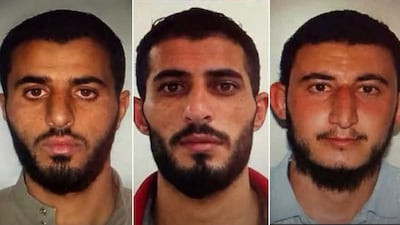
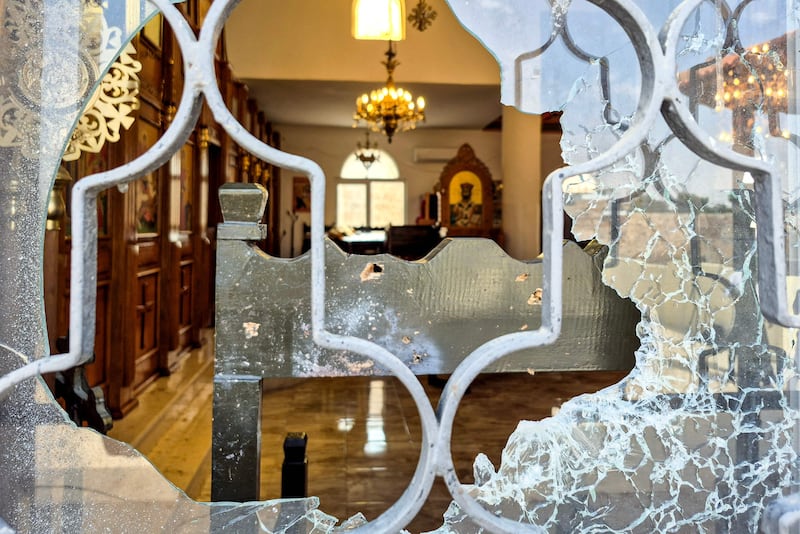
A Jordanian security court on Sunday sentenced three men to death by hanging for carrying out an attack at a church last month that killed nine people and wounded 34.
The attack on October 23, during a funeral at the Saint George's Orthodox Church in Hmoud, about 80km south of Amman, undermined Jordan's image as a bastion of safety in the Middle East.
Two weeks later, a former convict stabbed a police officer to death in front of the Sri Lankan embassy in Amman, in another attack the authorities described as terrorism.
After four sessions, the State Security Court found the three men guilty on nine counts of "premeditated murder for terrorism purposes" and "possession of weapons for use in terrorist acts". They were also convicted of conspiring to commit terrorism, and "propagating extremist ideology".
All nine victims were men, most of them from the Halasah, a prominent Jordanian Christian clan. There are about 250,000 Christians in Jordan's population of 11 million.

State media described the proceedings as swift and intended to send a message that the government would not tolerate terrorism.
Amer Halasah, the lawyer for the families of the victims, said that all three men had admitted in court to carrying out the attack and that some relatives of the deceased were present when the court delivered its verdicts.
"They wanted justice done. The court applied the law objectively and without bias," Mr Halasah told reporters.
He described the sentences as "the most severe" handed down under a 2006 anti-terrorism law. Those convicted can appeal within 30 days to Jordan’s Court of Cassation.
The court also sentenced two other men to six years in prison each for selling the three assailants the weapons used in the attack on the church.
One of the three attackers was also convicted of providing funds intended to finance terrorist acts, under Jordan’s anti-money laundering and counter-terrorism financing laws, the state news agency Petra reported.
The authorities have not disclosed a motive for the attack or any details of the investigation.
Among those attending Sunday's State Security Court session were the son and daughter of Assem Burkan, a political science professor who was among those killed.
The authorities named two of the assailants as brothers Hazzaa and Mishaal Mohammad. The third man, Ahmad Hussein, is their brother-in-law. All three are from the Thneibat clan. They were arrested in a village near Hmoud on October 25.
Security concerns
It was the most significant attack against the kingdom's Christian minority since the 1950s.
In response to the church attack, Jordan said on October 27 that its armed forces had killed at least 20 ISIS members in strikes on Syria. Syrian authorities said seven people, including three children, a woman and an elderly man, were killed. Syria denied that Jordan had co-ordinated the strikes with it.
On Tuesday, the Jordanian court charged a man with terrorism over the stabbing to death of Cpl Jawad Al Salayta and the wounding of another police officer outside the Sri Lankan embassy in Amman on November 5, in a busy area of the capital.
While militants have attacked security forces in the past decade, the killing of the corporal was widely seen as a brazen challenge to the security core of the establishment.
State media reported that the prosecution division of the State Security Court had “finished all the investigative procedures regarding the terrorist act against the ranks of the public security in Amman”. The suspect was interrogated and charged with two counts of “committing terrorist actions”, one of which “led to the death” of the police officer.
Authorities have largely maintained stability in Jordan since driving out the Palestine Liberation Organisation in a 1970 civil war. However, the economy has been stagnant for the past 15 years, and the official unemployment rate is 16 per cent.