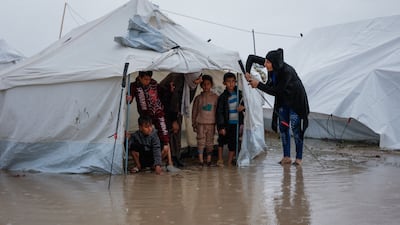
UN humanitarian chief Tom Fletcher has criticised delays in delivering essential winter supplies to Gaza, saying waiting for a new Israeli government to be formed was not an acceptable reason to hold up aid.
“Foreign ministers and partners have assured me of support, but also repeatedly said that progress would be hard until after Israeli elections,” Mr Fletcher said in a statement.
“Now we’re told to wait for the formation of a government. In case anyone has any doubt about international humanitarian law, this is not an acceptable excuse, as the international community and Board of Peace have made clear."
The Board of Peace, which oversees US President Donald Trump's 20-point peace plan for Gaza, on Monday urged Israel to let in essential aid after heavy rains caused widespread flooding at the weekend.
It urged the Israeli government to “authorise the entry of essential materials for temporary shelter, water and sanitation infrastructure, waste management, drainage and sewage removal, and to abide by its commitments under the Sharm El Sheikh Humanitarian Protocol”.
Mr Fletcher said the UN had been warning for months about the need to get winter supplies into Gaza, including durable shelter materials, warm clothes, blankets, bedding and safe heating.
He warned that delays, blockages and funding cuts were putting the population at “great risk”, particularly as harsh weather threatens people without adequate shelter for a fourth consecutive winter since war broke out in October 2023.
He called for all crossings into Gaza to be opened, rather than relying on one, and urged authorities to allow humanitarian organisations to operate and commercial markets to function.
The Israeli government responded to the Board of Peace's call by saying it was “committed” to Mr Trump's peace plan, and blamed the militant group Hamas for the lack of progress in its implementation.
A statement issued by Prime Minister Benjamin Netanyahu's office said Hamas, which started the war with an attack on Israel that killed 1,200 people on October 7, 2023, would use “every dual-use item” to bolster its military capabilities.
Aid and humanitarian groups have long criticised Israel's arbitrary categorisation of “dual-use” items, which include torches, wheelchairs, tarpaulins, tent poles and toilets, and how limiting their entry compounds the suffering of Gazan civilians.
The Israeli military agency that co-ordinates aid, Cogat, claimed to have allowed thousands of aid lorries into Gaza, but figures from the UN show a decline in the entry of assistance since January.
Direct Israeli attacks in Gaza have not stopped despite a truce. Health officials say at least 1,600 Palestinians have been killed in Israeli attacks since a ceasefire agreement went into effect in October last year, bringing Gaza's total death toll to more than 74,600 since the war began.
Ismail Al Thawabta, head of Gaza’s Government Media Office, said Israeli bans on “dual use” materials, including cement, steel and sewage pumps, had hampered repairs to Gaza‘s infrastructure.
The resulting breakdown in sanitation had allowed sewage to overflow near displacement camps and contributed to the spread of skin and intestinal diseases, he said.
According to a UN report on Tuesday, more than 6,000 family shelters were destroyed by the latest severe weather and another 17,400 were damaged. More than 3,900 households were left without any shelter.
Aya Kittaneh, Palestine human resources manager for Prosper Global, formerly Mercy Corps, said staff in Gaza had described increasingly desperate conditions in displacement camps.
“Thousands of families are living in overcrowded tents and makeshift shelters that offer little protection from the cold and rain, with barely enough space to cook, store water or allow children to play safely,” she told The National.
Unicef estimates that about 1.7 million out of Gaza's 2.2 million population are living in tents, makeshift shelters or damaged buildings vulnerable to flooding, cold and collapse. Almost one million live in areas at risk of flooding, including about 400,000 in areas where flooding is extremely likely.
Humanitarian agencies say Gaza urgently needs tents, tarpaulins, blankets, winter clothing, drainage pumps, sewage removal, vehicles, heavy machinery, fuel and spare parts. They have also called for the damaged drainage system to be repaired and for families in the most flood-prone locations to be moved voluntarily to safer ground.
“For families who have already lost so much, surviving another winter in these conditions is becoming an increasingly difficult struggle," Ms Kittaneh said.