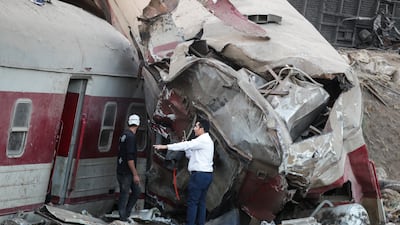

Egypt's Transport Minister has admitted failings in the country's railways but defended years of investment in the network, after the latest in a series of deadly crashes.
Appearing before parliament's transport committee on Tuesday in a session that ran for about six hours, Lt Gen Kamel El Wazir said he was mourning the seven people killed in Sunday's collision at El Ayyat and that passenger safety was his responsibility. The Health Ministry said 125 people were injured in the crash.
“We acknowledge that there are mistakes, and our aim is to prevent accidents or reduce them,” Lt Gen El Wazir told legislators. “There are still mistakes and there will still be mistakes.”

It was an unusually candid admission from a minister who has spent years rejecting calls to resign. It came a day after prosecutors laid out what they believe went wrong.
Prosecutors say technical checks showed the driver of one train had disabled the automatic control system, known as ATC, before it ploughed into the rear of a Cairo-Aswan service, which had stopped on the same track.
Egyptian Transport Minister
The system is designed to intervene when a driver makes an error, slowing or halting trains that run red signals or exceed the speed limit. Injured passengers told investigators the train had been travelling at high speed from the moment it left El Ayyat station.
The driver was among those killed. Prosecutors have detained the controller and station master at El Raqqa station, who admitted failing to monitor the control panel for the signal tower and was found to have tampered with the signal log to cover his tracks. The driver's assistant is also being held for questioning.
The prosecutor general has ordered a committee of engineering professors from Cairo University to examine the railway authority's safety, signalling and maintenance systems, assess whether its upgrades have actually reduced accidents and review past crashes for recurring causes.
The findings on the ATC system struck a nerve because it is not the first time the device has been at the centre of a deadly crash, nor that Lt Gen El Wazir has been linked to it being switched off.
After a collision in Sohag killed at least 19 people in 2021, he admitted the drivers of both trains involved had turned off the system and that he had earlier allowed the ATC system to be partially suspended on parts of the network because passengers had complained of delays.
On Tuesday, he gave a different account, however.
“People say I issued instructions to shut down the ATC. Yes, it happened, but people are taking my words out of context,” he said.
He described his decision in 2021 as a one-off, which was influenced by heavy rain at the time, meaning trains were allowed to run at no more than 15kph.
He said disabling the system had since been made an offence punishable by dismissal and that he did not know why it had been switched off on Sunday. “The prosecution will say,” he said.
Resignation demands
Lt Gen El Wazir also told the parliamentary hearing that 21 officials had signed off on the train's safety checks before it left the depot. He also made another blunt admission.
“I acknowledge that we are not good at management and the private sector has the tools to succeed,” he said. External operators could tie pay to performance. He stopped short of announcing any new privatisation plans.
Lt Gen El Wazir defended the railway's borrowing, saying about $3.05 billion had been drawn from external loan services, worth $5.1 billion, with $870 million already repaid from railway revenue, and that much of the debt he inherited in 2019 was now settled.

However, these figures cover the railway alone, not the wider transport programme whose borrowing has made his ministry a frequent target of parliamentarians alarmed by the country's mounting debt.
While some legislators called on him to resign, arguing that political accountability was separate from criminal liability, others rallied to his defence.
Mostafa Bakry, a staunch government loyalist in parliament, accused critics of “political assassination” and said blame should be left to investigators.
The committee produced more than 25 recommendations on safety and operations, and called for a broader review of why accidents keep happening in El Ayyat, the site of Egypt's deadliest rail disaster in 2002 and of a string of train crashes since. For now, the only people in custody are station employees.