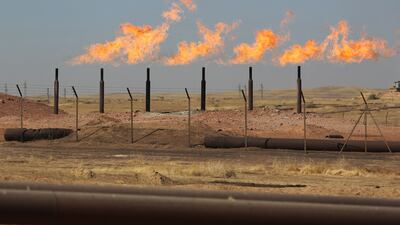
Iraqi and Kurdish leaders on Monday condemned an overnight attack on a major gasfield that caused blackouts across the Kurdistan region.
The suspected drone attack on on Khor Mor field in Sulaymaniyah province caused blackouts across the region, the Kurdish Electricity and Natural Resources ministries said.
The ministries described the strikes as a “terrorist attack” and said they were working on minimising its impact. There was no claim of responsibility for the attack.

Prime Minister Ali Al Zaidi and Kurdistan region Prime Minster Masrour Barzani met in Baghdad on Monday. They stressed "the importance of protecting oil facilities and infrastructure and taking necessary measures to prevent a repeat of such attack," a government statement said.
Immediately after the attack, Mr Al Zaidi ordered the formation of a joint investigation committee with Kurdish authorities to investigate the attack. Federal security officials visited the site on Monday morning.
About 2.8 gigawatts of power generation in the Kurdistan region was lost because of the attack, the region's Electricity Ministry said. Khor Mor has frequently come under attack during the Iran war, with Iraqi Kurdish authorities accusing Tehran-backed militia groups of seeking to destabilise the region's gas sector.
Omed Ahmed, a spokesman for the Electricity Ministry, said that because of the attack and the suspension of gas exports, electricity generation on the national grid would drop by between 2.5GW and 2.8GW. To prevent a total blackout, the ministry was supplying power to hospitals and water stations from hydropower stations and fuel-powered plants, he added.

Joint field operator Dana Gas confirmed on Monday that production remained suspended after the attack. In a statement to the Abu Dhabi Securities Exchange, the Sharjah-based company said the attack caused a fire, which had since been extinguished, and there were no injuries to personnel. The damage was being assessed.
Khor Mor has frequently come under attack during the Iran war, with Iraqi Kurdish authorities accusing Tehran-backed militia groups for seeking to destabilise the region's gas sector. In July, Dana Gas shut its main production sites in the field for a period, citing credible security threats.
Khor Mor was hit last November in an attack, halting production and again causing power cuts in the region. That attack was also blamed on Iran-backed factions and drew widespread regional condemnation.
In recent weeks, tension has mounted between the Iraqi government and militia groups, as Mr Al Zaidi has sought to assert state authority over armed factions operating outside formal command structures.
One of the militias, Kataib Hezbollah, has publicly challenged what it sees as attempts to curb its political and economic influence.
The government's initial plan was to begin bringing the groups' weapons under state control by a September 30 deadline, when the US-led anti-ISIS coalition left Iraq.
The deadline has been pushed back to June 30 next year at the earliest, as the government tries to tackle the resistance from influential factions.
Mr Al Zaidi has been facing US pressure since taking office in May to rein in Iranian influence in the country, especially through armed groups.
Iraq's Foreign Minister Fuad Hussein said the US Treasury had asked Baghdad to close most border crossings with Iran as part of Washington's policy of increasing economic pressure on Tehran.
“There are many official and unofficial border crossings with Iran, and closing all of them would be difficult and would affect our economy. The Americans are still demanding the closure of the crossings, and we are currently in discussions with them,” he said in an interview with Al Jazeera.
Last month, Iraq closed Al Sheeb border crossing with Iran, drawing protests from Tehran and local officials in Maysan province. Mr Hussein said the US had asked for all crossings to be closed except two, including one in the Kurdistan region.
Cracks within Kurdistan
Sulaymaniyah has long been under the control of the Patriotic Union of Kurdistan party, one of two main political groups that control the region. Its rival, the Kurdistan Democratic Party, controls the government and therefore all energy operations and revenue.
PUK president Bafel Talabani has complained his party was not kept informed about energy sector decisions, accusing the KDP of misusing public funds, marginalising political partners and distributing financial resources unfairly.
The division between KDP and PUK deepened last week, when Mr Talabani decided to withdraw from the Kurdistan Regional Government, threatening a return to the 1990s-era parallel administrations formula in the region.
The move came after the Kurdistan parliament convened for the first time in nearly two years and elected a Speaker, despite a boycott by the PUK and allied parties, which had demanded further negotiations over the distribution of senior government positions.
KDP leader and former president of Kurdistan, Masoud Barzani, on Monday called for dialogue to end the political crisis, saying all parties “must keep in mind that the interest of the people of Kurdistan is greater and stands above any other interest or goal”.
He invited PUK to “sit at the table of dialogue with the Kurdistan Democratic Party to address problems and put an end to the political crisis in the Kurdistan region”.
Mr Barzani also expressed a “sincere desire” for other parties in the region to take part in the political process, and to work together to “form an expanded and national government that meets the demands and aspirations of the people of Kurdistan”.
The Khor Mor gasfield is a strategic site and a vital artery of Iraq's energy system. It directly supplies power stations that provide electricity to millions of people. As such, an attack on it is not only an attack on an economic facility but also on energy security and on the daily living conditions of Iraqis.
The attack also comes as the PUK is seeking an arrangement with the government in Baghdad to secure separate funding allocations for Sulaymaniyah amid negotiations on the 2027 federal budget.
Kurdistan region is entitled to a 12.67 per cent share of the federal budget. The draft budget obliges Kurdistan to market no less than 400,000 bpd in co-ordination with the federal Oil Ministry; to hand over non-oil revenue to the federal treasury for both federal and regional audit; to hand over surplus gas to the federal government, or have its value deducted from its share; and not to enter oil and gas contracts with foreign or local companies except through the federal Oil Ministry.
Kurdistan's Mr Barzani led a delegation on Monday to hold talks in Baghdad over several issues, mainly the region's financial entitlements. Mr Barzani called for "ensuring a fair share" for the Kurdish region in the 2027 federal budget. The two sides also discussed ways to manage oilfields and revenues.