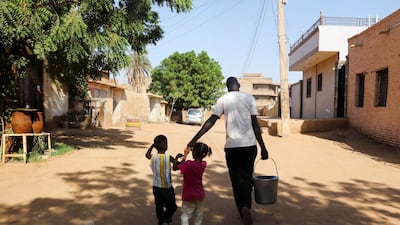

Abdel Rahman Tareq was tempted to return to Khartoum with his family after the Sudanese Armed Forces (SAF) retook the capital from its civil war adversary, the paramilitary Rapid Support Forces (RSF), in late 2024.
The 31-year-old engineer, his parents and siblings fled the country and found refuge in Saudi Arabia shortly after the war broke out in April 2023. There, they found security, jobs and education for two of his six siblings.
But he was homesick, so found the courage to return to Khartoum alone in May to repair the family home, which had been damaged in the fighting, and get a feel for living conditions in a city devastated by war. His plan was for his family to join him in Sudan when he had finished repairing the house.

A month later, Mr Tareq was grateful to be reunited with his family, but not in Sudan. He has returned to Saudi Arabia after abandoning his plans to return home with his family, at least for the foreseeable future.
Returning to Khartoum had not been an easy decision given what was being reported about drone attacks and scarce basic services, he said. But he felt that going home and resuming normal life “was a must-do”, he told The National.
When he was back in Khartoum, he “found the price of virtually everything to be too high”, he said. “Lines at the petrol stations were very long. Sometimes I waited for six hours to fill up.”
“But the final straw came in June,” he explained. Mr Tareq was making his way home in a lorry he used to ferry construction materials for the house repairs when three armed men stopped him.
He initially thought the men were legitimate security personnel, but they took his money and mobile phone and drove away in his vehicle. They left him on the ground with his hands tied behind his back.
“Army soldiers found and untied me and took me to file a police report,” he said.
Mr Tariq's predicament is not an isolated case, according to residents of Khartoum, who say the sprawling Nile-side city has been gripped by a crime wave unlike anything they have seen.
They blame members of a motley crew of former rebels and militiamen allied with the SAF for the spike in crime.
Aside from the SAF, armed groups present in the capital include former fighters from Darfur rebel groups, Islamist militiamen and members of the RSF who switched sides. But whether independent culprits or a specific group is behind crime in Khartoum, the spike in offending attests to the inability of the military-aligned government and local authorities to restore law and order in the capital.

Requests for comment from the capital's police headquarters have gone unanswered, and a spokesman for the local government said he was not authorised to speak to the media and referred The National to a security report dated October 29.
The report mentions the “stability” of crime – meaning there has been no sharp rise – but also the arrest of 539 people, including 16 foreign nationals and 49 repeat offenders. It does not say over what period the arrests were made or specify the crimes committed by those arrested.
Lengthy power cuts
The sharp rise in crime in the capital is a sensitive topic for the SAF-backed government, whose narrative has consistently emphasised safety in areas under armed forces control while pointing out that the same cannot be said about parts of the country under RSF control.
It uses this narrative to attract Sudanese who have found refuge outside Sudan to return home, thus giving areas under SAF control a semblance of normality that backs its image as the lawful party in the war.
But both sides in the three-year-old war are accused of war crimes as well as obstructing the flow of desperately needed humanitarian assistance to the country. Half of Sudan's population, or 25 million, are facing hunger, and at least 13 million have been displaced since the war began.
Besides the capital, the SAF and their allies control the eastern, northern and central regions of Sudan. The RSF has control over the entire western Darfur region, save for small pockets, as well as parts of neighbouring Kordofan and the southern Blue Nile region.

Khartoum resident Abdul Raheem Soliman contends that lengthy power cuts that leave streets completely dark have deepened the anxiety of the city's inhabitants, particularly in outlying and thinly populated areas.
However, he said there seem to be fewer armed groups inside the city and a slight reduction in crime in recent weeks, although it remains high.
Mr Soliman's 17-year-old cousin was killed five months ago when he resisted two armed men on a motorcycle who robbed him in Omdurman, one of the three cities that make up the capital's greater region.
“His death shocked and saddened his family. He was the one who had the courage since the war broke out to leave the house every morning to buy bread and groceries so the family could stay fed,” said Mr Soliman. “His father cannot talk about him without breaking down and crying.”
Jaafar Abbas, a retired army colonel turned security analyst, said the lack of trust in the ability of the capital's authorities to restore law and order is discouraging many displaced Sudanese from returning to their homes.
“The continuing presence of armed groups in residential areas and their local markets could turn them into spheres of influence outside state control.
“There is a relative improvement in security if compared to the time when the war was fought on the capital's streets, but it will never be enough if weapons remain in the hands of groups that are not under full state control.”
Al Shafie Ahmed reported from Kampala, Uganda.