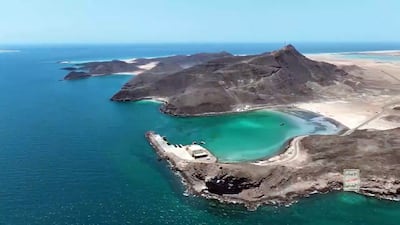

Yemeni government forces claimed on Monday they had seized key positions around the Bab Al Mandeb strait and the Dhubab area overlooking the sea lane, as a Saudi-led coalition said 100 fighter jets were taking part in an anti-Houthi offensive.
Coalition spokesman Maj Gen Turki Al Malki said the alliance was providing round-the-clock air support to Yemeni armed forces on the ground and air cover for the Bab Al Mandeb strait, with operations against moving targets continuing.
He said 324 “high-value” Houthi targets had been destroyed in the offensive, with 100 fighter jets involved.

Yemen's armed forces also began a “strategic offensive” on the Houthi-controlled capital, Sanaa, on Monday, said their spokesman, Col Majed Al Nuzaili. “We are using advanced capabilities,” he said. The Houthi-run Al Masirah TV has confirmed attacks on Sanaa.
The Houthi-run Health Ministry said a woman was killed by an air strike on a farm in the Sanhan area of Sanaa, while another attack on a car in Sawan killed a girl and injured seven other people.
The Yemeni colonel said government forces had carried out a flanking manoeuvre to take control of Bab Al Mandeb, with the Giants Brigades and Nation’s Shield Forces securing the strategic strait.
He said government forces also took control of Dhubab airport and cut off the road linking Dhubab with Mokha, establishing control over the route.
Hundreds of Houthi fighters were surrounded in Dhubab and were called on to surrender, while some fighters fled by boat, Col Al Nuzaili said. The claims could not immediately be independently verified and have not been confirmed by the Houthis.
US Secretary of State Marco Rubio sided with the Saudi and Yemeni governments. “Obviously the Saudis have come under Houthi attack and see the threat that that poses, and they have a right to defend themselves. And obviously the Yemeni forces are going to try to retake territory that they were ousted from,” Mr Rubio told reporters.
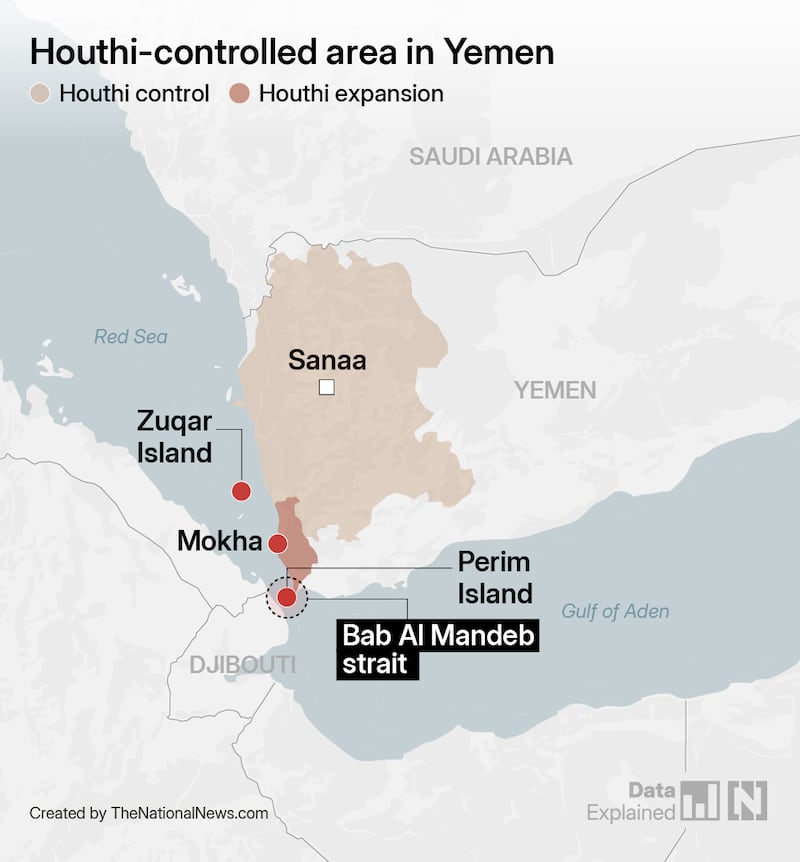
The Bab Al Mandeb strait is the southern exit passage of the Red Sea, a key shipping route between the Mediterranean and Asia. The waterway has assumed even more importance this year as an alternative to the Strait of Hormuz, which has been effectively closed by the Iran conflict.
A Houthi-run maritime body also issued a warning to airlines flying in Saudi airspace, saying it would not be safe as long as Saudi Arabia's “aggression” continued.
The developments followed an announcement by Rashad Al Alimi, head of Yemen’s Presidential Leadership Council (PLC), who said Operation Yemen Dawn had been launched to restore state institutions, retake Sanaa and end the Houthi “coup”.
“With God's aid, the will of our people, the valour of our armed forces and all military formations, and the support of our brothers and friends, Yemen will march towards a new dawn of freedom, peace and stability,” Mr Al Alimi said.
The Saudi-backed Yemeni government launched the offensive on Sunday to retake territory from the Iran-aligned Houthis. The coalition said its air operations were continuing, including strikes against moving targets.
The Yemen conflict began after the Houthis seized the capital Sanaa in 2014, prompting the Saudi-led coalition to intervene the following year with an air campaign aimed at restoring the government and ousting the rebel group.
The Saudi-backed PLC, which is also recognised by the United Nations, has since the Houthi takeover controlled the south and east of the country, based in the southern city of Aden.
The fighting quickly ground to a bloody stalemate with most front lines stalled, leading to a major humanitarian crisis in what was already the poorest Arab state. A ceasefire agreed in 2022 largely held until this summer.
Saudi Arabia, which arms and trains Yemeni government forces, is backing the current military campaign with air power and has sought logistical help from allies to push back the Houthis, restore free traffic in the Red Sea and end the group's attacks on its territory.
Fighting has raged along several front lines in Yemen for weeks, opening a new front in the wider US-Iran conflict.
The Houthis seized swathes of the Yemeni coast and captured Perim Island in the Bab Al Mandeb strait last month. They vowed to attack vessels linked to Saudi Arabia due to its backing of Yemen's government.
Three in four families in parts of Yemen are going hungry from the impact of the surge in fighting, which has displaced tens of thousands of people and disrupted supplies to millions, the World Food Programme said last week.
The World Health Organisation said that more than 5,000 casualties had been recorded in Yemen since August 6, including 959 deaths, as fighting intensifies and spreads.
The WHO said 685 new casualties were reported over six days, with Taiz emerging as the heaviest front. Nearly 200,000 people have been displaced and more than 3,600 people have crossed into Djibouti.
The WHO also warned that cholera cases had tripled in three weeks, with 647 suspected cases reported in the most recent week, compared with 217 three weeks earlier.