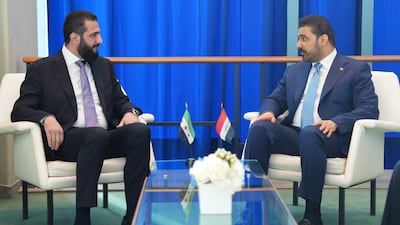
Syrian President Ahmad Al Shara and Iraqi Prime Minister Ali Al Zaidi have held their first meeting at the UN General Assembly in New York, as Baghdad and Damascus reset ties.
The relationship between the two countries has shifted, particularly in recent months, from deep mistrust to pragmatic co-operation since Bashar Al Assad was ousted from the Syrian presidency in late 2024. The start of the Iran war in February, rising regional tension and US pressure have pushed the two countries towards strengthening ties.
The first meeting between Mr Al Shara and Mr Al Zaidi was welcomed by Tom Barrack, the US special envoy to both Syria and Iraq. “Guided by leadership and bound by a shared vision – Iraq and Syria weave together a tapestry of co-operation, stability, and shared prosperity for their peoples,” he said.
Mr Al Shara and Mr Al Zaidi both enjoy a close relationship with Washington and have been described positively by US President Donald Trump. New York being the location of the first encounter was a symbol of this US push.
The Syrian and Iraqi leaders were seen shaking hands and embracing for the first time publicly while waiting for Mr Trump to join a meeting involving other Middle East leaders that aimed to find a path towards de-escalation in the region.
“The meeting addressed Syrian-Iraqi relations, explored ways to enhance political and security co-ordination between the two countries, and expanded economic and trade co-operation,” state-run Syrian news agency Sana reported.
The Iraqi Prime Minister's office release a similar statement. “The meeting witnessed a review of the general situation regionally and internationally, discussions on bilateral relations and ways to develop them in accordance with the requirements of mutual interests across various levels and fields,” it said.
Two Syrian sources told The National the meeting, on Tuesday evening, focused on security and economic co-operation. The two men, one of the officials said, recognised that “they have to deal with militants on their own side” and are framing the rapprochement in the context of economic gains for their constituents.
Iraq, one of Iran's last regional allies, is under increasing US pressure to diminish its ties to Tehran. US-led forces are due to withdraw from Iraq by the end of this month, while Mr Al Zaidi is overseeing the process of disarming militia groups and bringing all weapons under state control. The deadline for disarmament was also supposed to be September 30, but he has since laid out a time frame that would see its completion by June 2027.

When the Assad regime fell, Baghdad was wary of the newly established figures in Syria, many of whom had been linked to Al Qaeda. Since then, however, the two sides have built a relationship largely driven by security co-operation. Thousands of suspected ISIS members have been transferred from Syria to Iraq in recent months.
The Syrian leadership has also remained sceptical of Iranian influence in Iraq. This had previously provided Tehran with direct access to the Assad regime, its former ally. The border area on the Iraqi side also has a heavy presence of the Popular Mobilisation Forces, an amalgamation of pro-Iranian militias.
One of the Syrian officials said the meeting's agenda included how to keep militants away from their 600km border and increase Iraqi fuel oil exports through the Syrian coast.
The second official said that Mr Al Shara asked Mr Al Zaidi to keep Iraqi military units with close links to the militias away from the border, and expressed willingness to open an additional border crossing for Iraqi fuel exports, which currently only pass through the Tanf crossing.
Syria has requested that the Iraqi side inspects lorries before they enter through Tanf, as an additional security measure against weapons smuggling, the official said. They said that if Syria is confident about security measures, fuel oil lorries could soon pass through the Al Qaim crossing, to the north.
Iraq has turned to Syria as an alternative route for exporting its oil since the Iran war halted nearly all energy shipments through the Strait of Hormuz in March. Iraq began sending oil through Syria by road in April to be shipped from Baniyas port.
Iraq has long sought stability along its border with Syria, where ISIS remnants and drug trafficking networks continue to pose serious security challenges.
Syria, the official said, has been encouraged by American support for Mr Al Zaidi. “We know that when dealing with Iraq there are two layers. But the militias also have an interest in siding with Syria,” the official said.
Previously, high-level meetings had only taken place between Mr Al Shara and Iraqi Foreign Minister Fuad Hussein, and between Syrian Foreign Minister Assad Al Shibani and Iraq's former prime minister Mohammed Shia Al Sudani.