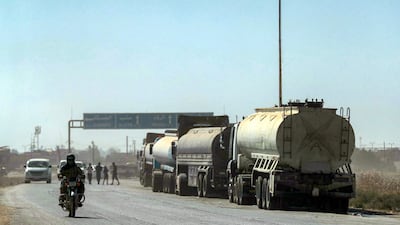
Syria has announced it will offer subsidised diesel for heating, agriculture and industry, days after demonstrations erupted across the country over a fuel price rise.
The decision has raised questions among experts about the effectiveness and durability of the measure, as broader social grievances continue to brew.
"People are frustrated and are waiting for realistic solutions to their problems in general," said one protester, Ayman Asfara from Idlib. "If they do not see results from the first protests, there will be further protests, but this time with greater awareness."

Energy Minister Mohammed Al Bashir said that the government recognised that higher energy prices “have a direct impact on people’s livelihoods and on the agricultural, production and service sectors”.
“Our responsibility is not limited to securing petroleum products. It also includes seeking solutions that ease the burden, while maintaining continuity of supply,” he added.
Benjamin Feve, a senior consultant at Karam Shaar Advisory, said the move could have harmful consequences for the economy and lead to a waste of Syria's already scarce public funds.
“Fuel subsidies distort prices across the economy, encourage overconsumption and create incentives for smuggling,” he said. “They are also regressive because the people who consume the most fuel benefit the most.”
Mr Al Bashir said subsidised diesel would be sold at 115 Syrian pounds ($0.94) per litre for heating, agriculture and consumers eligible for government support. A second grade would be sold at 150 pounds per litre for some production and service sectors.
The standard grade would remain at 175 pounds per litre, while petrol and gas prices would not change. The standard diesel price remains below its actual cost of 206 pounds per litre, Mr Al Bashir told a media conference in Damascus, where he was joined by Syrian Petroleum Company chief executive Yousef Qablawi.
Mr Al Bashir also said several small local refineries would resume operations under the management and supervision of the Syrian Petroleum Company, bringing their combined crude oil processing capacity to about 35,000 barrels per day. SPC chief, Mr Qablawi, said the company had begun drawing up an implementation plan for the measures after discussions with the ministry.
It remains unclear how long the subsidy will stay in place and how much it will cost the government. “Nobody can really answer where the money will come from except the government,” Mr Feve told The National.
Despite the lifting of western sanctions, Syria is still reeling from decades of economic isolation and years of war, which have left the country facing a reconstruction bill of hundreds of billions of dollars. “The budget is already deeply in deficit, by more than $1 billion. This was precisely one of the reasons subsidies were lifted in the first place,” he added.
The subsidies could be funded by allied countries, but this would risk making Syria dependent on foreign support and political agendas. “At the end of the day, it would be a donation, not a sustainable policy for the Syrian government,” he said.
Widespread protests
The decision to cut diesel prices came after a meeting with President Ahmad Al Shara on Wednesday night to discuss the fuel crisis that has led to protests, in a major test for the government that replaced the Assad regime.
The Ministry of Energy raised fuel prices by between 25 and 40 per cent last Saturday. The price rise came against the backdrop of the phasing out of what remained of the Assad government’s subsidy system, as the Syria's new authorities have pledged a shift towards a free-market economy.
The ministry said the increase in the cost of petroleum products reflected rising global oil prices and coincided with the temporary shutdown of the Baniyas refinery for a major overhaul, which has increased Syria’s dependence on more expensive fuel imports, Mr Al Bashir said. Global energy prices have increased sharply since the outbreak of the Iran war in February.
The move sparked some of the most widespread protests since the fall of the Assad regime, particularly in eastern and northern Syria, with demonstrators demanding that the increase be reversed.
Syrians rely heavily on diesel to run generators amid widespread power cuts. The fuel is also crucial for transport, adding further strain on a population already struggling with economic hardship after decades of western sanctions. About 90 per cent of Syrians live below the poverty line, UN estimates show.
Protesters have also questioned how Syria’s highly publicised economic reopening has seemingly benefited only a fortunate few, who have been displaying wealth rarely seen before, while doing little to ease the hardship faced by struggling households.
“Fuel prices went up, while at the same time people could see with their own eyes delegations coming and going, cars being replaced, new cars in the hands of a certain group of people,” Mr Asfara from Idlib, who took part in the protests, told The National. “At the same time, Syrians don’t have enough to eat, drink or to afford medical care.”
He said the fuel protests were just one symptom of a growing divide between social classes, meaning people were either very poor or very wealthy. There has also been a "complete absence" of support for the reconstruction and repair of homes, he said.
“People didn’t take to the streets just because of fuel. It was similar during the revolution: people weren’t protesting only because of what happened to the children of Deraa.”
Fuel was the trigger, Mr Feve said, but it may not have been the main cause. “Grievances have been accumulating, particularly in rural areas and outside the main cities.”
The difference, he added, is the breadth of the protests, which have spread beyond sectors. “Fuel touches everyone. It affects transport, generators, the price of bread, the cost of getting to work and heating your home.”
“It is one price that turns a series of separate complaints into a single shared grievance,” he said.