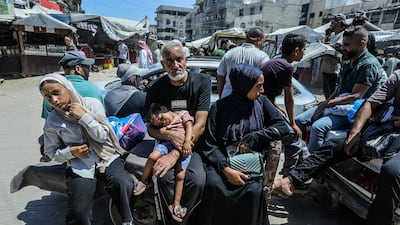

It is slow, bone-rattling and undeniably dangerous, but travelling in open trailers drawn by cars is one of the few ways Gaza residents can get around the small area of the coastal strip that is not occupied by Israel's army.
“We arrive exhausted and aching, barely able to stand because the trailer shakes throughout the journey, throwing us from side to side,” said Amina Al Hannawi, a 48-year-old resident of the Saftawi neighbourhood north of Gaza city. “On top of that, the heat is unbearable.”
“On several occasions, travelling in these trailers has made me extremely dizzy,” Ms Al Hannawi, who has diabetes and high blood pressure, told The National. “I almost collapsed when the trailer stopped and I tried to get off.”

The trailers, originally used to carry livestock and goods, became a common form of public transport in Gaza after the war began in October 2023. Now they are often packed with about 20 people, including children and the elderly.
Journeys have also become significantly longer. According to Ms Al Hannawi, a trip that took five minutes before the war can now take half an hour or more because of congestion, war-damaged roads and overcrowding in the narrow strip of land into which the territory's population of two million has been squeezed.
A fragile ceasefire in place since last October has not improved conditions much, with Israel continuing to carry out attacks and imposing tight controls on the entry of goods.
According to Anis Arafat, spokesman for Gaza’s Transport and Communications Ministry, more than 80 per cent of vehicles in the strip were destroyed or damaged during the war. Running those that remain is a struggle because of acute shortages of fuel, lubricants and spare parts.

“The trailers are not legally licensed, but their use has become an emergency measure that Gaza has been forced to adopt to meet people’s transport needs,” Mr Arafat told The National.
The improvised mass transport offers little protection from the sun or winter rain and lacks basic safety features. In some incidents, the trailers have become detached from the cars towing them, causing accidents and injuries.
This happened to Mohammed Al Madhoun, a resident of Gaza city's Sheikh Radwan neighbourhood. He was one of about 20 passengers, including women, children and the elderly, on a trailer travelling south along the coastal road when it came loose.
“The situation was catastrophic and everyone was terrified. The trailer could have overturned and caused a disaster,” said Mr Al Madhoun, 28.
He and several other young men tried to slow the trailer down before it veered off the road. “We tried to stop it before all the passengers were hurt,” he said. “These trailers are completely unsuitable for transporting people.” Three passengers, including him, were injured.

Taxi drivers say they have little choice but to operate this way. The limited number of working vehicles cannot meet demand, and carrying only a few passengers does not generate enough income to cover soaring operating costs.
“The rising cost of motor oil and spare parts has placed a heavy burden on drivers,” said Ayman Abu Ata, a 38-year-old taxi driver. “If I carry passengers only inside the car, I operate at a loss.”
Mr Abu Ata acknowledged that the trailers were dangerous but said the materials needed to make them safer were unavailable.
“Whenever I try to improve the condition of my trailer, I cannot find the necessary iron, tarpaulins, metal fencing, welding rods, tyres or other spare parts,” he said.
“We drivers are aware of danger, but there is no alternative,” he said. “The remaining drivers in Gaza who still have functioning vehicles have been forced to use trailers so that the work remains financially viable and they can continue operating.”
Gaza’s transport authorities are calling for fuel, spare parts and new vehicles to be allowed into the territory, and for roads to be repaired.
“We are calling for all necessary vehicle supplies to be allowed into Gaza, as well as new vehicles to address the shortage,” Mr Arafat said
Until then, people such as Ms Al Hannawi face a choice between enduring the danger and discomfort or not travelling at all.
“Transport in Gaza is an ordeal,” she said. “The suffering begins the moment we board these trailers and continues until we reach the destination.”