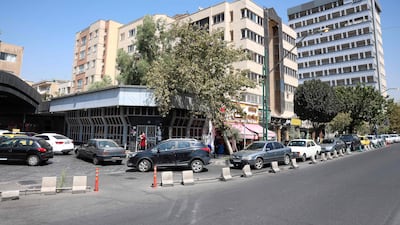

Iran was struggling to contain a fuel crisis on Tuesday as queues formed at petrol stations, a day after the US announced new sanctions in the hope of bringing Tehran to its knees.
There were signs of panic-buying in Tehran as more petrol was dispensed than on any other day this year. Amid fears that prices will rise, an Iranian government spokeswoman went public on Tuesday evening to say "no decision has been made so far" to increase them.
She hinted at "structural reforms" to come. Iran's economy is already in a fragile state after months of conflict and internet blackouts.

The disruption came as Pakistan and Oman sought to chart a way out of the impasse by sending senior officials to Tehran.
Before travelling to Iran, Pakistan's army chief Field Marshal Asim Munir was asked to relay a message by US President Donald Trump, a senior Pakistani source told The National.
Pakistan wants Iran to open the Strait of Hormuz and “stop its attacks and those of its proxies on neighbours and shipping, in return for US easing of sanctions,” the source added. Oman’s Foreign Minister Badr Al Busaidi meanwhile met Iranian counterpart Abbas Araghchi in Tehran on Tuesday.
The US Treasury Department says every country will be given a deadline to cut economic ties with Iran. The UAE announced last week that it was severing trade and financial ties with Tehran.
Long queues were forming at petrol stations across Tehran on Tuesday as fuel shortages and supply disruptions leave motorists scrambling for fuel.
Reports from the capital say several stations have closed or experienced disruptions, particularly in eastern and southern Tehran. Videos and images circulating online show lines of cars stretching around filling stations, while some motorists reportedly face lengthy waits to refuel.
Similar disruptions have been reported in other cities, including Kerman and Mashhad. The shortages come despite a sharp rise in gasoline distribution in Tehran.
Fereydoun Yassami, Tehran regional manager of the National Iranian Oil Refining and Distribution Company, said more than 26 million litres of gasoline were distributed in the capital on Monday – a record for the current Iranian year. Distribution was reportedly about 30 per cent higher than usual.
Mohsen Haji Mirzai, head of the Iranian's President’s Office, said in an interview on Iranian TV that petrol quotas would be reduced to some extent. He declared that subsidised fuel prices would remain unchanged but the price of non-subsidised fuel would rise, with the government still reviewing the latter.

The surge appears to reflect panic buying as drivers rush to fill their tanks amid fears that supplies could tighten further. Recent reporting has also pointed to limits on the amount of fuel motorists can receive, adding to the queues.
Iran is a major oil producer but has long struggled to balance gasoline consumption with domestic refining capacity.
The disruption has been intensified by the wider conflict and restrictions affecting Iran’s access to fuel supplies and energy infrastructure. The US sanctions aim to further weaken the country's economy in an effort to break the deadlock in peace efforts to end the war.
In Iran the immediate picture is one of rising demand colliding with an increasingly strained distribution network, with motorists lining up for hours and some stations running dry in Tehran even as more gasoline is being pushed into the capital.
The government has not indicated that a nationwide fuel shortage is imminent, but the growing queues are already adding to public anxiety over prices, availability and the reliability of basic services.
Anger over prices and Iran's weak currency erupted in December and January into one of the broadest anti-regime revolts in years, which were swiftly followed by the US and Israeli war. The conflict has also affected energy markets globally due to the closure of the Strait of Hormuz, something mediators
Qatar described US sanctions on Iran as unilateral and said it supports mediation efforts to resolve the conflict. Foreign Ministry spokesman Majed Al Ansari said the situation in the Strait of Hormuz should return to what it was before the crisis.
Despite the prolonged tensions, the US State Department is adjusting its staffing levels at diplomatic postings in the Middle East, an official said on Tuesday.
The New York Times earlier reported that Washington is preparing to send diplomats back to embassies in the Middle East that were evacuated before and during the war with Iran.
The return of Foreign Service officers and the scaling back of emergency measures at US missions in the region could begin as early as this week, the report said. The move could signal that the US is not expecting a return to all-out war with Iran in the immediate future.