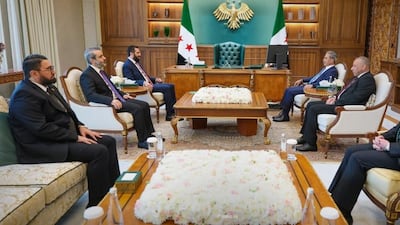
Syria and Iraq have agreed to form judicial committees to oversee the cases of ISIS prisoners who were transferred from Syrian detention facilities to Iraqi prisons this year.
An Iraqi judicial delegation led by head of the Supreme Judicial Council, Faiq Zaidan, was in Syria on Thursday. Mr Zaidan and Syrian President Ahmad Al Shara discussed ways to strengthen legal and judicial co-ordination, at a time of increasing co-operation between the two countries.
“The issue of ISIS detainees was discussed, and technical and expert teams will be formed to examine the matter and reach mutually acceptable solutions,” Syrian Justice Minister Mazhar Al Wais told Iraqi state media.

In February, the US Central Command and Iraqi officials said about 5,700 detainees had been transferred to the country from Syria. For years, ISIS prisoners were held in prisons and camps administered by the Kurdish-led Syrian Democratic Forces in north-eastern Syria. The Syrian government extended its control into those areas earlier this year.
The offensive saw clashes between government troops and the SDF, raising concerns that security would not be ensured at the prisons and camps. Iraq agreed to take in prisoners from Syria in co-ordination with the US.
“The two sides agreed to form joint judicial committees to hold continuous meetings to resolve the files related to their trials,” Judge Laith Jabr, head of the Iraqi Judicial Supervisory Commission, told state media after Thursdays meeting.
“We will await the results of these committees and their work in the near future,” Mr Al Wais said, adding that “there are promising steps in this direction that will contribute to achieving justice in this matter”.
The SDF had been holding about 10,000 ISIS detainees and thousands of their relatives in camps.

Iraqi courts have handed down hundreds of death sentences and life terms to people convicted of terrorism offences, including foreign fighters. Human rights groups have criticised some trials, saying they were rushed, and raised concerns about due process.
Thousands of Iraqis and foreign nationals convicted of links to ISIS are held in Iraqi prisons. The Iraqi government has also called on other countries, especially EU states, to begin repatriating their citizens who travelled to join ISIS and are in legal limbo in the camps system.
ISIS overran large parts of Iraq and Syria in the summer of 2014. Three years later, Iraqi forces, backed by a US-led international coalition, reclaimed all ISIS-held territory after fighting that cost thousands of lives.
Damascus and Baghdad are co-operating in various sectors – from developing markets for Syrian produce to reactivating, under US auspices, an oil pipeline between Iraq’s northern oil centre of Kirkuk and Syria's port of Baniyas.
After the collapse of the Assad regime in December 2024, Iraq's relationship with Syria transitioned into a pragmatic phase with a cautious approach towards Mr Al Shara and his militant past. But the Iran war and US pressure have pushed the two countries closer.